Sign In
Upcoming Event
 Free Newsletter

Challenges to primary election candidates oust 12, 10 survive
Kiera Riley, Arizona Capitol Times//May 6, 2026//
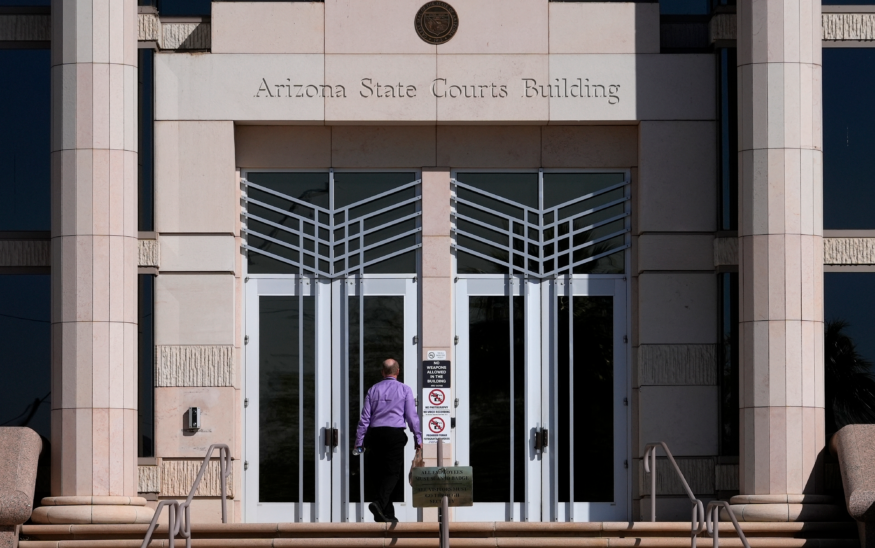
A man enters the Arizona Supreme Court building, Wednesday, April 10, 2024, in Phoenix. (AP Photo/Matt York)
Challenges to primary election candidates oust 12, 10 survive
Kiera Riley, Arizona Capitol Times//May 6, 2026//


Key Points:
-
Litigation removes 12 political hopefuls, allows finalization of ballots
-
Courts keep 10 candidates on ballot in statewide, congressional, legislative races
-
Signature disputes and technical errors determined candidate legal challenges
Primary ballots can now head to the printer after a series of rulings on nomination challenges officially finalized the list of candidates allowed to appear on the ballot.
This year’s legal challenges weeded out 12 primary candidates via voluntary withdrawal or court-ordered removal, while ten others who faced challenges to their eligibility prevailed and now head to voters.
Under state law, any elector can file a lawsuit to challenge a candidate’s eligibility, which targets the number of signatures a candidate has collected or a candidate’s general eligibility to serve in their chosen office.
Courts have historically favored ballot access when assessing eligibility, but legal challenges can and do prompt removal based on a number of factors, such as a failure to collect enough signatures.
As of April 6 — the deadline to file a candidate challenge — a total of 27 lawsuits sought to cut 22 candidates running in statewide, legislative and congressional races.
Six challenges went up to the Arizona Supreme Court.
In the gubernatorial race, No Labels candidate Hugh Lytle faced challenges to both the validity of his signatures and the fact that he listed a business address on his petition sheets rather than his home address, as required by state law.
The signature challenge failed first, and the address claim followed, with Lytle’s place on the ballot affirmed by both the Superior Court and Arizona Supreme Court.
Craig Beckman, an elector represented by attorneys with Coppersmith Brockelman, a law firm frequently used by Gov. Katie Hobbs, filed the address challenge.
And while both the Superior Court and the Arizona Supreme Court concluded Lytle failed to comply with state law, it also determined his use of a commercial business address did not irreparably confuse voters nor warrant removal from the ballot.
“Based on the record here, (the) Candidate’s use of the business address in the same city and county in which he resides was unlikely to confuse or mislead the thousands of people who signed Candidate’s nomination petitions for statewide office,” chief Justice Ann Timmer wrote. “Therefore, we are unwilling to disqualify their candidate from the ballot.”
In a prior Supreme Court ruling, justices held that candidates must use their residence and “a candidate who intentionally does otherwise flirts with disqualification.” And in allowing Lytle on the ballot, justices again backed that stance while adding new clarification.
“To be sure, a candidate would flirt with disqualification if the candidate gave a bogus address with the intent to mislead different factions to gain political advantage in the course of seeking nominating petition signatures,” Timmer wrote.
Lytle said the lawsuit was an effort to limit competition and it was unfortunate that the campaign had to spend money to defend it. But, in the end, he said he was “fortunate” in light of the final ruling.
“The judges in all cases saw it from my perspective,” Lytle said. “Which is, this is nonsense.”
Justices ruled in favor of three other legislative candidates as well.
Democratic Rep. Alma Hernandez, who’s running for state Senate in Legislative District 20, faced two claims that her unpaid campaign finance fines disqualified her from the ballot, citing a state law setting a $1,000 limit.
She was granted a spot on the ballot by a Pima County Superior Court judge, who found that, even though she had unpaid fines, she did not need to formally face penalties. In a brief ruling, the Supreme Court agreed.
“Once again, the court has spoken, and once again, we have prevailed,” Hernandez said in a statement.
Hernandez’s sister, Democrat Rep. Consuelo Hernandez faced the same claim of unpaid campaign finance fees and also received the court’s approval to proceed. She is running for the state House in Legislative District 21
Finally, David Rose, candidate for the state House in Legislative District 30, faced a challenge alleging he failed to restore his civil rights after a past felony conviction. But the Superior Court found Rose expunged his past convictions and regained the civil rights necessary to vote and run for office.
His challenger then failed to file her opening brief to the Supreme Court in the correct format. The court dismissed the challenge based on technical filing failures and issued another ruling finding that, even if they considered the merits, the challenge would still be unsuccessful.
As for removals, the Arizona Supreme Court barred Ryan Slawson, a Democratic state Senate candidate in Legislative District 19, after he fell short by a single signature.
The Supreme Court found there was no reversible error.
At the Superior Court, five candidates prevailed after challenges were either dismissed or fended off. Two candidates were removed and decided against pursuing an appeal.
Rep. Walt Blackman, running in LD7, fended off challenge based on unpaid campaign finance fees after Steve Slaton, Blackman’s former Republican primary opponent, failed to serve the correct parties
Republican candidate for Treasurer Katherine Haley is also safe after Merissa Caldwell, a grassroots organizer, dropped her signature challenge.
Similarly, Green Party gubernatorial candidate Risa Lombardo prevailed in two challenges. One plaintiff, No Labels gubernatorial candidate Teri Hourihan, voluntarily dropped her challenge, while the other, Craig Beckman, failed to show enough invalid signatures to prevent Lombardo from appearing on the ballot.
And contrary to claims by a challenger, incumbent Sen. Brian Fernandez in LD23 also submitted the necessary signatures to stay on the ballot, backed by county reports and made official by a court order.
Rose Cantu, candidate for the Arizona House in LD24, saw her case voluntarily dismissed by the elector who originally filed.
And as for those unsuccessful, Democrat candidate for superintendent of public instruction Michael Butts lost his spot after a judge found he failed to collect enough signatures
Jerone Davison, a Republican running in CD4, failed to collect the required 1,430 minimum signatures, per a final judgment from a Maricopa County Superior Court judge.
A cut of candidates declined to engage in litigation and withdrew their candidacy instead. Per the Secretary of State’s Office, ten candidates willingly bowed out of the race.
In legislative races, James “Jimmy” Holmes, a Republican running for the House in district 23 against incumbent Rep. Michele Peña, photocopied his signature on petition sheets instead of signing off himself to verify signatures.
“Photocopied signatures are not verifications, one cannot verify that a petition was signed in his presence before the petition was signed,” attorney Tim La Sota wrote.
In District 2, Neil DeSanti, a Republican challenging Rep. Justin Wilmeth, agreed to back out after a challenge contended he failed to collect enough signatures.
DeSanti has tried and failed four times now to run for office. He has withdrawn his candidacy or been disqualified in past cycles over failure to restore his civil rights following felony convictions.
And, even though he made a last-ditch effort to dismiss the case after the plaintiff in his candidate challenge initially failed to show up to a court hearing, DeSanti ultimately agreed to withdraw from the race.
In a final statement to the court, DeSanti said, “This is not my first rodeo.”
No Labels candidate for treasurer Michael Zepeda backed out, too, in light of a signature challenge.
The remaining withdrawals transpired in congressional races.
In Arizona’s 1st Congressional District, Christopher Ajluni, a No Labels candidate, Victor Weintraub, a Democrat, and David Redkey, a Republican all withdrew their candidacy after facing signature challenges.
Eric Descheenie, a Democrat running in the 2nd Congressional District, also backed out over a signature challenge, as did Blake Bracht, a Democrat running in the 5th Congressional District.
Jessie Martines, a No Labels candidate running for the 8th Congressional District, bowed out after a lawsuit claimed his petition sheets were invalid as they were “defaced/corrected by hand-written strike throughs throughout the body of the petition.
With this cycle’s candidate challenge window now wrapped up, county election officials across the state can now proceed with printing ballots before the May 11 deadline.