Sign In
Upcoming Event
 Free Newsletter

Hobbs: Border Czar’s threat to flood sanctuary cities could put Arizona at risk
Howard Fischer, Capitol Media Services//May 11, 2026//
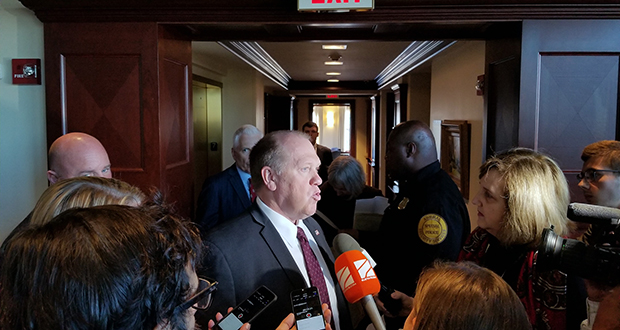
Border Czar Thomas Homan speaks after a 2017 Heritage Foundation presentation. (Photo by Andrew Nicla/Cronkite News)
Hobbs: Border Czar’s threat to flood sanctuary cities could put Arizona at risk
Howard Fischer, Capitol Media Services//May 11, 2026//


Key Points:
-
Gov. Katie Hobbs fears border czar Tom Homan’s threat to flood sanctuary cities with federal agents could lead to problems in Arizona
-
Homan criticized “sanctuary cities” that refuse to cooperate with ICE, vowing to deploy more agents in those areas
-
Arizona Attorney General Kris Mayes is suing Homeland Security over its planned migrant detention facility
Gov. Katie Hobbs said she believes border czar Tom Homan’s threat to “flood” the streets of “sanctuary cities” with federal agents could lead to the same kinds of problems in Arizona that left two people dead in Minneapolis.
Homan, in Arizona this past week, lashed out at what he called “sanctuary cities” who have refused to cooperate with Immigration and Customs Enforcement in their efforts to deport people who the government says entered this country illegally.
“You will see more agents in your neighborhoods, because you forced us into this position,” he told those attending the Border Security Expo.’
Hobbs said she does not believe that there are actually sanctuary cities in Arizona, something her press aide defines as those who actively interfere with federal enforcement of immigration law in violation of state laws.
Still, she conceded that Homan is taking a broad approach, one that may not have room for the nuance of particular cities and counties within states not actively cooperating with ICE. And it is these communities who could find themselves with new deployments of immigration agents.
And, that, Hobbs told Capitol Media Services, concerns her.
“What I hope this doesn’t signal is a return to the kind of enforcement practices that ended up getting two people in Minnesota killed because they were more focused on indiscriminately rounding people up and not on keeping us safe,” she said. “Because those kinds of tactics, they undermine the safety of the communities and law enforcement.”
Homan’s comments come the same week that Arizona Attorney General Kris Mayes essentially gave the green light to city councils and the board of supervisors to adopt policies that specifically bar cooperation with ICE, particularly if they are involved in the non-criminal roundup of those without documents.
Mayes, in a formal legal opinion, acknowledged there are provisions in both state and federal law that forbid local communities from actively interfering with immigration enforcement efforts.
But Mayes, in an extensive analysis of the laws, said there is nothing that actually requires local governments to help in those roundups. In fact, cities and counties can even make their buildings off limits to civil immigration enforcement and bar ICE agents from using city property, including parking lots, as staging areas, she said.
What it ultimately all boils down to, Mayes said, is the U.S. Constitution.
“Federal government cannot require state cooperation without running afoul of the Tenth Amendment,” she said. And the attorney general bristled at the idea that the border czar would threaten communities that are acting within what she believes to be their lawful authority.
“Arizona isn’t going to be intimidated by threats from Homan,” Mayes told Capitol Media Services. “Pima County and the city of Phoenix have enacted lawful measures that reflect the views of their communities.”
Hobbs, for her part, said it’s not up for her to decide when immigration efforts go beyond the reasonable.
“I think that’s for the courts to decide,” she said. “And I hope it doesn’t get there.”
Hobbs said, though, that one way to avoid that confrontation between federal and local authorities is cooperation and coordination.
“I’ll just go to the Surprise warehouse facility as an example,” the governor said.
There, ICE and Homeland Security simply announced that it had purchased a vacant 418,400-square-foot industrial warehouse to house up to 1,500 people detained on immigration violations.
City officials pronounced themselves unable to do anything about it because they have no authority over zoning or land use of federal facilities.
Mayes is trying a different tactic, filing suit in federal court. She contends that Homeland Security did not comply with various immigration and environmental laws.
That case is still pending, though the plans for the warehouse conversion appear to have stalled, at least temporarily.
Hobbs said it should not have had to come to this kind of confrontation.
“When the federal government comes in and they just make this decision and don’t work to gain the support of the community or even talk to the community about the impact that will have, that undermines safety all across the board,” she said.
That also applies to the possibility of some Arizona communities flooded, to use Homan’s term, with ICE agents, the governor said.
“They should be looking at ways that they can work with communities, whether it’s on how they’re going to house migrants or how they’re going to go in and round them up,” she said. “And the more they can do to cooperate and not have cities or jurisdictions feel like they’re just coming in and just taking over, that’s better for everybody.”
And that, said Hobbs, includes local communities — and the peace officers that serve them.
“Our law enforcement are doing everything they can to keep our communities safe,” she said. “And they don’t need other law enforcement coming in from the outside undermining that.”
Mayes has her own fears of what might happen if Homan orders federal agents into the state based on his view that cities and counties are not cooperating.
“Arizonans across the state do not want to see the disastrous policies implemented by ICE in cities like Minneapolis that do nothing to ensure public safety and in fact endanger everyone,” she said.
The governor expressed similar concerns when asked if she fears that having federal agents patrolling streets in Arizona would interfere with local law enforcement.
“Absolutely,” she said. “I don’t think anyone wants to see that here.”