Sign In
Upcoming Event
 Free Newsletter

Supporters maintain pressure for prison oversight appropriation
Kiera Riley, Arizona Capitol Times//May 30, 2026//
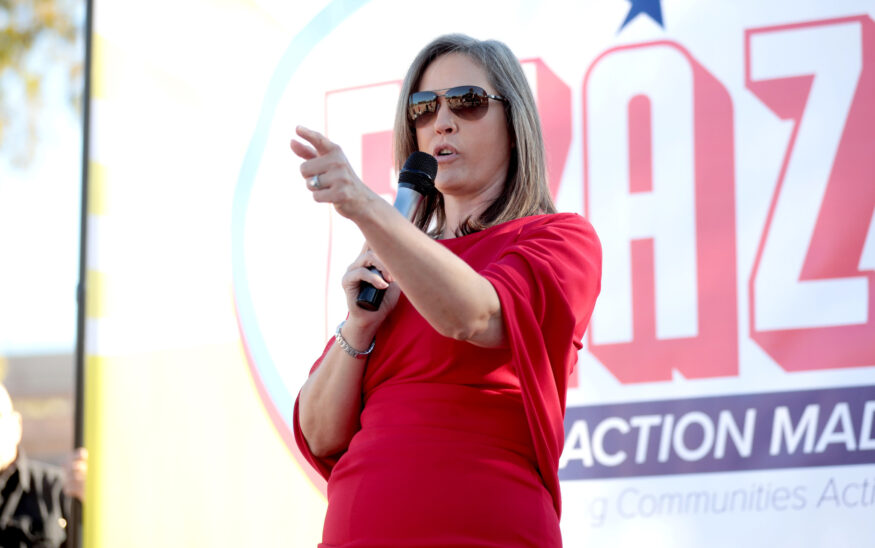
Sen. Shawnna Bolick, R-Phoenix, speaking with attendees at a January 2022 rally hosted by EZAZ at Wesley Bolin Memorial Plaza at the Arizona State Capitol in Phoenix. (Gage Skidmore / Flickr)
Supporters maintain pressure for prison oversight appropriation
Kiera Riley, Arizona Capitol Times//May 30, 2026//


Key Points:
-
Lawmakers push funding for prison oversight office passed into law last year
-
Advocates cite receivership, violence, worsening conditions in state prisons
-
Budget negotiations could bring funding, but advocates brace to look elsewhere
Lawmakers and advocates are waiting to see whether the allegedly incoming bipartisan budget will include $1.5 million to actualize an oversight office to monitor state prisons.
So far, the line item has been absent from every budget proposal from Gov. Katie Hobbs and the Legislature.
And though the original legislation did include a provision allowing the office to rely on alternative funding sources, proponents hope the state prioritizes prison oversight, citing an ongoing line of complaints from staff, inmates and their families.
“When you are basically a ward of the state, you should be making sure that things are moving pretty fluidly inside the prison walls and not having fights breaking out, people getting murdered,” Sen. Shawnna Bolick, R-Phoenix, said. “The issue is not going away.”
Senate Bill 1507, sponsored by Bolick last session, created the Independent Correctional Oversight Office.
It passed with bipartisan support and was signed into law by the governor in July but lacked any funding from the state budget to get started.
Under the legislation, the office would be led by a director, appointed by the governor and confirmed by the Legislature.
The office is tasked with keeping a close eye on the Arizona Department of Corrections, Rehabilitation and Reentry, with obligations to monitor conditions of confinement, ensure compliance with state and federal regulations, provide information to inmates, family members or department employees and man a hotline and a complaint system.
Each year the office would also have to transmit a report detailing data on complaints received and resolved, inmate deaths, suicides, assaults, drug overdoses, lockdowns, housing assignments, and information on inmate classification policies, staffing statistics and transition and reentry programs.
Staff would also have near-unfettered access to department records and facilities, though all communications with the department are deemed confidential.
Though the office was left unfunded last year, Bolick said she added in a provision in the final language allowing for the corrections oversight fund to consist of legislative funds, federal funding, private grants, gifts and contributions, fearing funding from the state would fall through.
“We got the bills through, and it got signed,” Bolick said. “But it’s on paper only. It doesn’t actually do anything.”
This session, allocating money for the office emerged as an early priority for Bolick and Rep. Walt Blackman, R-Snowflake, who both introduced appropriation bills to funnel $1.5 million to fund the office.
Blackman and Bolick’s bills passed their respective chambers unanimously, but the appropriation has made little legitimate headway in proposed budgets so far.
Hobbs omitted the $1.5 million from her executive budget proposal unveiled at the start of the session, but at a Joint Appropriations Committee meeting in January, budget director Ben Henderson said the governor was open to a conversation “about how to make sure there’s funding for that office.”
The Legislature’s budget, vetoed by Hobbs in early May, skipped funding the office too.
Estrella Lopez, senior state policy manager for Justice Action Network, a criminal justice group that lobbied for the oversight office’s passage, acknowledged the fiscal landscape has become more difficult this year given the limited state coffers.
She compared the corrections budget and ongoing costs accrued from lawsuits to the $1.5 million funding request.
“You can find $1.5 million when you’re talking about a $1.6 billion budget,” Lopez said. “I don’t want to say it’s change in the couch cushions. But if you look at the scale of it, kind of.”
If the office is not funded in the state budget this year, advocates remain hopeful in sourcing funds from elsewhere.
Bolick said she had spoken to a few groups and sensed some appetite for nonprofits to pool resources. Lopez added, however, that stakeholders have not been actively pursuing funds thus far.
“The fact that it hasn’t been in any of the versions so far, I’m not taking that as an indication that all parties won’t come together and fund this important issue,” Lopez said. “We do still have a hope and expectation that the state will find it in this budget, that would be the best place for it.”
At bottom, though, lawmakers and advocates stress the continued need for independent oversight.
Bolick said she continues to get emails and letters detailing issues inside the state prison system. Lopez pointed to a federal judge’s decision to order the department’s health care system under receivership.
John Fabricius, executive director of Praxis Initiative, longtime advocate for oversight and former inmate, pointed to the problems entrenched in the department.
“It is not a rehabilitative engine. It is a mess, and it is a morass that you have to navigate and survive, and it is getting exponentially worse,” Fabricius said. “We can’t kick the can down the road anymore, we’re out of road.”
And though he too hopes for funding in the budget, he voiced a commitment to getting the office running in any case.
“It’s not a matter of if, it’s a matter of when,” Fabricius said.