Sign In
Upcoming Event
 Free Newsletter

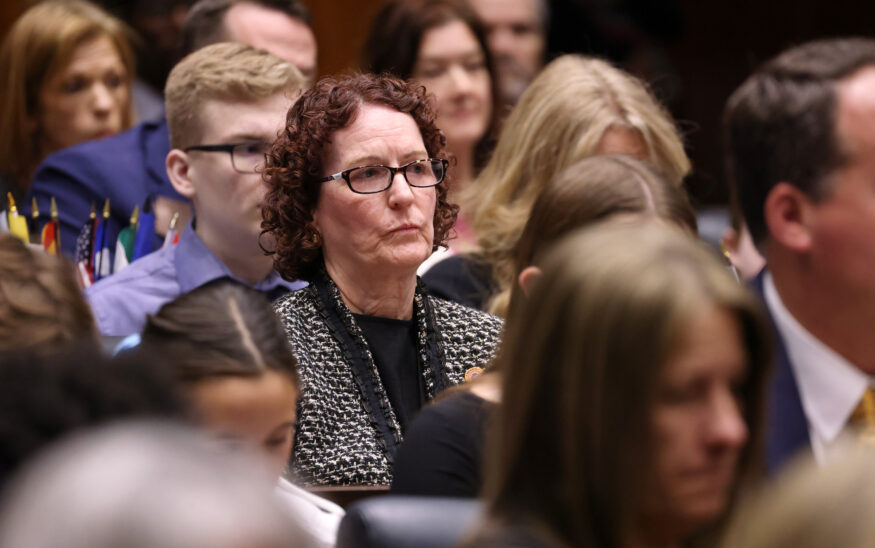
Rep. Beverly Pingerelli, R-Peoria, on the floor of the Arizona House of Representatives on opening day of the 57th legislature in Phoenix. Pingerelli’s HB 4011 would require HOAs to act “reasonably” when governing neighborhoods. (Gage Skidmore / Flickr)
Homeowners are gaining ground against HOAs
Jordan Gerard, Arizona Capitol Times//May 30, 2026//


Key Points:
-
HB 4011 would require HOAs to act fairly and reasonably when boards exercise their power
-
Supporters say it will help people be aware of the standard to which HOAs are held
-
Opponents say the bill doesn’t go far enough and needs a stronger enforcement mechanism
When Caroline Trotter noticed issues in her neighborhood, she went to her local homeowners association. What she encountered prompted her to propose a piece of new legislation.
Trotter has lived in Sun City West for the past six years. For the last year, she has worked on a bill to bring to Rep. Beverly Pingerelli, R-Peoria, that she says could have a significant impact on how HOAs operate.
If passed, House Bill 4011 would charge a condominium unit owners’ association (COA) and a planned community association, such as a homeowners association (HOA), with the duty to act reasonably in the exercise of discretionary powers. The bill defines “duty to act reasonably” as a duty to exercise discretionary powers neutrally, fairly, without favoritism and in a nonarbitrary fashion.
The bill moved through the Legislature with bipartisan support and no votes in opposition, a rare feat. That means it should be on track to reach the governor’s desk after the House gets back to business on June 1. It joins more than 30 bills affecting HOAs that have been filed this session. Most are dead, but a handful are still alive, according to an analysis by the Arizona Capitol Times.
Pingerelli said she and her family live in two HOAs. One is a master community association and the other is a sub-association. She said she hasn’t had any issues with them, and her husband has been active with both associations, but acknowledged not all HOAs are problem-free.
“There are associations out there where people are having issues,” she said. “The language we came up with was the most appropriate to start out the conversation. It’s a very bipartisan issue.”
Essentially, Pingerelli thinks it’s a starting point — something to move the needle and help future HOA members. HOA bills are a step outside of Pingerelli’s usual arena, with her background being largely in education and health care. She joked in committee that it might be her first and only HOA bill, but said she’s encouraged by the fact that it has no opposition in the Legislature.
The Arizona Association of Community Managers, the trade organization for planned communities, did not respond to a request for comment. The League of Arizona Cities and Towns, another influential local voice for housing issues, said they do not typically weigh in on HOA bills.
One person who does believe the measure will help HOAs and homeowners is retired attorney Steve Cheifetz. He has litigated different sides of HOA cases throughout his career and currently serves as counsel at Iannitelli Marcolini Law Firm in Phoenix.
As a quasi-government unit, HOAs and planned communities are usually set up with deed restriction law, Cheifetz said. Developers are often tasked with the responsibility of writing them. When someone agrees to buy a home within an HOA, they’re deemed to have accepted those restrictions, he said. Cities would prefer that new developments have an HOA because it shifts some responsibility, he added.
HOAs often have a document called a Declaration of Covenants, Conditions and Restrictions, or a CC&R, which is a legally binding document that outlines what property owners can and cannot do with their property. Cheifetz noted that many HOA restrictions are limited by law, otherwise they would be too overbearing.
Courts tend to be suspicious of this type of contract because they’re pre-established terms the homeowner doesn’t have a right to negotiate before they buy and it comes down to take it or leave it, he said.
“HOAs are, I think, somewhat of a failed concept, because they have a lot of complicated issues, and they’re just a volunteer board of people that are not necessarily experts in the field, so they rely on management companies, and management companies are making a big profit,” he said. “It’s just an unfair fight. If you get an HOA against a homeowner, the HOA board members don’t have to pay a penny … whereas the homeowner, they have to reach in their pocket if they get in a fight with their HOA.”
Cheifetz is hopeful HB 4011 will help even things out. The bill codifies a landmark 2007 Arizona Court of Appeals case, Tierra Ranchos Homeowners Association v. Kitchukov, which established HOAs have a duty to “treat members fairly” and the duty to “act reasonably in the exercise of its discretionary powers including rulemaking, enforcement and design-control powers,” language very similar to HB 4011.
An association’s failure to meet its duties to a homeowner is deemed to be a breach of contract, which is a homeowner’s best claim against their HOA, Cheifetz said. He said few people know about the standard in that common law case.
“It’ll create better awareness of what the standard is,” he said. “HOA board members are volunteers. They’re not necessarily trained. Sometimes they get trained, but they really are just volunteers.”
Others are a bit more skeptical of how much it will help. Dennis Legere started the Arizona Homeowners Coalition in 2016 after he successfully fought his HOA on open meeting law violations. He was invited by Sen. David Farnsworth, R-Mesa, to be part of a working group of homeowners who helped legislators understand what needs to be done to address HOAs. He heard a lot of horror stories and started looking at ways to change the law.
Ten years later, he still drafts legislation and works with legislators. He does it for free, he said. There are about 2,500 members across the state as part of his group. His website provides information for homeowners to understand what their duties and responsibilities are.
Legere also referenced the Tierra Rancho case and said it’s been a top priority for him to get that into statute.
“If these boards understood those duties, life would change in these communities,” he said.
He said it’s a bit like “motherhood and apple pie.” Likely, the change would help incrementally, but there’s still going to be issues, due to a lack of enforcement mechanism.
“The biggest problem we have in HOAs is there is no enforcement mechanism for the law,” he said. “The only way the law can be enforced is if a homeowner risks their own money to sue the association for breach of law and the association knows that most homeowners are not going to be able to afford that.”