Sign In


 Free Newsletter

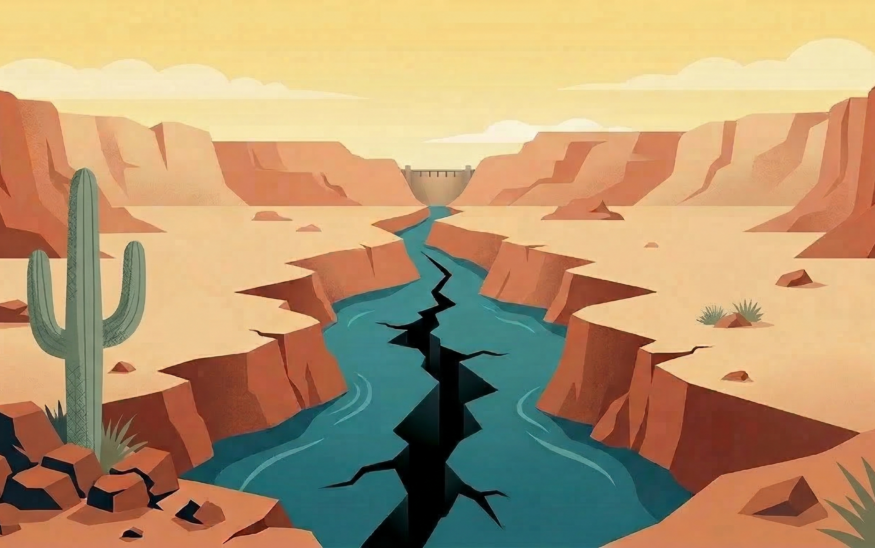
Illustration made using Gemini artificial intelligence.
A crack in Arizona’s Colorado River front
Reagan Priest, Arizona Capitol Times//March 18, 2026//


Key Points:
-
Arizona leaders are anxious amid stalled Colorado River negotiations
-
Some Republicans are splitting hairs with Gov. Katie Hobbs over what to do next
-
One lawmaker is accusing his rural colleagues of organizing to sell out cities
Arizona leaders are getting antsy as the state’s water future hangs in limbo without a negotiated deal on Colorado River sharing guidelines and without federal intervention.
A federally imposed deadline for an agreement on splitting the river’s water between the seven basin states came and went in February with no movement. And despite leaders from the Department of Interior pledging to step in and broker a deal, no progress has been made so far this year.
Arizona leaders at every level and from every party are opposed to the Interior Department’s draft environmental impact statement on post-2026 Colorado River operations, which they say fails to consider the meaningful cuts the state has already made to its water usage. The public comment period on the draft environmental impact statement ended on March 2 and the Department of Interior and Bureau of Reclamation have yet to communicate a path forward.
In the meantime, with competitive elections hanging over the heads of nearly all the state’s elected officials, cracks are beginning to form in Arizona’s united front as leaders contemplate how best to make a case to the federal government.
“People are pretty united about the state’s position, and I think it’s because the state’s position is we’re not going to take a deal that leaves us worse off than no deal,” said Sarah Porter, director for Arizona State University’s Kyl Center for Water Policy. “… I don’t expect to have perfect unanimity in terms of ‘what do we do next.’”
Arizona’s position
In January, the Bureau of Reclamation published a draft environmental impact statement, offering five alternatives to the current operating guidelines. All of those alternatives suffer from “serious legal and analytical defects,” according to Arizona’s chief water negotiator and director of the Department of Water Resources, Tom Buschatzke.
In a letter, Buschatzke notes that the alternatives do not adhere to the 1922 Colorado River Compact, which requires the Upper Basin states of Colorado, Utah, Wyoming and New Mexico to deliver certain quantities of water to the Lower Basin states of Arizona, California and Nevada.
Gov. Katie Hobbs has said Arizona is not willing to cut more than the around 5 million acre feet in water usage it has already conserved unless the Upper Basin states also agree to meaningful reductions in their own usage.
At a U.S. Chamber of Commerce summit in Washington, D.C. on March 17, Hobbs said the environmental impact statement signals that the federal government plans on balancing the Colorado River water shortage “completely on Arizona’s back.”
“Since the 1950s, we’ve added over 6 million people to our state and have an economy roughly 100 times bigger, yet we’re still using roughly the same amount of water,” Hobbs said. “And we’re willing to do more, but recent plans from the Department of Interior are putting our water supply in jeopardy.”
Making the case
Hobbs went on offense over the fall of 2025 to promote the state’s position, blasting the Upper Basin states for their “extreme negotiating position” and urging the Department of Interior to intervene ahead of a Nov. 11 deadline to reach a deal.
During the annual Colorado River Water Users Association in December, some states’ water stakeholders complained to Arizona’s representatives that Hobbs was “getting so engaged” in an area where governors typically rely on their state’s Colorado River negotiators to communicate their position.
Hobbs “called for and secured the unprecedented meeting” between the Colorado River governors and Interior Secretary Doug Burgum in February, according to her office. The governor told reporters the meeting left her feeling “cautiously optimistic” about a negotiated deal, though nothing further emerged from it.
All of that isn’t stopping Arizona Republicans in the Legislature and in Congress from accusing Hobbs of not doing enough to sway the conversation in the state’s favor or to court the approval of President Donald Trump’s administration. U.S. Rep. Andy Biggs, R-Ariz., told reporters on March 13 that he met with House and Senate Republicans at the state Capitol to strategize on the Colorado River.
“We’re working with the Bureau of Reclamation and trying to make our case and we really haven’t seen much help from the Governor’s Office,” he said.
Biggs, who is seeking the Republican nomination to run against Hobbs in November, said the governor hasn’t collaborated enough with Arizona’s congressional delegation on the Colorado River.
“She should have been working with us for the last couple of years to work with this administration,” Biggs said. “Whether we like it or not, Washington, D.C. deals in politics and parties, and that’s why I’m glad Senator (Mark) Kelly is working on this and pushing from his side, and we’re pushing from our side, and I think that that’s where she should have been all along.”
Biggs and Kelly sent a letter calling on the Bureau of Reclamation to rescind the draft environmental impact statement, given that none of its outlined options are favorable to Arizona. Some Republicans in the Legislature, like Rep. Alex Kolodin of Scottsdale, are echoing Biggs’ concerns at the state level.
“I am concerned that the Hobbs administration is simply not qualified or capable of negotiating a resolution that is going to be anything but devastating to the people of Arizona,” Kolodin said. “They have been way too hesitant to seriously prepare for litigation and I believe this weakness is being sensed by all participants.”
Hobbs and Republican lawmakers earmarked $3 million for potential Colorado River litigation in the state’s budget last year, but Rep. Gail Griffin, R-Hereford, said in an early February press release that Arizona is late to the party.
“Arizona does not get to wish its way out of a water fight,” Griffin said in a statement. “Other states have been positioning themselves for court long before this fund was created.”
While a court battle is still largely viewed as a last resort by Arizona leaders, lawmakers in the House unanimously approved a funding measure in February to add another $1 million to the state’s litigation fund, signalling bipartisan appetite for a lawsuit.
In a statement, Hobbs’ communications director Christian Slater slammed Republican lawmakers for staying silent on Colorado River issues for the last three years.
“Their failure to stand up and fight for Arizona’s fair share of Colorado River water is a stunning failure of leadership from politicians more interested in launching partisan attacks than getting the job done,” Slater said. “Their criticisms are nothing more than a desperate, election-year stunt to attack Governor Hobbs and cover for their complete and utter lack of engagement on the issue.”
Water is for fighting
Rifts are also starting to form within the Legislature’s Republican caucus over the river. Kolodin told a meeting of the Legislative District 3 Republicans on March 9 that he believes rural lawmakers are forming a negotiating party to advocate for their districts in the event of drastic cuts imposed by the federal government.
“If we’re in a situation where Arizona’s Colorado River allotment gets cut back severely, every lawmaker is going to be trying to protect their districts, that’s their job,” Kolodin told the Arizona Capitol Times. “Because water is a zero sum game, everybody’s going to be trying to get the best deal for their districts at the expense of others.”
Hobbs’ office says Arizona has been a leader on water conservation over the past few decades, but only because leaders have been able to set their differences aside.
“That success has been made possible by bipartisan leaders who know water isn’t a Democratic or a Republican issue, it’s an Arizona issue,” Slater said in a statement.
Porter, of the ASU Kyl Center for Water Policy, also cautioned against discord among state officials, saying a lack of unity from local leaders at all levels could spell trouble.
“There are different politics, and if we get to a very deep shortage, what will be daylighted is the dysfunctionality more than anything else,” Porter said.