Sign In



 Free Newsletter


How mules deliver Grand Canyon election ballots
Mary Jo Pitzl, Capitol Media Services//November 1, 2026//
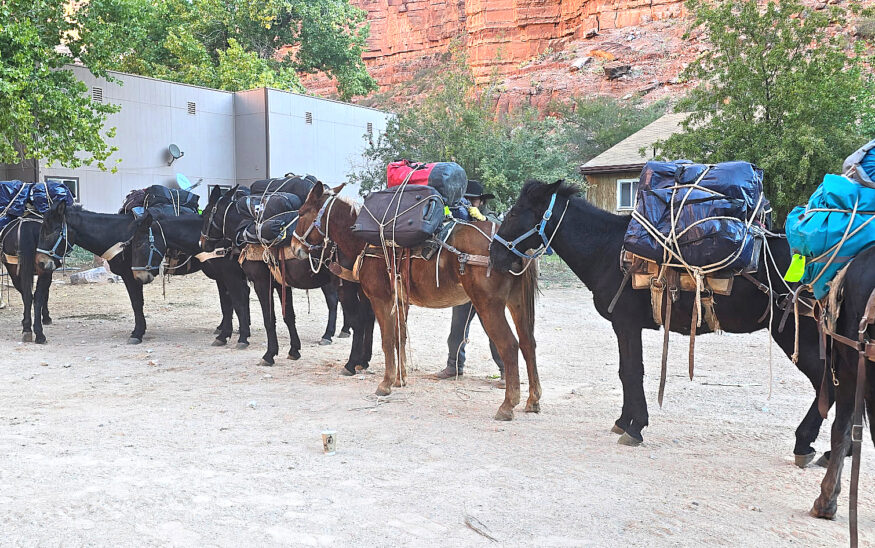
Loaded up with election equipment, these mules allow residents of the Havasupai tribe inside the Grand Canyon to vote on Election Day and then have their ballots carried back out. (Photo courtesy of the Coconino County Recorder's Office)
How mules deliver Grand Canyon election ballots
Mary Jo Pitzl, Capitol Media Services//November 1, 2026//


Elections officials in Coconino County are saddling up for a uniquely Western way of voting: using a train of mules and horses to bring ballots out of a tribal village at the bottom of the Grand Canyon.
Nothing like it exists in the United States. Even at Phantom Ranch, deep in Grand Canyon National Park, park staffers must mail in their ballots or hike up to the South Rim to vote.
But the mule trains continue just to the west of the park. County elections officials see it as a way to honor tribal practices and strengthen ties with voters.
“It’s more organic,” Eslir Musta, elections director for Coconino County, said of using mules rather than motors to bring up the ballots. The practice has been the standard in recent years and is a great way to build rapport with the locals, he said.
“And it helps the local economy with the mules,” Musta said.
The county hires mules and wranglers from the Havasupai Tribe‘s tourism office — the same people who outfit the hikers who flock to Havasu Canyon’s blue-green waters and cascading waterfalls.
“With packs clearly marked ‘Coconino County Elections,’ the mule train is a great marketing strategy as the crew wends its way down the canyon and over to Supai, the tribal headquarters and only village in the canyon.
On Monday, two election office staffers will accompany the wranglers and pack mules as they ride down the eight-mile trail. In line with election guidelines, the staffers are from differing parties and work in tandem to ensure bipartisan oversight.
It’s unclear if the mules — which are half donkey — are held to the same bipartisan standard.
For Katherine Morgan, Monday’s trek to administer the election in Supai village marks her third election cycle. She was volunteering when Musta approached her for the coveted duty. She didn’t hesitate.
“Absolutely not,” Morgan said, adding it was a chance to see the much-heralded canyon.
“I’d never been down there,” she said. “I’d just heard about how beautiful it was.”
A long trail ride and saddle sores
The three-day assignment is busy, but fun in its own saddle-sore way.
Morgan said she knew how to ride when she took the job. But this summer, she took lessons to improve her performance on the rocky trail.
It paid off when she rode out with the ballots after the July primary election. Her soreness was “not that bad,” she said.
The trip down the trail takes about 2 1/2 to 3 hours; add another two hours to get back up to the canyon rim at Hilltop. No express trail exists for the election crew, but tribal officials ensure passage goes smoothly.
“The trails are very wide,” Morgan said, unlike the narrower Bright Angel Trail at the national park. Hikers stand aside to let the horse-and-mule train through.
Election materials are packed onto the mules, from poll books and ballots to accessible voting equipment and a Starlink internet router.
“It’s a pretty sizable suitcase that goes down,” Musta said, noting it includes a touchscreen for voters with disabilities.
So far in the recent history of mule trains, nothing has toppled off the mules and into the canyon, Musta said. But just in case, he added, backup supplies are available.
A tiny voting precinct
After the Supai poll (the only one in the canyon) closes on Tuesday, the staffers complete their duties, pack up the materials and spend a second night in the lodge.
They pack out early Wednesday morning and transfer the gear to vehicles at the top of the canyon. The ballots arrive at county elections headquarters by noon, if not earlier.
Musta hopes the practice will increase voter participation in the tiny precinct, which has 155 registered voters.
Turnout is highest during presidential elections, at 30%-40%, he said. Although some tribal residents vote by mail — which is also packed out by mule — most prefer to cast ballots in person.
The county has used other methods to bring out the ballots; for the July primary election, they used a helicopter to get election equipment to Supai but opted for a mule train for the return trip.
The county has also relied on long-distance runners, as long as they are from opposing political parties.
“We had people who were trail runners who loved to do it for extra exercise,” Musta said, adding they’d strap on backpacks to carry the equipment. But mule trains remain the preference.
A unique Arizona tradition
The mule train is seemingly unique to Arizona. But it is just one example of ballot delivery in areas with no roads, said Tammy Patrick, chief program officer at the National Association of Election Officials.
Other jurisdictions have relied on helicopters, ferries and snowmobiles, Patrick said.
“It’s driven by geography and topography,” she said of various ballot delivery practices.
In Alaska, for example, 219 remote villages have no roads connecting them to county elections offices.
So bush pilots transport ballots. In other cases, depending on the weather, snowmobiles do the job, Patrick said.
Even very urban Los Angeles County has turned to helicopters to bring ballots back from remote parts of the sprawling county, she said.
But Coconino County, with its mule train plying the colorful gorge of the Grand Canyon, is unto itself, she said.
“People love to talk about it because it’s such an anomaly,” Patrick said.