Sign In




 Free Newsletter
Hobbs asks court to halt Tohono border wall work
Howard Fischer, Capitol Media Services//September 24, 2026//
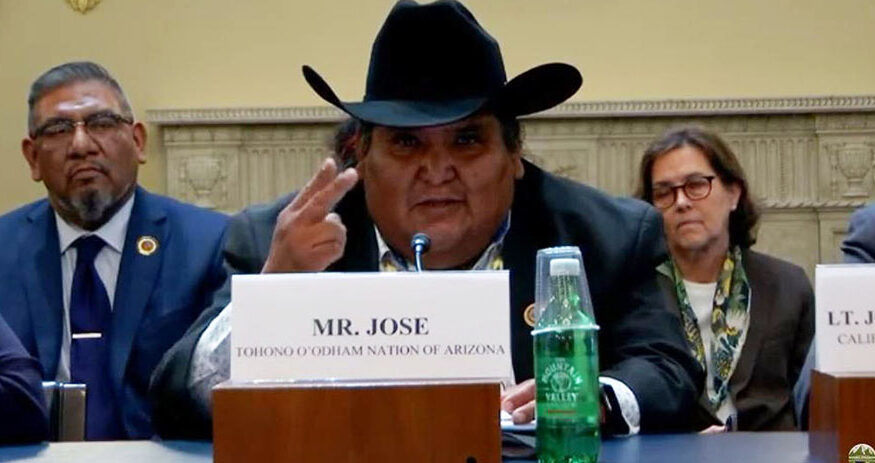
Tohono O'odham Chairman Verlon Jose on Oct. 18, 2023, told a U.S. House panel that migrants crossing his tribe's reservation may cause problems, but that the construction and presence of the border wall has caused bigger problems. (Photo courtesy House Natural Resources Committee)
Hobbs asks court to halt Tohono border wall work
Howard Fischer, Capitol Media Services//September 24, 2026//


Gov. Katie Hobbs is siding with the Tohono O’odham Nation in its bid to delay work on a border wall the federal government wants to build along the Mexican border.
At the center of the dispute is the Department of Homeland Security’s proposal to build that 62-mile barrier. Tribal officials filed suit claiming that it amounted to an illegal trespass on their land.
“Arizona’s own record demonstrates that vigorous border security does not require disregarding tribal sovereignty,” Justin Cox, a private attorney representing Hobbs, told the Court of Appeals for the District of Columbia. He said the state has achieved “major enforcement results” through cooperation with the tribe.
Hobbs is not asking that the 62-mile double-layered, 30-foot-high steel and concrete barrier be canceled entirely — at least for now. Nor is the governor taking a position on the underlying legal question of whether the land where the twin walls are being proposed belongs to the tribe or the federal government.
Instead, Hobbs wants the court to halt the work while these issues are worked out.
“Prior border wall construction conducted without meaningful tribal consultation resulted in irreparable damage to sacred sites and cultural artifacts,” Cox told the court.
He cited a 2020 incident where federal contractors building a section of border wall inside the Organ Pipe National Monument engaged in blasting a sacred site that held cultural artifacts and human remains. And earlier this year, a contractor damaged an ancient, 200-foot fish-shaped geoglyph — essentially a design drawn directly on open ground — by bulldozing through the site to build a border barrier.
U.S. District Court Judge Richard Leon tossed the case last month.
He specifically rejected arguments that this was tribal land, citing a 1907 proclamation by then-President Theodore Roosevelt declaring the first 60 feet of land north of the border with Mexico belongs to the United States. He also noted that Congress did not actually establish a reservation for the tribe until 1917.
And even if that were not the case, Leon said the United States’ need to secure the border trumps the tribe’s concerns.
“Given the national security and foreign policy considerations related to the border wall, deference to the government is warranted,” he wrote.
Tribal attorneys appealed, contending that the ruling was incorrect.
The tribe erected “no trespassing” signs and tried to remove contractors from the reservation. But that only made the contractors return, this time accompanied by armed federal agents.
Cox, in his filing on behalf of the governor, said a stay is appropriate.
He pointed out that Leon, in refusing to stop the work, wrote that he believes that many of the harms the tribe fears “could be mitigated through consultation with the Nation and accommodations.” And the judge also said he expects that the federal government and the Department of Homeland Security would “follow through on its guarantees of consultation.”
“Events have since tested that expectation,” Cox wrote.
“Within hours of the ruling, DHS’s general counsel posted, ‘We respect tribal sovereignty but not to the detriment of border security. The wall is getting built. Our authority is beyond dispute,”’ Cox told the appellate court. And that, he said, led to the contractors being escorted onto the reservation by armed agents to start work.
“Consultation that follows the destruction of a sacred site is not consultation; it is notification,” Cox said. “The value of consultation lies entirely in its capacity to shape a decision before that decision is made — particularly where, as here, the decision is irreversible.”
Anyway, Cox said, halting construction while the case proceeds would impose “minimal harm” on the government.
In siding with the tribe, Hobbs also finds herself at odds with Senate President Warren Petersen and House Speaker Steve Montenegro.
In their own legal brief, the Republicans said Homeland Security interests outweigh the concerns of the Tohono O’odham, both in terms of erecting a fence on what it says is reservation land and dividing the tribe, which has existed for centuries on both sides of the border.
Lee Whitesell, a private attorney retained by the pair, cited Arizona’s history of dealing with border crime and incidents, including “millions of dollars that the state has spent to assist with border-related security.” And they blame pretty much all of it on the Biden administration.
The pair acknowledged that the tribe’s police chief has said that “border crossings on the reservation are at historic lows.”
But they said even if that is true, it’s because the Trump administration has “made border security a top priority.” More to the point, they said that situation isn’t guaranteed to continue.
“A future administration may return to the lax practices of prior administration and choose to pull personnel from the border; to retract border security policies; and to again send an implied message to the world that the integrity of our border will not be enforced,” their legal filing states.
The appellate court has not set a date to hear arguments.