Sign In


Upcoming Event
 Free Newsletter

Protect Education Act fails to qualify for November ballot
Jakob Thorington, Arizona Capitol Times//August 18, 2026//
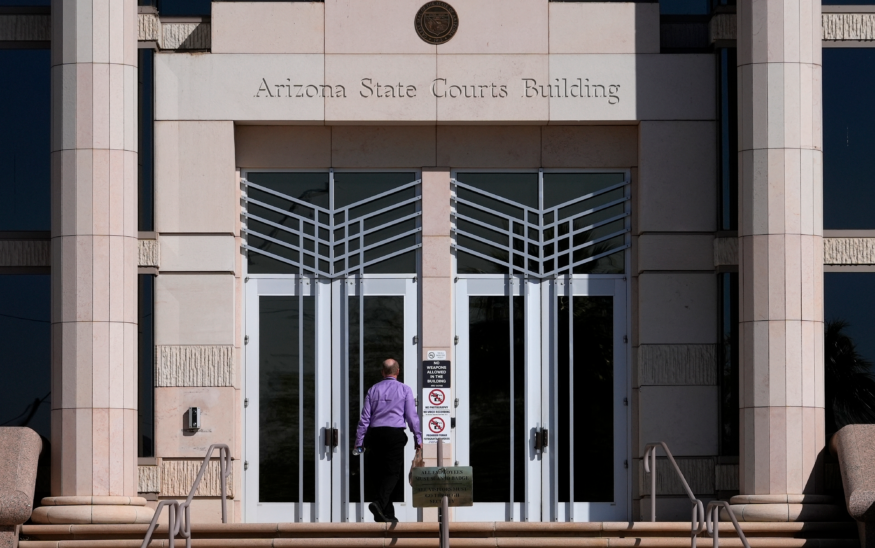
A man enters the Arizona Supreme Court building, Wednesday, April 10, 2024, in Phoenix. (AP Photo/Matt York)
Protect Education Act fails to qualify for November ballot
Jakob Thorington, Arizona Capitol Times//August 18, 2026//


Key points:
-
A citizen’s initiative that would reform the state’s Empowerment Scholarship Account program appears not to have enough valid signatures to qualify for the November ballot
-
The Arizona Supreme Court affirmed a ruling that will likely keep the measure off the ballot
-
ESAs continue to be a major issue for Republicans and Democrats this election
Arizona voters won’t get a chance to weigh in on proposed reforms to the state’s Empowerment Scholarship Account program this November after a state Supreme Court ruling that would likely invalidate enough signatures to disqualify the Protect Education Act citizens’ initiative.
The decision, which upholds a ruling from the Maricopa County Superior Court, is a win for the conservative Goldwater Institute, the Free Enterprise Club and ESA advocates who have contended that signature gatherers fell short. The state Supreme Court’s ruling disqualified about 24,000 signatures that proponents argued had been improperly subtracted twice — leaving the measure 10,000 short of the needed 255,949 signatures.
Goldwater celebrated the Supreme Court’s ruling and described the Protect Education Act as an “attack” on school choice for more than 100,000 students who are enrolled in the program.
“Despite spending an unprecedented amount of money in an effort to deceive voters into restricting school choice, the unions could not convince even a small fraction of Arizonans to sign their petition,” said Victor Riches, President and CEO of the Goldwater Institute. “Instead, they had to resort to unlawfully collecting thousands of signatures to try to game the system and dupe their way onto the ballot.”
The court rejected Protect Education Act Accountability Now Committee’s argument that removing duplicate signatures during multiple reviews could result in double counting.
The Secretary of State’s Office identified duplicate signatures in a random sample it prepared for further review from Arizona’s 15 counties to determine a county signature validity rate. According to the committee, duplicate signatures were subtracted twice by both the Secretary of State and the counties, thus resulting in a higher effective signature threshold to qualify for the ballot than the constitutionally required 15% of statewide votes in the previous gubernatorial election.
But Chief Justice Ann Timmer wrote in the decision that the committee found no specific evidence that signatures were subtracted twice from the valid count and the court could not rule on a theoretical possibility.
The Supreme Court sent the case back to the superior court to make the final determination of the measure’s ballot status. That decision was not filed by Tuesday afternoon, but proponents of the Protect Education Act began conceding the measure’s defeat before the trial court’s ruling.
“Today is a victory for the powerful and a loss for the people,” Protect Education Committee spokeswoman Olivia Fierro said in a written statement following the Supreme Court’s ruling.
The committee initially submitted more than 421,000 signatures in July. Fierro blamed “anti-public education lawmakers” and “wealthy” allies for keeping the measure off the ballot.
“They knew Arizonans were ready to vote for accountability for a billion-dollar voucher program that is draining resources from public schools and putting children at risk, so they stopped at nothing to keep this issue off the ballot and out of the hands of the voters,” Fierro said.
Lawmakers also put forth a competing ballot measure, Proposition 145. Republicans designed that measure on the final day of the legislative session to protect ESAs for military families and prevent Prop. 212 from taking effect if both measures passed.
The Supreme Court also affirmed a lower court’s ruling that Prop. 145 is unconstitutional. The court ruled its provisions that would keep other measures like Prop. 212 from taking effect don’t form a “single, workable proposition” that can stand or fall on its own.
Leaders of both political parties signaled the fight over ESAs is not over. The future of the ESA program will be heavily influenced by which party has control of the Legislature and the governor’s office in 2027.
House Minority Leader Oscar De Los Santos, D-Laveen, and House Minority Assistant Leader Nancy Gutierrez, D-Tucson, said in a joint statement that they hope a new legislative majority will continue their efforts to reform the ESA program.
“School choice opponents have spent years trying to roll back educational freedom in Arizona, and they will keep trying,” said House Speaker Steve Montenegro, R-Goodyear. “Arizona House Republicans will keep standing with parents. We will defend ESAs, protect school choice, and make sure parents, not unions, bureaucrats, or politicians, remain in charge of their children’s education.”