Sign In


Upcoming Event
 Free Newsletter

Pinal County sheriff accuses Flock of ‘dishonesty’ about its cameras
Sophia Braccio, Cronkite News//September 27, 2026//
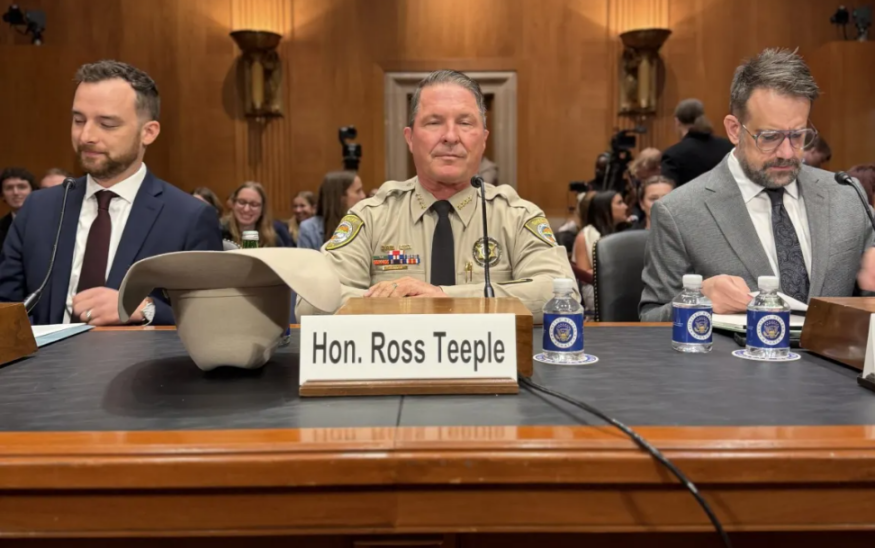
Pinal County Sheriff Ross Teeple prepares to testify at a U.S. Senate hearing on surveillance cameras on Sept. 23, 2026. Pinal County ended its contract with automated license plate reader company Flock in August. (Photo courtesy of Joe McCarthy/Pinal County Sheriff’s Office)
Pinal County sheriff accuses Flock of ‘dishonesty’ about its cameras
Sophia Braccio, Cronkite News//September 27, 2026//


WASHINGTON – Pinal County Sheriff Ross Teeple accused surveillance technology company Flock Safety of “disinformation … and dishonesty” about its cameras in Senate testimony on Wednesday.
“It’s not Flock Safety, it’s Flock surveillance,” Teeple told Cronkite News.
Flock, which makes automated license plate readers used by law enforcement, is the subject of a nationwide backlash that erupted in recent months amid concerns that its vast AI-powered camera network tracks the movements of tens of millions of drivers.
Teeple announced Aug. 5 that he would end the contract with Flock, making Pinal the first Arizona county to cut ties with the company.
In a YouTube video, he cited “serious Fourth Amendment concerns with the technology contained within those cameras,” referring to the constitutional right to protection against unreasonable search and seizure.
According to a group called DeFlock that tracks automated license plate readers, there are more than 1,700 in the Valley, nearly all of them from Flock. Nationwide, more than 150 jurisdictions have canceled contracts with Flock and its competitors or halted plans to install the cameras, according to DeFlock open-source data.
Sen. Josh Hawley, R-Mo., who chairs the Senate Judiciary Subcommittee on Crime and Counterterrorism, said he called Wednesday’s hearing “to get to the bottom of what is going on with the expanding surveillance networks that appear to be going coast to coast in this country.”
In his testimony, Teeple expressed frustration with the company’s communication with him in the weeks prior to the contract termination.
“I started getting questions from my constituents, and they were asking very specific questions, and I started asking Flock, the company, questions, and they were not getting answers to me,” Teeple told senators.
Hawley invited the CEOs of Flock and three other AI-powered camera companies – Axon, Motorola Solutions and Verkada – to testify. None showed up.
Flock responded to inquiries about the sheriff’s testimony by referring Cronkite News to a letter the company’s director of public trust and technology, Max Weinstein, sent to him Aug. 6, the day after he announced the cancellation. The Pinal County Board of Supervisors ratified the termination on Aug. 12.
In the letter, Weinstein told Teeple it is “a common misconception” that automated cameras violate the Fourth Amendment.
“A fixed LPR camera, which captures an image of a vehicle in plain view at a specific moment, does not violate the 4th Amendment,” he wrote.
The letter did not address concerns about the AI technology or resolution of images captured by the cameras.
Lawmakers agreed that individual photos of vehicles on public roads generally don’t violate constitutional privacy rights. The concern about Flock’s system, though, is that it can piece together any driver’s movements for hours, over hundreds of miles – and that the data can be retrieved later.
There have also been instances in which people with access to the data have misused it, for instance to stalk a romantic partner.
“We have got to find a way to balance, in America, privacy and security,” said Sen. Dick Durbin, D-Ill.
Some cities in Pinal County still use Flock cameras, including Casa Grande.
In an interview, Teeple said the county itself continues to use non-Flock license plate readers on anti-smuggling unit vehicles and on trailers. He called those an especially important tool in rural parts of the county.
He pointed to a joint statement from the National Sheriffs’ Association and other law enforcement groups defending the use of automated license plate readers to help find fugitives, criminal suspects and missing persons, while also supporting “meaningful safeguards and accountability.”
“Let’s move forward with that so we don’t lose a valuable tool that law enforcement desperately needs,” Teeple said.
Pinal County’s contract with Flock was in place when Teeple, a Republican, became sheriff in January 2025.
He initially praised the license plate readers for helping in cases like Silver Alerts, when an older person goes missing.
As he recounted to lawmakers, and afterward in an interview, Teeple contacted Flock for clarification after residents saw older cameras being replaced with newer and bigger ones, and started expressing concerns.
A company representative told him the newer cameras don’t take photos at high enough resolution to identify individuals, he said, but once he saw images from the newer cameras, he could recognize faces.
Teeple said when he asked if the newer cameras used AI, the company said no.
After learning later that Flock’s system does use AI to connect images from its camera network and “create a digital fingerprint of your vehicle,” he reached out again. This time, a representative told him he had not asked about the right kind of AI.
“There was just too much disinformation from them and dishonesty,” Teeple testified. “I was trying to get answers … and there were too many concerns.”
A spokesman for the sheriff’s office said Teeple’s conversations happened both in person and by phone, involved multiple Flock representatives, and took place in the weeks leading up to his decision to end the contract.
“For them not to show up, I thought that was pretty cowardly,” Teeple told Cronkite News after the hearing. Hawley called the absence “unfortunate.”
Flock did not respond to a question about those comments.
Other witnesses at the hearing included a Florida woman who was arrested for a crash that killed three people. Investigators said Flock camera images put her Dodge Durango near the crash site but the identification turned out to be wrong.
A lawyer from the American Civil Liberties Union, senior policy counsel Chad Marlow, urged Congress to “ban any law enforcement entity who receives federal funding from using ALPRs.”
In the House, at least four bills have been introduced this year to regulate automatic license plate readers.
This article first appeared on Cronkite News and is republished here under a Creative Commons Attribution-NoDerivatives 4.0 International License.