Sign In



 Free Newsletter


Schools superintendent Tom Horne is leaving office — but he isn’t retiring yet
Rachel Ohm, Arizona Capitol Times//November 18, 2026//
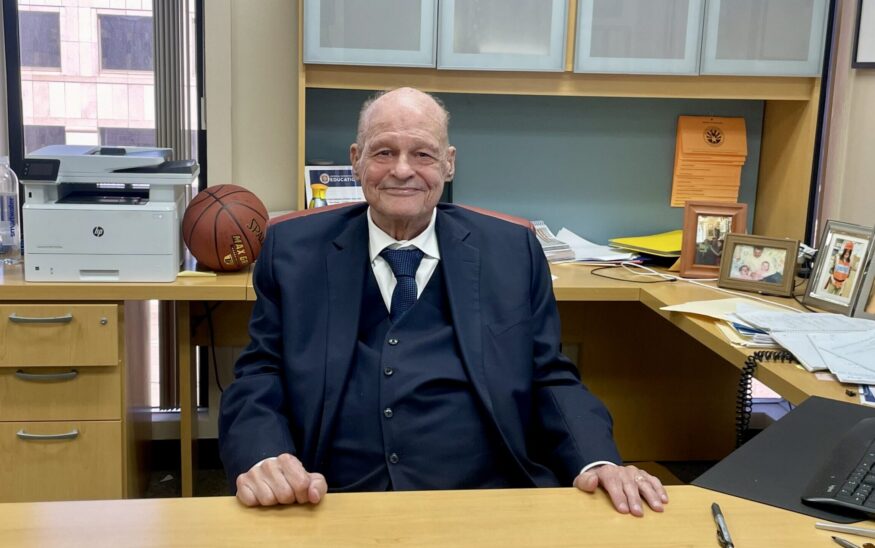
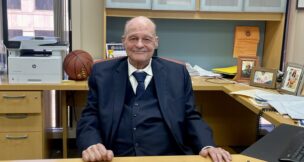
Tom Horne, superintendent of public instruction, poses for a portrait in his office at the Arizona Department of Education on Wednesday, Nov. 18, 2026. (Rachel Ohm/Arizona Capitol Times)
Schools superintendent Tom Horne is leaving office — but he isn’t retiring yet
Rachel Ohm, Arizona Capitol Times//November 18, 2026//


Tom Horne has had a long career in public office, but he said he isn’t ready to retire.
The Republican former Arizona attorney general, state lawmaker and longtime Paradise Valley school board member will step away from his current role as superintendent of public instruction in January, with Democrat Teresa Leyba Ruiz taking over.
Horne, 81, won’t be spending much time at the pool or on the golf course just yet, though. He plans to return to practicing law and to start a charter school to serve students living in poverty.
Horne’s most recent tenure at the Arizona Department of Education — he also served as superintendent from 2003 to 2011 — was marked by rapid growth in the state’s school choice program and calls for more oversight of how it’s run.
The questions and answers have been edited for style and clarity.
You’ve had a long career in the public eye, between serving as attorney general and twice as superintendent of public instruction. What’s next for you?
I’ve spent 16 years in elected statewide office, and overall, between local and legislative elections, I’ve won 36 and lost three. If I was a baseball team, that’d be a pretty good record. I can’t retire. So, for the next two years I’m going to be practicing law again, and during those two years I’m hoping to get licensed to start a charter school. Our plan is to try and start a charter school where about half the students are in poverty, to prove they can learn just as well as other kids if they’re properly taught.
Looking at this current term as superintendent, what would you say were your biggest achievements? What were the biggest challenges?
In Project Momentum, we worked with the bottom 5% of schools, and after a year, 80% were no longer in the bottom 5%. [The department] also adopted a school in this neighborhood [near the Capitol], where there’s a lot of kids in poverty. After a year working with them, we raised their math scores by 27%. That is sort of an illustration of what I also want to do with the charter school. We sent people from the department there weekly to work with them, to help the superintendent and principal with leadership and to help the teachers with teaching. We’ve also provided leadership training that’s expanded very fast and was extended to training teachers as well. We’ve trained 11,000 teachers and leaders.
The biggest challenge was ESAs.
There’s been a lot of discussion around trying to reform the ESA program. Do you think reforms are needed? Have you tried to implement any reforms, and if so, has that been challenging at all?
Arizona was the first state to adopt ESAs. And there were a lot of articles [at that time] advising you not to try to check every transaction, because you’ll just get bogged down. Just do it on a sample basis. But I said no, we’re not going to do that. We’re going to check every transaction.
I established two rules. Rule No. 1 was that money had to be for valid educational purposes. We got requests that you wouldn’t believe for crystals, Rolex watches and $24,000 golf simulators. Second, it had to be a reasonable cost. We famously turned someone down who wanted a $16,000 cello. You can get a perfectly good cello for less than that.
As we proceeded, we had funding from the Legislature for the same number of administrators of the program as when there were 11,000 students. Now there are 110,000 students in the program, and they never increased our administrators. So they became overwhelmed, and the delays for approval [of expenses] got to be 90 days, 120 days.
That’s where we came to checking [expenses less than $2,000] afterward instead of before. It was so we could get the money out quickly. At 120 days, the system would have collapsed. Of course, that caused a lot of problems because, particularly one TV station, focused on people who shouldn’t have gotten $2,000 and neglected the fact we get [the money] back afterward, because we do audits.
The position I’ve always taken is I’m an administrator. If the Legislature passes changes, I would administer them faithfully.
I’ve heard that your office is using an AI system to audit the ESA expenses. How is that going?
It’s ongoing. Right now, it’s operating, but we have human beings checking because it’s not well-educated enough to do it perfectly. When it reaches the point where it’s perfect, then we will be able to audit everything [in advance]. There will be no more $2,000 limit. It will audit everything before [families] get the money.
You lost the Republican primary for superintendent to state Treasurer Kimberly Yee, who in turn lost the general election to Democrat Teresa Ruiz amid a wave of victories for her party. Do you have any thoughts on how Republicans move forward after this tough election year?
I think they need to start ignoring Turning Point, and in primaries they need to vote for people who have the possibility to win general elections. Politics should be about obtaining government power to do good for the community and the state, whereas their focus is on winning intramural fights that are meaningless.
You recently met with Teresa Ruiz, your successor. How did it go? What did you talk about?
It was very friendly. She has been a lifelong educator, and my focus is on education. So we have that in common. Her success now is needed to continue to help the schools the way I’ve been doing, so I want to help her in any way I can so she’ll be successful.
Is there anything else you’d like to talk about as you reflect on the last four years as superintendent?
When I took office, the proficiency rate for Native American students [in math and reading] was about 3%, which was really shocking. So I went to the Office of Indian Education and said, “You need to change what you’re doing and focus on academics.” We got some resistance from the head of that office, and we ultimately replaced her, and the people there are doing fantastic work. I’ll give you some statistics that I think are important. These are for math scores. Ganado Unified increased 159%; Red Mesa, 149%; Baboquivari, 197%. We did this by sending people there to help. That’s been pretty much my philosophy of what we’re here for. We’re here to help the schools do better academically.