Sign In
 Free Newsletter

Arizona Court of Appeals rejects GOP challenge to mail-in voting signature verification
Howard Fischer, Capitol Media Services//August 28, 2025//
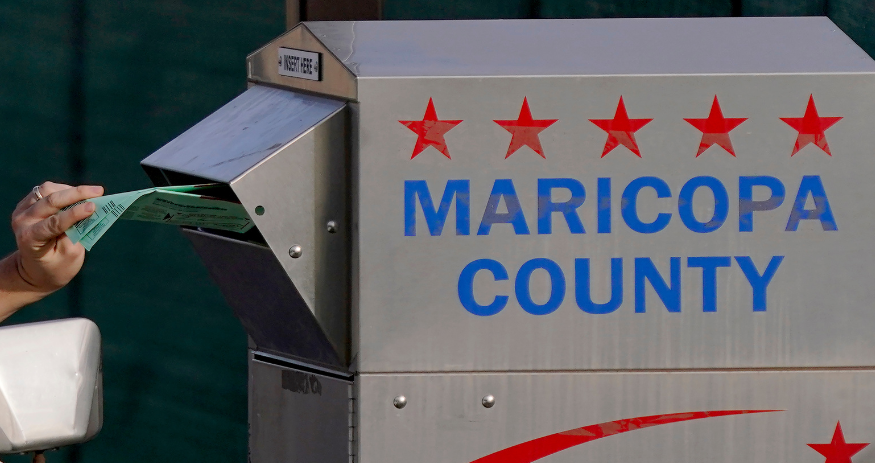
A voter casts their ballot at a secure ballot drop box at the Maricopa County Tabulation and Election Center in Phoenix, Tuesday, Nov. 1, 2022. (AP Photo/Matt York)
Arizona Court of Appeals rejects GOP challenge to mail-in voting signature verification
Howard Fischer, Capitol Media Services//August 28, 2025//


Key Points:
-
Arizona Court of Appeals tosses GOP claim on mail-in ballots
-
Judges rule GOP lacks standing to challenge signature verification process
-
Arizona has long allowed no-excuse early voting since 1991
The state Court of Appeals has tossed out a claim by the Arizona Republican Party and some of its allies that could have created a new obstacle for people trying to vote by mail.
In a unanimous ruling, the three-judge panel declined to rule on claims that Democratic Secretary of State Adrian Fontes acted illegally when he concluded that signatures on early ballot envelopes can be verified by comparing them to any other signatures on file. Attorney Kory Langhofer, who represents the challengers, said that is contrary to state law.
Instead, the judges decided that Langhofer and his clients lacked the standing to sue.
They said the law gives Fontes, “at least some discretion on the rules he enacts.” And that, they said, exempts those rules from the kind of challenge they brought.
The ruling, unless overturned, leaves in place the ability of county election officials to use multiple sources to verify ballot signatures.
In contrast, a ruling in favor of the GOP would have meant more early ballots would have been set aside for verification, especially in circumstances where the signatures had changed over the years — or decades — since people had first signed up to vote. That verification process involves reaching out to voters, whether by phone or mail, to “cure” their ballots by asking them if they had, in fact, voted by mail.
“It would be very burdensome on the curing process,” said Aaron Thacker, a spokesman for the Secretary of State’s Office. “It would increase the demand to cure signatures, which would become a strain on the timeline.”
That timeline, under state law, is five days after the election. If voters cannot be reached or if they never verify their signatures, their ballots would never be counted.
There was no immediate response from Langhofer. But Fontes himself cheered the ruling, calling the lawsuit “nothing more than a red herring.”
“We know that signatures naturally change over time due to age, health, or other personal circumstances,” he said. “Using the most current signature on file to verify mail-in ballots is not only common sense. It’s essential to maintaining election integrity.”
The ruling comes as Republicans, led by President Donald Trump, are trying to kill early voting nationwide.
“I am going to lead a movement to get rid of mail-in ballots,” Trump wrote earlier this month on his social media platform. The president also said he would sign an executive order to that effect ahead of the 2026 elections.
However, that is virtually certain to spark a legal fight from Arizona and other states that contend election rules are a state decision. Fontes himself said if Trump were to try to override state law he would “tell him to pound sand.”
Arizona has long allowed early voting. But prior to 1991, that privilege was available only to people who provided proof they needed it, like being away from their voting precinct on Election Day or a physical disability.
That year, the Republican-controlled Legislature made Arizona among the first states in the nation to adopt no-excuse early voting. It has proven extremely popular, reaching close to 90% in 2020.
The state GOP sued in 2022 to have the practice declared unconstitutional. However, that lawsuit was dismissed by the Arizona Supreme Court.
This latest action focuses on a narrower issue – how to verify signatures.
In filing the 2023 lawsuit, Langhofer argued that election officials have only one option: compare what is on the ballot envelope with a person’s “registration record.”
“It is the only means by which the county recorder can verify that a person casting an early ballot by mail is, in fact, a duly qualified elector,” the lawsuit said.
But Fontes argued that the wording of the law allows election officials to use any signatures available to them. And that includes requests for early ballots, signatures on voter rosters, as well as signatures on prior early ballot envelopes.
And it was that interpretation he put into the Elections Procedures Manual that he is required to compile to help election officials interpret Arizona law.
Langhofer called that “unreasonably permissive criteria.”
He represents not only the state GOP but also the Arizona Free Enterprise Club, which tends to align itself with GOP interests and is currently engaged in other legal battles, including an attempt to void a 2022 voter-approved law that requires the true source of political spending to be made public.
Langhofer also represents Restoring Integrity and Trust in Elections. Reuters says that RITE was formed in 2022 by former U.S. Attorney General William Barr, Karl Rove, who was a top adviser to former President George W. Bush, and casino billionaire Steve Wynn.
The challengers actually won an early round in the lawsuit when Yavapai County Superior Court Judge John Napper ruled in 2023 that state law is “clear and unambiguous” that election officials must compare the signatures on the envelopes with the voter’s actual registration record. And that, he said, consists only of the document signed when a person first registered along with subsequent changes for things like altering party affiliation.
But Napper later overruled his own decision, saying it appeared that state lawmakers actually had given Fontes sufficient legal latitude to conclude that “registration record” includes signatures on anything else in county records.
The Court of Appeals, in the new ruling, didn’t even try to go that far.
Appellate Judge Jeffrey Sklar, writing for himself and his colleagues, said what Langhofer was seeking for his clients was a court order directing the secretary of state to rewrite the Elections Procedures Manual in a way to tell local officials they could use only the original registration records for signature comparison.
The problem with that, he said, is that Fontes has “at least some discretion” in crafting the manual. Sklar said that makes sense.
“Otherwise, there would be no need for an EPM,” he wrote. “It would simply reiterate the statutory scheme.”
And that discretion, said Sklar, makes Fontes immune from having courts overrule his decisions.
Fontes chided the challengers for filing the lawsuit in the first place.
“Efforts to undermine the process aren’t about fixing anything,” he said. “They’re about sabotaging a system that has proven to work.”