Sign In
 Free Newsletter

Arizona Democrats sue to block No Labels Party rebranding
Howard Fischer, Capitol Media Services//December 8, 2025//
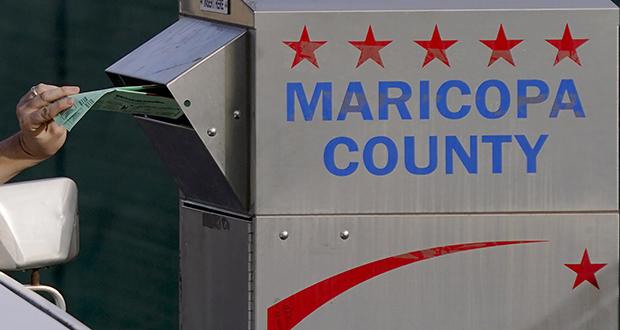
A voter casts their ballot at a secure ballot drop box at the Maricopa County Tabulation and Election Center in Phoenix, Tuesday, Nov. 1, 2022. All Arizonans will continue to be able to vote by mail despite efforts by the state Republican Party to kill the practice. (AP Photo/Matt York)
Arizona Democrats sue to block No Labels Party rebranding
Howard Fischer, Capitol Media Services//December 8, 2025//


Key Points:
-
Arizona Democratic Party sues to block No Labels Party renaming
-
Democrats claim renaming could harm their candidates in upcoming elections
-
Secretary of State Adrian Fontes faces a separate lawsuit from Citizens Clean Elections
The Arizona Democratic Party is going to court to block the renaming of the No Labels Party, admitting in its legal filings that it believes the name change could harm its own candidates.
Attorney Roy Herrera contends that Secretary of State Adrian Fontes lacked the legal authority to allow the No Labels Party to change its name to the Arizona Independent Party.
“If permitted, this last-minute rebrand will sow chaos for Arizona’s upcoming elections,” Herrera said.
He added that Fontes, a Democrat, is telling county recorders that would-be voters who write “IND Party” must be registered as members of the Arizona Independent Party. But those who write “IND” or “Independent” will be logged in as “Party Not Designated,” meaning they are true unaffiliated voters.
“In other words, in some cases, the only distinction between voters who will be registered as Arizona Independent Party members and those who will be registered as unaffiliated is the lone word ‘Party,’ ” Herrera said.
One thing that makes that critical is that actual independent voters can cast ballots in either the Republican or Democratic primaries. But that’s not true for those who might accidentally find themselves registered as members of the Arizona Independent Party, who will only be able to choose among candidates from that party.
What that also means for the Democratic Party, Herrera said, is that some people who really wanted to be true independents will no longer be able to sign petitions for Democratic candidates to get on the ballot or vote for them in the primary.
And there’s something else.
Paul Johnson, who chairs the Arizona Independent Party, has acknowledged he wants the name change to make it easier for independent candidates to qualify for the ballot. That’s because it takes only 1,288 signatures for them to qualify for a statewide race; true unaffiliated candidates need 42,303 to have their names listed in the general election on equal parity with traditional party nominees.
And the Arizona Democratic Party, which will have its own slate of candidates on the 2026 ballot, clearly wants to keep in place that higher burden which will limit the number of competitors.
“This distinction reflects a deliberate policy choice: Such laws are designed to weed out the cranks, the publicity seekers and the frivolous candidates yet not to keep out those who are serious in their efforts and have a reasonable number of supporters,” Herrera wrote.
But Charlene Fernandez, who chairs the Arizona Democratic Party — and signed the legal complaint — insists that it has nothing to do with culling out opposition.
She said it’s about the confusing name. And Fernandez said there wouldn’t be the same objection if No Labels chose some different name, like the “Blue-Red Party.”
That, however, ignores the fact that the Arizona Democratic Party filed suit in 2023 when Fontes first granted recognition to the No Labels Party. Democrats contended that No Labels was not following the rules, including by failing to disclose donors behind the effort to have it certified in Arizona.
“Arizonans deserve better and voters deserve to know who is behind this shadowy organization and what potentially nefarious agenda they are pushing,” said Morgan Dick, who was the spokeswoman for the Arizona Democratic Party at the time.
A judge rejected that effort. And Fernandez, a former legislator who was working at the time in the Biden administration, said Monday she was unaware of that lawsuit.
The Democrats are not alone in challenging Fontes’s decision to approve the name change.
He already is facing a lawsuit by the Citizens Clean Elections Commission. It also contends that the name change is illegal and confusing, and that the secretary lacks the authority to simply allow the No Labels Party to call itself something else.
Johnson, a former Phoenix mayor who ran unsuccessfully for governor as a Democrat in 1998, has repeatedly said his former political party has been openly hostile to efforts to open the election process. He noted that Herrera filed suit in 2024 to keep an “open primaries” measure off the ballot.
That measure would have required all candidates for all offices to run in a primary, with anyone registered to vote entitled to cast a ballot. Then, at least the top two vote-getters would face off in the general election, regardless of party, something that could put two Democrats, two Republicans or even two political independents — or any combination thereof — on the November ballot.
But opposition to putting Proposition 140 on the ballot was bipartisan, with a separate lawsuit filed by the Arizona Free Enterprise Club, which generally aligns with Republican and business interests at the Capitol.
Both lawsuits failed. But so did the ballot measure, which went down to defeat by a 2-1 margin.
There was no immediate response from Fontes to the latest lawsuit.
But he has previously said that the name change is legal and that he is working with local election officials to minimize confusion.