Sign In
 Free Newsletter

Bill aims to safeguard small businesses operating franchise chains
Jakob Thorington Arizona Capitol Times//December 13, 2025//

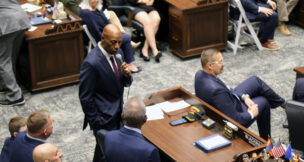
State Rep. Stacey Travers, D-Phoenix, speaks on the floor of the Arizona House of Representatives at the State Capitol in 2023. Travers’ latest bill would provide substantial business protections for franchise owners within Arizona. (Gage Skidmore / Flickr)
Bill aims to safeguard small businesses operating franchise chains
Jakob Thorington Arizona Capitol Times//December 13, 2025//


Key Points:
-
Rep. Stacey Travers introduces measure to regulate franchise agreements
-
Bill aims to protect small-business owners from unfair contract terminations
-
Travers says stronger franchise laws are needed amid rising bankruptcies
A returning bill from 2023 aims to establish regulations to protect small-business owners operating large chain restaurants and businesses as franchisees, but the bill sponsor expects heavy opposition.
Rep. Stacey Travers, D-Phoenix, has introduced a measure for the upcoming legislative session that would establish regulations for the franchisors and franchisees who pay royalties to operate a franchise restaurant or business such as McDonald’s, Subway, Burger King and other companies.
“It’s important that small-business owners know that there’s somebody out there fighting for them against private equity,” Travers said.
House Bill 2038 is a returning measure from 2023, when Travers sponsored an identical bill, HB2404.
The measure would establish several regulations for laws governing franchises. One of the more significant provisions in the bill is that it would prevent franchises from terminating contracts with a business owner if the franchise can’t point to a “good cause” reason for terminating the contract.
The 2023 version of Travers’ bill is one of the few legislative measures sponsored by a Democrat to be heard in a committee. It passed the House Commerce Committee in 2023, but died in the House with no further action after the International Franchise Association lobbied against it and sent a letter to all members of the Legislature calling it the most “far-reaching franchise law of any state.”
“This anti-business legislation is copy and pasted from California law — and taken one step further,” Jeff Hanscom, International Franchise Association vice president for state and local government relations, said in a 2023 news release about the bill.
The franchise association did not return a request for comment from Arizona Capitol Times before the publication’s deadline.
In 2023, the franchise association argued the bill would drop Arizona’s franchise growth from about 2.2% annually to 1%, eliminating about 136 small businesses from opening and halting the creation of about 1,500 jobs in the franchise sector.
Keith Miller, the founder of Franchisee Advocacy Consulting and a franchisee of Subway, said he doesn’t believe stronger protections for franchisees would lead to slower growth in the franchise sector. Instead, he said a bill like HB2038 would incentivize small-business owners to enter into contracts with franchisors.
“Shouldn’t franchisees have due process,” Miller said. “The franchise shouldn’t be the arresting officer, the prosecuting attorney, the judge, the jury and execution are all in one. There should be some guidelines there on termination.”
The 2023 bill received support from several small-business owners operating as franchisees and the Chandler Chamber of Commerce, however the Arizona Lodging and Tourism Association and the Arizona Chamber of Commerce and Industry opposed the measure.
Travers said she believes stronger franchise laws are needed now more than ever with the toll that small-business owners are experiencing under President Donald Trump’s tariff policy.
Business Insider reported on Nov. 7 that the number of small businesses operating under retail chain names including Bed Bath & Beyond, Starbucks, Walgreens and Big Lots, to close in 2025 is higher than the numbers of closures reported both in 2024 and 2023.
“Businesses are failing,” Travers said. “We know that we’ve had a record number of bankruptcies of business and personal bankruptcies in the United States since this administration took office.”
If Travers’ bill goes nowhere in the upcoming session, there could still be national action as lawmakers in Congress are considering the American Franchise Act — House Resolution 5267. Travers is again expecting heavy opposition from the franchise industry, she said.
The bipartisan national measure would clarify the definition of a “joint employer,” which supporters of the legislation say would make it more straightforward when a franchisor can be held liable for labor law violations at a franchisee’s business and would reduce costs for small-business owners by reducing litigation. Under the resolution, franchisors would be considered a joint employer only if they exercise direct control over a business, such as hiring and setting wages.
“Ending the uncertainty around the federal joint employer standard will protect the independence of small businesses and allow the franchise model to create more opportunity in all corners of this country,” said International Franchise Association Chief Advocacy Officer Michael Layman in a Dec. 3 news release. “For lawmakers on both sides of the aisle focused on addressing their constituents’ economic concerns, the American Franchise Act represents an opportunity to make meaningful progress in a bipartisan manner.”