Sign In
 Free Newsletter

René Guillen: From intern to advocate for cities and towns
Jakob Thorington Arizona Capitol Times//December 28, 2025//

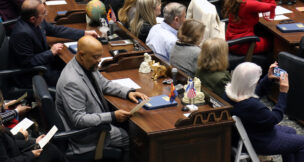
(Jakob Thorington / Arizona Capitol Times)
René Guillen: From intern to advocate for cities and towns
Jakob Thorington Arizona Capitol Times//December 28, 2025//


The League of Arizona Cities and Towns will be wishing its Executive Director Tom Belshe a happy retirement at the end of the year. Belshe’s incoming successor, the league’s Deputy Director René Guillen, recently sat down with the Arizona Capitol Times for a Q&A interview about his upcoming position and his experience in public policy both at the Legislature and in the Arizona Governor’s Office.
The questions and answers have been lightly edited for style and clarity.
Tell me about how you got your start in public policy.
The real start was like many people around the Capitol. I started out as an intern at the Legislature. I was an intern back in 2003. I’m a Wildcat. I’m born and raised in Tucson, and I went to the University of Arizona, where I found out about the legislative internship program. I really didn’t have an interest in politics or public policy and it was frankly more of an opportunity to get out of Tucson. And it was paid, which really wasn’t that common. I was a House majority research intern and my analyst was Todd Sanders, who is now the CEO of the Greater Phoenix Chamber of Commerce. So that shows you we all hang around the Capitol in one way or another.
How valuable would you say your internship was?
It was huge. I am a huge proponent of the legislative internship. At the time, I wanted to be a forensic pathologist, so I wanted to do the judicial internship. Initially, I was disappointed, but once I started the internship, I fell in love with it, and I think it’s a great opportunity. I will admit that I have a bias for any applicant, whether they’re for our internship or any of our positions, if they have experience as a page. There’s nowhere you can go that teaches you the Arizona legislative process — so knowing that process firsthand is really invaluable.
How was it working for Gov. Doug Ducey’s administration?
That was great. I actually left the league to go to the Ducey administration. I really saw that as a great opportunity because I had worked with the Legislature and saw the legislative perspective, but I just knew of others who, like Scott Smith, Doug Cole and Barry Aarons, had gone through the governor’s office and became known as experts in policy and are well-respected around the Capitol. So, I saw it was a tremendous opportunity. It’s hard work, but I think everyone should have that experience if they’re at the Capitol because there’s really no other job like it. I used to warn people who took a job on the Eighth or Ninth Floor that, if they were coming from a legislative background, they would have to run the whole state government all year round. It can be a lot of work, but also it can be very rewarding. I think some of the bonds I forged working those hard hours and working on those hard issues are among my best memories.
What does the executive director of the league do?
When somebody asks me that and they’re within earshot of my wife, she just laughs and she says,“Well how much time do you have?” Outside of the Capitol, most people don’t know what the League of Arizona Cities and Towns is. It’s kind of a weird name and they think something like the Justice League, so we are kind of a niche organization. The executive director for the league wears a lot of hats and here at the league, we sort of have an unofficial slogan that “everybody carries boxes.” We all try to chip in and help where help is needed. I think that one role I see for the executive director is making sure that other staff can be successful. Of course, a big piece of it is that the league is governed by a 25-member executive board, currently composed of 25 mayors. That board needs to know what the league is doing on their behalf, but, let’s be realistic, a big reason for the league’s creation is legislative affairs.
What have been the most significant policy advancements for cities since you’ve been here?
I’ve been around the league for the last 15 years but directly employed by the league for about 10 of those years, so I’ll give you two major ones from each era.
During the legislative director era, I think a great advancement was tax simplification under the Brewer Administration. That was a huge lift. The big piece of that was a desire to move to a point of sale for essentially construction materials, which is an issue. It’s easier said than done. The reason why I think that was a big policy advancement is that because of those discussions, that kicked off a years-long process where the model city tax code, which is the tax code that governs the local TPT sales tax for cities and towns, underwent its most significant revisions in decades. And those revisions were all tied to simplification, which made it easier for the taxpayer.
From the deputy director era, I think, the one I’d have to point to is the Wayfair deal. The taxation of online commerce is a big deal. We have to recognize that businesses that locate in Arizona, specifically in cities and towns, are the ones creating jobs in our cities and towns. The way Arizona and the country had been operating up until then was giving an advantage to online retailers, even though they weren’t having the same effect in our cities and towns. With Wayfair, you finally could give equal footing to the job creators who are actually investing in our local communities, so getting that Wayfair decision at the Supreme Court level was huge.
Now as executive director, what could be a significant accomplishment in that era as we head into the late 2020s?
Maybe I’m an optimist, but I would like to think that we have a lot of opportunity to change the nature of the conversation with the Legislature in restoring local decision-making, particularly restoring local authority with short-term rentals to make sure our folks have the tools they need to go after bad actors in a way that is viable and actually make sure that bad actors aren’t allowed to continue. Maybe looking at density caps or a spacing requirement, it could reduce the proliferation of short-term rentals in certain communities. I’ll be blunt, the loss of residential rental tax was big. For cities that have it, it can be a significant source of revenue, and we seem to be losing revenue options. The state economy is not the economy of Thatcher. It’s not the economy of Wilcox. Many of my members just don’t have the diverse economy that the state as a whole has. Nobody but Phoenix has a TSMC coming their way, right? Having a broad tax base and having a robust tax portfolio is vital for some of these communities.
How would you describe the league’s relationship with the Legislature?
The more things change the more they stay the same. I think one of the challenges we face, whether it’s back then or now, is being viewed as a left-leaning organization by members of the majority. I would argue they say that because they see us opposing their bills. If someone opposes a Republican bill, they must not be a Republican. Therefore, they must be a Democrat, right? Well, I would argue that’s not the case. We are very much a nonpartisan organization. I worked for the House Republican majority research staff. I worked for Ducey, a Republican governor. We have a saying: There are no Republican potholes. There are no Democrat potholes. They’re just potholes. Cities and towns are in the service delivery business. Our issue is that the Legislature is trying to move the decision point from the city and council. That decision point should stay at that local level with the mayor and the council. They live in Jerome, they live in Globe, they live in Superior, they live in Bisbee. They’re the ones running into their residents at church, at the supermarket, and at the local burger shop. They’re the ones who are closer to their residents and connect with them daily. You look at where the majority of the population is and where the majority of tax revenue is generated — it’s in cities and towns. The answer to all those questions is cities and towns. The cities and towns are the economic engines of Arizona, so when they thrive, the state thrives.
Any final thoughts?
When I look at the Legislature and my mayors, and cities and towns, I truly believe the main motivator is that we want what’s best for Arizona. If that’s truly the case, then let’s work together. For my organization, it truly doesn’t matter who’s in control of the Ninth Floor or the House or the Senate, because we’re nonpartisan and ready to work with you. But that means true collaboration. That doesn’t mean that cities and towns should just move out of the way.