Sign In
Upcoming Event
 Free Newsletter

GOP looks to bypass governor’s veto on Florida-style elections
Jakob Thorington Arizona Capitol Times//January 25, 2026//
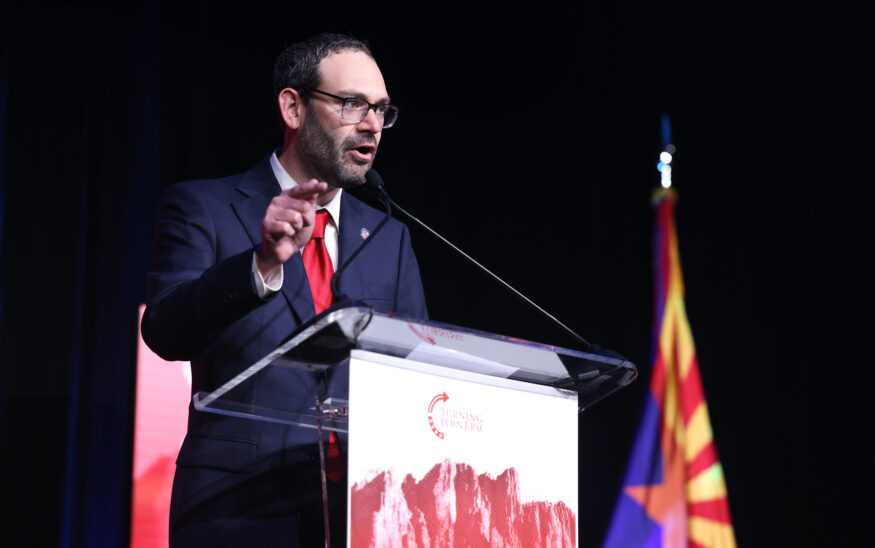
State Rep. Alexander Kolodin, R-Scottsdale, speaking with attendees at a May 2025 campaign rally for Andy Biggs at the Arizona Biltmore in Phoenix, Arizona. (Gage Skidmore / Flickr)
GOP looks to bypass governor’s veto on Florida-style elections
Jakob Thorington Arizona Capitol Times//January 25, 2026//


Key Points:
-
Republican measure would reform Arizona election law after Florida
-
Democrats say it would make it more difficult for some voters
-
Measure would go to the ballot, avoiding a likely veto from the governor
An election measure that would ask Arizona voters if they want Florida-style elections is one step closer to appearing on their ballots.
The House Federalism, Military Affairs and Elections Committee passed House Concurrent Resolution 2001 with a 4-3 vote along party lines on Jan. 21. The GOP measure, titled the “Arizona Secure Elections Act,” is intended to deliver faster Election Day results by changing voter identification and mail-ballot requirements.
“This year, the Arizona state Legislature will give the voters of Arizona the opportunity to transform our elections from a national embarrassment to a national model,” said the measure’s sponsor Rep. Alex Kolodin, R-Scottsdale.
If the resolution passes the Legislature and is approved by voters in November, the deadline to cast an early ballot would move to 7 p.m. on the Friday before Election Day. It would also require all voters to provide government-issued identification before casting their ballot and require mail voters to confirm their address each election year.
Republicans have been pushing for Florida-style election reform for the latter two years of Gov. Katie Hobbs’ term.
Democrats oppose the measure, believing it will lead to disenfranchisement through shorter voting windows for early ballot users, and expressed concern over the automatic removal of voters with unconfirmed addresses.
Currently, the Active Early Voting List removes voters from the list if they fail to vote in two consecutive federal elections. Hobbs vetoed a prior version of the measure in the 2025 legislative session. Now, Republicans have decided to bypass the governor and ask voters directly if their proposal should become law.
“It’s time, in other words, to take this choice out of the hands of politicians and put it in the hands of people who actually deserve to have it,” Kolodin said.
Rep. Aaron Marquez called on Republicans to hear House Bill 2907, a Democratic measure that Secretary of State Adrian Fontes supports dubbed the “Voters First Act” that would make the early voting list permanent and require counties to use voting centers instead of precincts.
Marquez said he was also worried the measure would be too difficult to change as a constitutional amendment if it negatively impacts the state’s elections.
“Why should voters have to wait years to undo the damage,” Marquez said. “This will, and could, eliminate the Active Early Voting List.”
HB2907 also counters the GOP ballot referral by calling to extend early voting to Monday before an election and allowing counties to count and process ballots accidentally returned to the wrong county. That bill is likely dead on arrival with legislative Republicans, and the House Elections Committee chairman Rep. John Gillette, R-Kingman, said he would not commit to hearing it.
Another urgent matter the Legislature is acting on is the state’s primary election, which could make it so military and overseas voters are unable to vote or cause Arizona to be unable to meet federal deadlines in submitting primary election results in the event of a recount.
The committee passed House Bill 2022 on a 5-2 vote. If it sees approval from the governor, then it would permanently move the primary election date from the first week of August to the last week of July to better align Arizona’s election schedule with the Electoral Count Reform Act of 2022.
Hobbs signed a temporary version of this measure in 2024 after strenuous negotiations from lawmakers early that session to pass it and give counties enough time to prepare for the change of the primary election date.
After failing to take on the issue in the 2025 legislative session, lawmakers are in a similar position to 2024. Arizona Association of Counties Executive Director Jen Marson told the Arizona Capitol Times in December that the counties were pushing for the issue to be handled in 2025, but lawmakers waited until this session.
“This is a time-sitive issue because once again, we find ourselves in a position to change the primary date in the year of the primary,” Marson said during the House committee meeting.
In order to be enacted immediately, the bill must pass with its emergency clause that requires two-thirds of support in each chamber and signed by the governor.
“This is exactly the same solution agreed by the counties and the Legislature and the governor for the 2024 cycle made permanent,” Kolodin said. “And it worked in 2024. We didn’t have a disaster. So why don’t we just do what we know works again.”