Sign In
Upcoming Event
 Free Newsletter

Arizona Senate approves renaming Loop 202 after Charlie Kirk
Howard Fischer, Capitol Media Services//February 18, 2026//
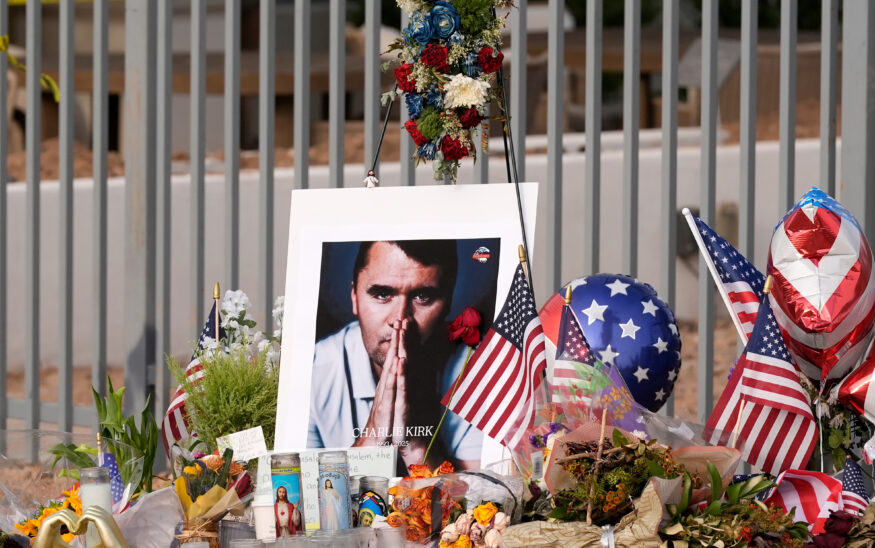
A makeshift memorial grows in size at the Turning Point USA headquarters after the shooting death at a Utah college of Charlie Kirk, the 31-year-old founder and CEO of the organization, Sept. 17, 2025, in Phoenix. (AP Photo/Ross D. Franklin, File)
Arizona Senate approves renaming Loop 202 after Charlie Kirk
Howard Fischer, Capitol Media Services//February 18, 2026//


Key Points:
-
GOP senators want to honor late conservative activist Charlie Kirk with two bills
-
Senate Bill 1010 renames Loop 202 as “Charlie Kirk Loop 202”
-
Lawmakers also propose a bill to create specialized Charlie Kirk license plates
Republican state senators found not just one but two ways to honor the late Charlie Kirk.
And one is crafted to help raise money for Turning Point USA, the organization he co-founded.
On a party-line vote, the Senate approved SB1010 to rename the entire 78-mile Loop 202 around the Phoenix metro area as the “Charlie Kirk Loop 202.” The proposal comes from Senate President Warren Petersen, R-Queen Creek, who said it will ensure that “Arizonans are regularly reminded of the tremendous legacy of this champion of free speech who was assassinated for his stand.”
Moments later, on the same 16-12 margin, the Senate gave its blessing to SB1439. This second separate measure would authorize the state Department of Transportation to create a special license plate that Arizonans could purchase to memorialize Kirk.
Both measures now go to the House. And, if approved there, both would require the signature of Democratic Gov. Katie Hobbs to become law
A spokeswoman for Hobbs declined to comment about her intent.
The votes followed some debate about whether the controversial Kirk, assassinated last year, is worthy of the honor and the maneuver to bypass the normal procedure to name a highway — a procedure that requires someone to have been dead for at least five years.
It starts with the highway.
Sen. Mitzi Epstein read a series of messages she said she got from constituents opposed to honoring Kirk. One read by the Tempe Democrat expressed the view that such honors should be reserved for those who bring communities together and advanced the common good, “not those whose public record is defined by divisive rhetoric and promotion of hatred.”
Green Valley Democratic Sen. Rosanna Gabaldón said the proposal bypasses the normal process — one set up by the Legislature itself — that assigns the task of reviewing name changes to the Arizona State Board on Geographic and Historic Names.
“SB1010 politicizes the state highway naming process,” she said, with the board designed to pursue a process “that’s supposed to be neutral (and) reflective.”
“Our transportation system should unite Arizonans, not be used for political statements,” Gabaldón said.
Sen. Lauren Kuby pointed out that the board policy — the one lawmakers are overriding — is not to name anything after someone until at least five years after they have died. That, said the Tempe Democrat, “both avoids political controversy and allows historical perspective.”
And Sen. Kiana Sears said this whole controversy was avoidable.
The Mesa Democrat pointed out that when the measure was being heard in the Senate Committee on Public Safety she offered a compromise: Call Loop 202 the “Freedom of Speech Highway.” That gained no traction.
Petersen, in a prepared statement after the vote, defended his bill and the decision for lawmakers to create this honor for Kirk.
“He believed Americans could disagree and still engage one another civilly and respectfully,” the Senate president said.
“He encouraged people, especially young people, to get involved in civic life and help shape the future of their communities,” Petersen continued. “Designating Loop 202 ensures his contribution to civic engagement and public participation won’t be forgotten.”
The approval of the license plate bill, SB1439, despite its party-line vote, provoked less debate.
That is not surprising, given the long history of lawmakers of both parties approving a series of requests by various organizations to create special license plates. In fact, there are now more than 100 options from which motorists can choose, from Boy Scouts and promoting organ donations to funding research into Alzheimer’s diseases and funding the Arizona Life Coalition to promote its anti-abortion measure.
Part of the reason for these requests is to visibly promote the cause. But most of it is designed to raise money.
It can be lucrative: ADOT reports the charities that have these plates collected $12 million in 2024.
In this case, as in for all special plates, that starts with the group that seeks to benefit by raising the $32,000 to start the process, including design of the plates. Once that is raised, ADOT adds it to the list of available options — if the vehicle owner pays an extra $25 a year.
Of that fee, $8 goes to ADOT, with the sponsoring organization getting the $17 balance.
There is an interesting quirk with how all that happens: Lawmakers cannot approve a special plate and say in statute that only a particular organization can qualify. Instead, they legally have to craft each measure that — at least on paper — is designed to let any group that qualifies to get the plate and benefit from the sales.
But there are ways around that. The key is in the wording.
So, strictly speaking, there’s nothing in SB1439 that says the money will go to Turning Point USA.
Instead, it says the entity wanting the cash must “educate people through the development of knowledge, skills, values and motivation to engage in communities to restore traditional values, including patriotism and fiscal responsibility and the respect for life, liberty and family.”
But to further ensure that Turning Point — and only Turning Point — qualifies, it adds a requirement to have a grassroots activist network on high school and college campuses in the state and that it assists college students in registering to vote and obtain absentee ballots.
And if that doesn’t narrow it enough, there’s one other condition: The qualifying group must “have been founded in 2012,” which happens to be the year that Turning Point was founded.