Sign In
Upcoming Event
 Free Newsletter

Arizona Republicans push for citizen-only census to redraw legislative districts
Howard Fischer, Capitol Media Services//February 25, 2026//
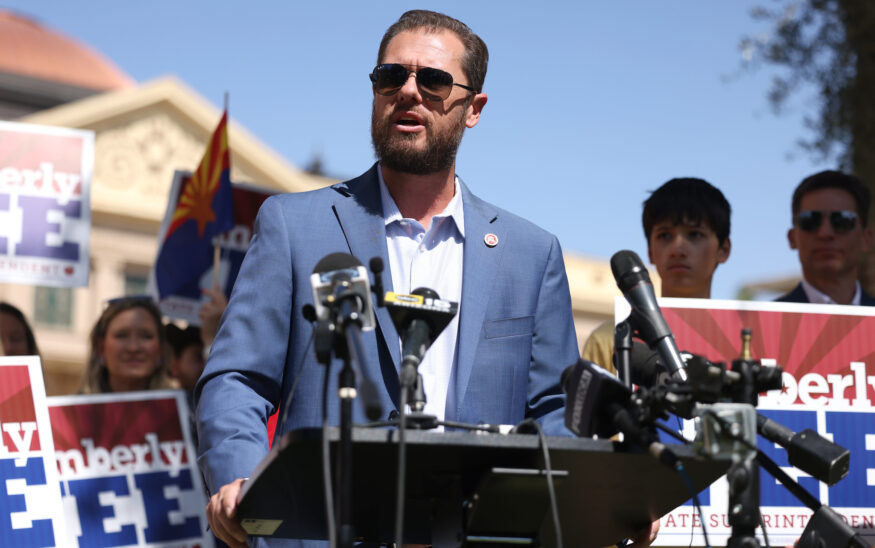
Sen. Jake Hoffman, R-Queen Creek, speaking with the media at a press conference in May 2025. (Gage Skidmore / Flickr)
Arizona Republicans push for citizen-only census to redraw legislative districts
Howard Fischer, Capitol Media Services//February 25, 2026//


Key Points:
- Republican lawmakers propose a citizen-only census in 2030
- The census aims to draw legislative districts favoring Republicans
- The proposed citizen-only census would not affect Arizona’s US House seats
Republican state lawmakers are moving to have the state conduct its own census in 2030 — one that would count only those who are citizens.
And Sen. Jake Hoffman, R-Queen Creek, acknowledged at least part of the reason he is pushing for a citizens-only census is political: He believes it will give Republicans an advantage.
However, several Democratic lawmakers say a second census will only lead to confusion, inaccuracy and fear from families with “mixed status” households. But Hoffman, who pushed the measure through the Republican-controlled Senate on Feb. 24, said it’s a simple matter of accuracy.
Consider, he said, if he went to Los Angeles to see a football game.
“I’m not a citizen, I’m not a resident of California, nor would I ever expect to be counted in their population,” he said.
“Similarly, the 20-plus million illegal aliens who invaded this country … they are also not citizens,” Hoffman continued, saying “they should be deported and sent back.”
Pew Research Center said the number of undocumented immigrants hit a peak of 14 million in 2023, but predicted a decrease in 2025. And the Migration Policy Institute’s own 2023 estimate put the figure at 307,000 for Arizona.
More to the point, his SCR 1031 means their presence would not be taken into account when dividing up the state’s 30 legislative districts.
By law, the Independent Redistricting Committee is legally required to create districts of approximately equal population. And it uses figures from the U.S. Census Bureau’s decennial count.
During his first term, President Trump sought to have a citizenship question included in that count.
But his plan was sidelined when the U.S. Supreme Court concluded that Commerce Secretary Wilbur Ross lied about why he wanted that information.
So the census was conducted without the question. And both congressional and legislative lines were drawn with the full population, citizen, permanent resident or undocumented — or at least what the agency reported.
Nothing in Hoffman’s measure would affect how many more seats Arizona gets in the U.S. House, with that still determined by official Census Bureau numbers. There are currently nine representatives from the state — preliminary estimates say the state will pick up at least one more after 2030.
But what a citizen-only count would do is affect how the 30 legislative districts in Arizona — a number set in the Arizona Constitution — are drawn. Put simply, it would mean that areas with a large population of non-citizens — whether here legally or not — would lose population, requiring them to be redrawn to be geographically larger to take in more residents.
And that would make the remaining districts, those composed largely of citizens, geographically smaller. That, Hoffman concluded, would mean more Republicans in office.
The GOP does have an edge in both chambers, but their margins are not large, with 17 of 30 senators being Republicans; and 32 of 60 members of the House belonging to the party.
Those margins, however, have been narrower in the past. In fact, Democrats controlled the Senate for two years in the 1990s, and a subsequent Senate was split 15-15 in the 2000 election.
The House, by contrast, has not been run by Democrats since 1964.
Hoffman said it’s no surprise that Democrats oppose his plan.
“They like when illegal aliens are included for the purpose of apportionment,” he said. “It gives them undue representation that they are otherwise not owed if we were only counting U.S. citizens.”
But Senate Minority Leader Priya Sundareshan said it is the Republicans who are playing politics.
The Tucson Democrat said the Census Bureau already is doing the work.
“I can’t believe we want to waste millions of dollars in this state just so you can have your own count that’s separate from that already conducted by the federal government so that you can draw legislative districts differently and stack them the way you’d want,” she said, with one estimate putting the price tag at $50 million.
Sen. Analise Ortiz said there’s a more practical problem: accuracy.
The Phoenix Democrat said that when the U.S. Census Bureau was considering adding a citizenship question to the 2020 census, a report found that it would have decreased overall voluntary self-response by 2% — and by 8% among mixed-status families. Doing that in Arizona, Ortiz said, means the citizens in those households are going to be undercounted “out of fear.”
“This is nothing more than a Republican driven and funded door-to-door ‘show me your papers’ campaign,” she said.
And that’s not her only concern.
“This language would allow the Legislature to designate “any untrained, unqualified person to go door-to-door, demanding proof that someone is a citizen,” Ortiz said. “What could go wrong?”
Hoffman’s measure is crafted so it cannot be vetoed by Gov. Katie Hobbs, who, less than a week ago, quashed another GOP measure requiring hospitals that accept Medicaid payments to ask patients for their immigration status. Instead, HCR 2031 would go on the November ballot if it is approved by the Republican-controlled House where it now goes.