Sign In
 Free Newsletter

Arizona’s top election official challenges federal bid for voter registration data
Howard Fischer, Capitol Media Services//March 2, 2026//
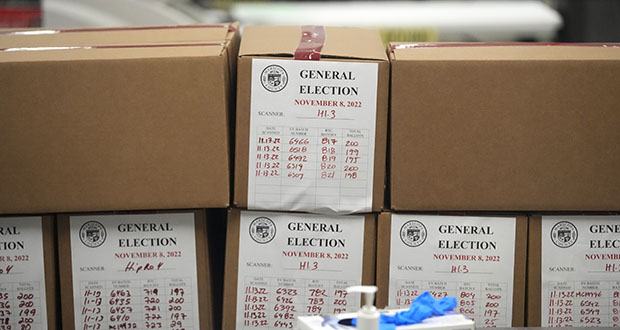
Ballots from the general election are boxed up at the Maricopa County Recorder's Office in Phoenix on Nov. 14, 2022. (AP Photo/Ross D. Franklin)
Arizona’s top election official challenges federal bid for voter registration data
Howard Fischer, Capitol Media Services//March 2, 2026//


Key Points:
-
Secretary of State Adrian Fontes wants a federal judge to throw out efforts by the Trump administration to force him to turn over voter registration and election records
-
Fontes says much of the information demanded by the Department of Justice is protected by state privacy laws
-
He also argues that the federal government hasn’t appropriately justified the reason behind the demand
Saying the demand is illegal, Secretary of State Adrian Fontes wants a federal judge to throw out efforts by the Trump administration to force him to turn over voter registration and election records.
In a new court filing, Fontes argued that while some of what is in those records is already public, things like names, addresses, and party affiliation, other information demanded by the Department of Justice is protected under state privacy law. That includes any part of a voter’s social security number, driver’s license number, mother’s maiden name, the state or county of birth, an email address or signature.
And that’s just for ordinary residents. He said there is an entirely separate and more comprehensive law covering those in the state’s confidentiality program — people like prosecutors and judges — who have obtained a court order shielding anything in the records, like their home address, from public view.
But even if that were not the case, Fontes believes there’s no basis for the demand.
He said Harmeet Dhillon, the assistant attorney general of the agency’s civil rights division, is claiming she is entitled to the records to see if Arizona is complying with the 1960 Civil Rights Act. That law is designed to prevent race discrimination in voting.
The caveat, Fontes said, is that Dhillon has never explained how the records would help the Department of Justice investigate civil rights violations. In fact, in a lawsuit filed last month in federal court, she claimed her agency needs the information to monitor adherence to federal law that requires state officials to conduct “list maintenance” to keep voter registration records current and accurate.
And Attorney General Pam Bondi, in a prepared statement when she sued Arizona, said these legal actions are necessary “to protect American elections.”
In his new filing, however, Fontes claimed the real goal is a national and centralized database on millions of Americans for the sake of immigration screening the voter rolls.
He’s not the only one questioning what’s behind the actions of the Department of Justice.
Last month, a federal judge in California threw out a similar bid to get that state’s voter database, calling the claim by the agency of why it needed it “lacking in depth” and “contrived.”
“If the DOJ wants to instead use (the) statutes for more than their stated purpose, circumventing the authority granted to them by Congress, it cannot do so under the guise of pretextual investigative purpose,” wrote the judge handling that case.
Now, Fontes wants U.S. District Court Judge Susan Brnovich, who is hearing Dhillon’s demand on Fontes, to reach a similar conclusion and dismiss the case.
The challenge follows years of President Trump arguing, since losing his first reelection bid in 2020, that American elections are rampant with cheating and fraud. The president even used a social media post last year to publicly pressure Bondi to investigate.
Importantly, Fontes said that even if the Department of Justice had a legal basis to demand the voter registration records to find people who are not citizens — and he is not conceding that it does — what’s in those records won’t help.
“As this court is surely aware, for more than 20 years, Arizona has required that a voter registration application for one registering to vote for the first time or re-registering when moving from one Arizona county to another be accompanied by ‘satisfactory’ evidence of United States citizenship,” he told U.S. District Court Judge Susan Brnovich, who is hearing the case.
And a more recent state law, Fontes said, requires county officials who do not get such proof to check federal databases for evidence of citizenship.
“Simply put, any person who makes it onto Arizona’s voter rolls has already demonstrated United States citizenship,” he said. “Accordingly, if the purpose for plaintiff’s demand is to find noncitizens on Arizona’s voter rolls, the state has already done that and access to Arizona’s voter record database will not further plaintiff’s purpose.”
Fontes told Capitol Media Services that none of that is undermined by the fact that it actually is possible for those who don’t provide things like a birth certificate or other documents to register to vote.
That’s because they are entitled under federal law to sign up by signing a form designed by the federal Election Assistance Commission. And that form includes a sworn affidavit, under penalty of perjury, that they meet all the legal requirements to vote, including being citizens.
They can, however, vote only in federal elections.
Fontes said that specific federal law means their signature on the affidavit provides all the proof of citizenship needed to vote.
The legality of that also was affirmed in 2024 when U.S. District Court Judge Susan Bolton heard arguments by those who said that it is illegal for these “federal only” voters to cast ballots in presidential races.
Challengers pointed out that Donald Trump lost to Joe Biden by 10,457 votes in Arizona. And at the time there were about 21,000 Arizonans who registered using the federally designed form.
All that, they argued, means those federal only voters could have affected the election, though no proof was provided that those using the federal form were not citizens.
Bolton rejected arguments that Arizona can keep those who sign up using that federal form from voting in the presidential race.
“The plain language of the National Voter Registration Act reflects an intent to regulate all elections for federal offices, including for president or vice president,” she wrote. “And binding precedent indicates that Congress has the power to control registration for presidential elections.”
Her ruling was upheld by the 9th Circuit Court of Appeals.
There are currently more than 44,600 of these federal only voters.
Election officials have said most of these appear to be from people who do not have easy access to birth certificates, like students going to college in Arizona and military voters who are overseas.