Sign In
Upcoming Event
 Free Newsletter

Va.’s data center boom shows how hard it is for lawmakers to rein in industry
Humberto Sanchez, Pluribus News//March 12, 2026//

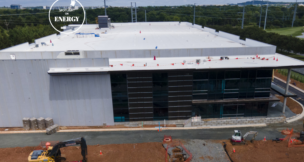
A data center is under construction in Ashburn, Virginia, on July 16, 2023. (AP Photo/Ted Shaffrey)
Va.’s data center boom shows how hard it is for lawmakers to rein in industry
Humberto Sanchez, Pluribus News//March 12, 2026//


EDITOR’S NOTE: This story is part of a special State Affairs series highlighting energy policy dominating state legislative action this year. See the full list of stories here.
Virginia is illustrating for data center critics in other states how difficult it is to build enough political support to impose restraints on an established industry.
Its northern exurbs outside of Washington, D.C., are home to more than 250 data centers, which handle roughly 70% of global internet traffic, according to the Northern Virginia Regional Commission. That constitutes the world’s highest concentration of data centers.
While the industry touts its record of job creation and economic investment, Sen. Danica Roem and other Democratic lawmakers concerned about the energy, environmental and other ramifications of further spread have drafted legislative proposals to curb the industry’s growth.
But the chances of substantive legislation passing dimmed due to the industry’s intense opposition, said Chris Miller, president of the Piedmont Environmental Council, a Virginia-based conservation group.
“Essentially, the leadership of the Democratic Party does not want to move forward with meaningful reform,” Miller said
The data center industry in Virginia launched in the late 1990s when Dulles-based internet access pioneer America Online built a facility nearby to support its business. Since then, many state lawmakers and environmental groups say the data center industry has grown rapidly with few, if any, guardrails.
They say the massive facilities are being built in neighborhoods, put upward pressure on electricity rates, threaten grid reliability and the environment, are loud and unsightly, and receive tax benefits that subsidize the richest companies that have ever existed, including Amazon, Meta and Microsoft.
“Go talk to my constituents who have been on the front line of having to fight for reforms in this industry that promises the Earth, moon, wind and stars,” said Roem, who is at the vanguard of industry pushback.
“Then when the time comes, you find out we have now put such enormous pressure on our electrical grid that … the [state] Joint Legislative Audit Review Commission has determined that if we continue the path that we’re on, we’re going to overload the grid. They are uniquely responsible for that, more so than any other industry, by magnitudes.”
With the Legislature scheduled to adjourn Saturday, the Senate budget may provide one of the best chances for passage of significant data center legislation. It includes a provision to repeal the sales and use tax exemption for data centers. Such breaks cost the state $1.6 billion in 2026, according to a recent state report.
But the House budget has no such provision. Democratic House Speaker Don Scott has signaled reluctance to backing a subsidy repeal, which has become a sticking point as budget negotiations enter their final hours.
Roem, whose Prince William County district includes Bull Run, the site of two historic Civil War battles, supports repeal of the sales and use tax exemption for data centers. She finds it galling that the state is providing more than $1 billion to wealthy tech companies. She also said the data center industry has not been a good neighbor, seeking to use its financial might to try to crush any pushback from her constituents.
At least 36 other states have sales and use tax exemptions for data centers — meaning they hope to attract the tax revenue and jobs associated with the industry. And other Virginia localities are interested in attracting the industry beyond what’s known as Data Center Alley in Northern Virginia.
Projects have been announced in other Virginia localities, including Chesterfield County, Caroline County, Louisa County, Wythe County, Botetourt County, Wise County and the City of Petersburg, according to Nicole Riley, director of Virginia government affairs for the Data Center Coalition, an industry trade group.
“In communities across Virginia and around the country, the data center industry is creating hundreds of thousands of high-wage jobs, providing billions of dollars in economic investment, and generating significant local, state, and federal tax revenue that helps fund schools, transportation, public safety, tax relief for residents and small businesses, and other community priorities,” Riley said.
Del. Josh Thomas, a Democrat who represents a district in Prince William County, introduced legislation this year requiring new projects for large energy users — at least 100 megawatts — to assess the effects of noise levels on homes and schools within 500 feet of their property boundary. The bill, which was vetoed last year by former Republican Gov. Glenn Youngkin, was approved by the House and was advancing this week in the Senate. Democratic Gov. Abigail Spanberger hasn’t said if she supports the measure.
“Virginia has been ground zero for the data center industry,” Thomas said in an interview.
“I’m not sure anyone’s gotten it right, because the industry … wants to move forward in an unregulated fashion and enjoy their time under the sun,” Thomas said. “But it just creates so many problems for the average working man and woman.”
Data centers are specialized buildings that house information technology infrastructure, such as servers, storage and networking gear to process, store and distribute massive amounts of data. They require large amounts of power and water, as much as a city and hundreds of thousands of gallons of water, depending on the size of the facility.
The facilities operate around the clock to support internet operations, including financial transactions, health care applications and artificial intelligence development, which are particularly energy-intensive.
Thomas said he recommends that state and local officials seeking to court data center sites place them in industrial areas, away from neighborhoods. States need to consider where the electricity to power the facilities will come from, which can include options such as requiring the project to build its own power generation source.
He also said states should put in place policies to protect ratepayers, which could include imposing higher electricity rates for an extended period, known as a large load tariff.
“You need to think about how you’re going to protect your ratepayers from paying for the capital outlay necessary to get the grid in a position to support the immense amount of energy that data centers need, and water as well,” Thomas said. “I would counsel any state thinking about that to go ahead and put legislation in ahead of time that makes it very clear that the data centers pay their fair share for grid enhancement, power plant completion, and then water resources.”
Thomas introduced legislation to provide more state oversight of siting, but the bill did not advance out of committee.
Miller said the problem is so large that lawmakers are having trouble understanding it and its consequences. He said data centers will require about 70 gigawatts in Virginia by 2045, about three times the current peak demand in the state. That’s also roughly equivalent to the electricity usage of Germany or France.
“The ability of decision makers and the public to absorb that information is really testing the limits,” Miller said, “because there’s no precedent.”
Read more:
Lawmakers seek solutions to rising electricity rates
Pro-coal legislation picks up in push to meet growing energy needs
Data center growth threatens state climate goals
Electricity demand spurs states to find a way to meet the moment