Sign In


Upcoming Event
 Free Newsletter

Advanced air mobility could soon take flight in Arizona
Jordan Gerard, Arizona Capitol Times//March 13, 2026//
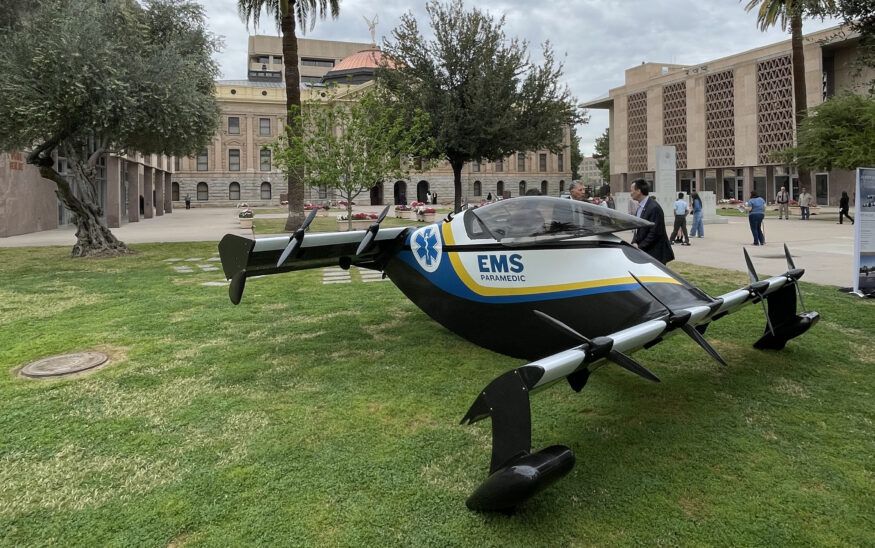
Pivotal’s Helix model was on display at the Capitol on March 10. The aircraft is an electric vertical take-off and landing vehicle designed for fire and medical emergency services. (Jordan Gerard / Arizona Capitol Times)
Advanced air mobility could soon take flight in Arizona
Jordan Gerard, Arizona Capitol Times//March 13, 2026//


Key Points:
-
Sen. David Farnsworth filed four bills that would get Arizona ready for new flying vehicles
-
The vehicles were on display at the Arizona Capitol on March 10
-
Opponents say tax dollars could be better spent on other things
The future of transportation is approaching Arizona and one senator is making sure the Grand Canyon State will be flight ready when it arrives — vertically, that is.
Capitol goers might have seen the new aircraft displayed on the Senate lawn on March 10. No, it wasn’t a helicopter, and it’s not quite a flying car either.
It was a light electric vertical take off and landing vehicle (eVTOL), designed and built by Palo Alto-based advanced air mobility company Pivotal. It was their Helix model, a tilt aircraft with fixed rotors and tandem wings. One day, it could serve on emergency medical missions, search and rescue, wildfire fighting and border defense in Arizona.
Sen. David Farnsworth, R-Mesa, is the pilot behind the idea of getting Arizona ready for advanced air mobility. He has worked on a few pieces of legislation in the past, and this year, has several bills that address new air capabilities.
“Air mobility is coming. It’s already here, and they’re talking about California, Florida, Texas,” he said in an interview. “We want them to come to Arizona.”
Pivotal already has 55 certified pilots in several states — including its own CEO. Its Helix models cost approximately $190,000 and up, according to their website. The company designs, builds and tests its aircraft with aerospace-grade materials fully engineered and manufactured in the U.S.
The aircraft attracted quite a few onlookers, including some excited Senate pages who got to sit in the pilot’s seat. Sen. Hildy Angius, R-Bullhead City, was impressed, saying, “We’ve been hearing about flying cars for a very long time, and now they’re around the corner.”
While we aren’t likely to see droves of eVTOLs buzzing around the skies immediately, it’s not beyond the realm of possibility that they’ll be used for emergencies. In fact, Pivotal is partnering with Hyde County Emergency Services in North Carolina to train their volunteer first responders to fly the aircraft to emergencies. An ambulance will still follow, but the goal is to help people faster, CEO Ken Karklin said in an interview.
Farnsworth is hoping Arizona could see similar uses, especially given Phoenix’s vast traffic network and congested roads. Alternatively, the vehicles could be used for carrying equipment for firefighters when they’re battling wildfires, or used on search and rescue missions for locating missing hikers in remote areas of Arizona’s rugged landscape.
“We need to address those challenges as soon as possible, but responsible leadership also means preparing what transportation will look like tomorrow,” he said. “If we only focus on the present, we’ll be reactive instead of acting or leading.”
Perhaps the two biggest questions around the possibility of flying transportation are necessity and safety. Addressing necessity, Farnsworth acknowledged there are some naysayers who make fun and think he’s focusing on the wrong thing, but he’s not shy of a challenge.
“I intend to hold my ground and continue to be passionate, not unaware of the pressing issues,” he said. “Of course, the current transportation infrastructure is my number one priority.”
Not everyone is hopping on board though. Sen. Mitzi Epstein, D-Tempe, explained her vote against SB1549, a measure defining “ultralight vehicle” and modifying the definition of advanced air mobility to include an ultralight vehicle, on March 9 during the third reading, saying that, while a flying car could be cool, she didn’t think taxpayers should foot the bill.
“With bills like this, the Legislature is contemplating an exciting future, including zippy cars that fly through the air. Jetsons, here we come,” she said. “But do the hard paying taxpayers of Arizona have to help pay for these things? No. They do not. The taxpayers have a very long list of other priorities that are more important and better uses of their money.”
She applauds people who want to use their private dollars to invest in ultralight vehicles and advance the research on them, but said public dollars have a lot of better uses. She voted no on the bill.
Back to the second concern of safety, Pivotal CEO Ken Karklin said it’s as safe as any aircraft, though flying is probably never a zero risk proposition and gravity always gets a vote.
“Our number one value and behavior is safety. And the filter for that is make decisions as though a loved one were aboard every single flight,” he said.
Farnsworth also wants to be proactive about making sure monopolies don’t form over the burgeoning industry. The effort has to be a balanced partnership between government and the private sector, he said.
“I am hoping and expecting that advanced air mobility at some point can be economical enough that it’ll actually compete with the other forms of transportation,” he said. “So although I don’t see the future clearly, I see the future with enthusiasm and with belief.”
Legislatively, Arizona is preparing for new flight
This year, four of Farnsworth’s bills address a new kind of flight.
Senate Bill 1024 would establish registration requirements for “roadable aircraft” that can also operate like motor vehicles and are manufactured to meet the federal safety standards for motorcycles.
Each registered flying vehicle would need an N-number, which would be included in the registration. An N-number is specific to each civil aircraft and is usually found near the tail; it’s required by international convention.
The bill would also require both aircraft and vehicle registration, except when the vehicle is subject to an annual license tax or if the vehicle registration is cancelled.
A motorcycle-sized license plate would be issued to the roadable aircraft. As for licenses, roadable aircraft fall under Class D, a standard, non-commercial license. A driver would not need a motorcycle license to operate the roadable aircraft, according to the bill.
The bill passed the Senate and flew over to the House for consideration. Arizona wouldn’t be a solo flyer if it passed the legislation. New Hampshire and Minnesota recently passed similar measures, dubbed “Jetsons Laws,” according to Flying Magazine.
Senate Bill 1549 defines “ultralight vehicle” and modifies the definition of advanced air mobility to include an ultralight vehicle. It joins SB1024 in the House for consideration.
Senate Bill 1819 requires each public vertiport or electric aircraft charging station and any separate infrastructure project for advanced air mobility to open for public bid with no preference given to existing public vertiport owners or operators.
This bill also specifies that a political subdivision may establish the location of public and private vertiports and electric aircraft charging stations and the infrastructure needs of advanced air mobility after approval of the vertiport layout plan by the Federal Aviation Administration.
The bill passed the Senate Appropriations, Transportation and Technology Committee, which Farnsworth chairs, but it has not been heard in Committee of the Whole nor third reading yet.
Senate Bill 1827 establishes the Office of Advanced Air Mobility and outlines related requirements. It also appropriates $500,000 from the Advanced Air Mobility Fund in Fiscal Year 2027 to the office to grant to entities for the advancement of advanced air mobility in Arizona.
It would also allow the office to act as a liaison between the state, FAA and aviation organizations, including federal and state agencies and industries that support advanced air mobility and identify and pursue, as appropriate, opportunities to increase advanced air mobility in Arizona.
Among other requirements, if passed, the Office of Advanced Air Mobility would also support Arizona-based companies that seek to expand advanced air mobility in the state and implement a strategic plan to enhance the state’s competitiveness in advanced air mobility. Another piece of the bill would encourage collaboration with the Arizona Board of Regents, universities and research institutions that would increase funding for research and development.
The bill passed in the Senate on a third reading and now goes to the House for consideration.