Sign In
 Free Newsletter

Appeals court rejects GOP bid to overturn Biden national monument order
Howard Fischer, Capitol Media Services//April 2, 2026//
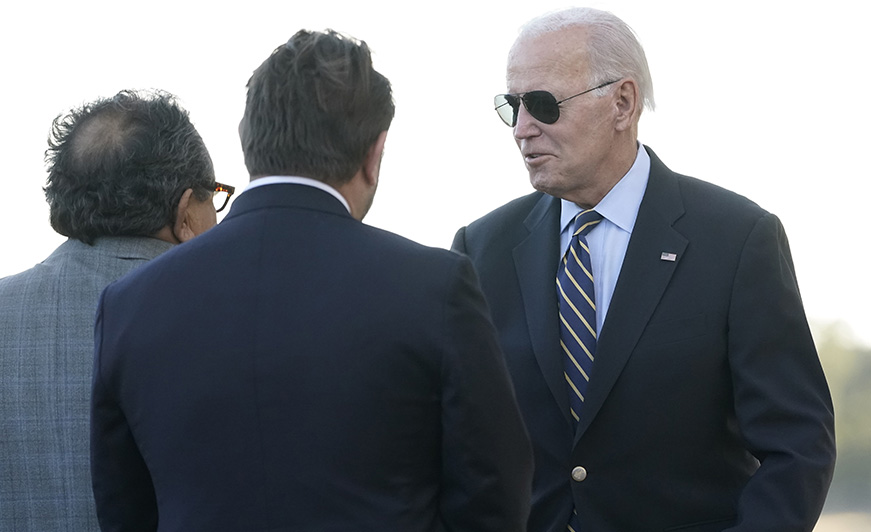
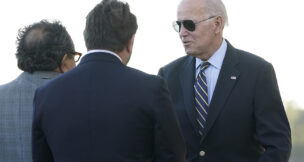
President Joe Biden greets U.S. Rep. Ruben Gallego, D-Phoenix, and late U.S. Rep. Raul Grijalva as he arrives on Air Force One at Grand Canyon National Park Airport on Aug. 7, 2023, in Grand Canyon Village, Ariz. (AP Photo/Alex Brandon)
Appeals court rejects GOP bid to overturn Biden national monument order
Howard Fischer, Capitol Media Services//April 2, 2026//


Key Points:
-
Federal appeals court says Republican leaders have no standing to sue
-
Lawsuit claims national monument designation will hurt state economically
-
GOP could ask President Trump to intervene
A federal appeals court has tossed out a bid by Republican state lawmakers to overturn the designation of nearly a million acres of federal land near the Grand Canyon that the Biden administration had dedicated as a national monument.
In a new ruling April 1, the three judge panel concluded GOP legislative leaders lack the legal standing to even bring a claim in federal court over creation in 2023 of the Baaj Nwaavjo I’tah Kukveni Ancestral Footprints of the Grand Canyon National Monument. Ditto, they said, of Republican state Treasurer Kimberly Yee.
That’s right, they said, it belongs to Democratic Attorney General Kris Mayes.
She – along with Gov. Katie Hobbs, also a Democrat – actually intervened in the case against the challengers and in support of then-President Joe Biden’s designation. That, said the court, leaves no one with the right to sue.
“Neither the legislature nor the treasurer points to any law designating them as agents to represent the state, so neither has standing to assert the state’s injury,” they wrote in the unsigned opinion.
And even if they had the right to sue, the judges wrote, their claims would fail, with any claims about damages to legislative interests being speculative at best.
This case stems from a 2024 lawsuit filed by the Republicans last year who called Biden’s actions an illegal “land grab.”
In their lawsuit, the challenges acknowledged that the 1906 federal Antiquities Act does allow a president to set aside parcels of federal land – which is solely what is involved here – for protection.
But they say such a proclamation has to be limited to historic landmarks, historic and prehistoric structures and other objects of historic or scientific interest. More to the point, they argue that such designations must be confined to the “smallest area compatible” with the care and management of the items to be protected.
And they contend the Baaj Nwaavjo I’tah Kukveni Ancestral Footprints of the Grand Canyon National Monument – the formal name for 1,462 square miles of the site which the White House says translates in part in the Havasupai language to “where indigenous peoples roam” and in Hopi to “our ancestral footprints” – meets neither requirement.
“Congress passed the Antiquities Act to protect just that: antiquities,” the lawsuit says. “It did not pass the law to allow the Biden administration to declare every inch of federal land a federal forest, cut off from all but those it selects.”
They also argued that there is damage to the state from everything from the inability to manage adjacent state trust lands to the loss of jobs and revenue because the monument designation would reduce the value of nearby state lands, depriving the state of tax revenues it could collect from companies that would develop those properties.
The appellate judges were unimpressed.
“Contrary to the legislature’s assertion, the proclamation does not strip the legislature of any of its powers,” they wrote. “The legislature may continue to manage and dispose of state land as it sees fit.”
The court also rejected parallel arguments made by Mohave County, Colorado City and the town of Fredonia.
The local governments did not dispute that no new uranium mining has been allowed in the area since at least 2012 when the secretary of interior withdrew pretty much the same federal lands from mining through 2032 – if not beyond – a decision that a different federal judge upheld.
But they argued that designating the monument takes future mining off the table, something they claim would result in lost revenues.
“Their alleged loss of future tax revenues depends on uranium prices being sufficiently high in 2032 (or whenever the 2012 withdrawal lapses) such that third-party companies would choose to begin mining,” the appellate judges wrote.
“But it is speculative whether the right economic conditions and incentives for uranium mining will exist so far into the future,” they said. And that, the judges said, makes the allegations only a “possible future injury” which does not provide standing for the communities to sue.
The court also rejected a separate argument by Colorado City that the monument’s designation threatens its water supply because some of its water comes from an aquifer under the monument, a claim the city said could lead federal officials to restrict its water supply in the future.
“The proclamation by its plain terms does not ‘alter the valid existing water rights of any party, including the United States,’ ” the court noted. “And there is no other reason to speculate that the federal government will reduce Colorado City’s water supply.”
“The House is currently reviewing the ruling,” said House GOP spokesman Andrew Wilder.
There is potentially another avenue for GOP lawmakers and others to pursue: seek intervention by President Trump.
The president, in his first term in office, announced he was cutting the size of the Grand Staircase-Escalante National Monument in Utah in half. And he also trimmed the Bears Ears National Monument by 85%.
Those cuts were restored when Biden took office in 2021.
The state of Utah and others challenged that move, saying the Biden administration exceeded its authority by creating a vast, multi-million-acre reserve rather than limiting it to the smallest compatible area. But that lawsuit was dismissed by a federal judge there, though the case remains on appeal.
Less clear – and yet to be fully litigated – is whether Trump or any other subsequent president has the power to modify or revoke the decision of a predecessor to designate a specific area as a national monument.