Please ensure Javascript is enabled for purposes of website accessibility

When oversight becomes a campaign strategy in Arizona utility regulation

Nick Myers

Arizona’s Constitution is clear. The Arizona Corporation Commission was designed to operate as an independent, elected body with exclusive authority over utility ratemaking. That independence exists to ensure decisions affecting millions of ratepayers are made through evidence, due process, and transparency, rather than political pressure.

That balance is increasingly being tested.

Over the past year, Attorney General Kris Mayes has repeatedly used her office to challenge actions of the commission in a pattern that raises serious concerns about the use of legal authority as a political tool for lawfare rather than a measured exercise of oversight.

Consider the breadth of recent actions.

The attorney general challenged the commission’s approval of an Annual Rate Adjustment Mechanism for UNS Gas, targeting a ratemaking tool that falls squarely within the commission’s constitutional authority under Article 15 of the Arizona Constitution. 

Disagreements over rate design are not unusual but elevating them into legal challenges aimed at overturning commission authority is something different entirely.

The same pattern appears in the challenge to Tucson Electric Power’s energy service agreement tied to a major data center project. That agreement was structured specifically to ensure that the data center pays its own costs rather than shifting burdens to existing customers. Yet the attorney general sought to invalidate the decision, despite the consumer protections embedded within it.

At the same time, the attorney general has taken aggressive positions in Arizona Public Service and Tucson Electric Power matters more broadly, intervening in ways that go beyond traditional legal participation and into sustained public opposition to commission proceedings.

From litigation over the repeal of the Renewable Energy Standard and Tariff rules to repeated challenges across multiple utility proceedings, the attorney general has demonstrated a willingness to escalate nearly every major commission decision into a legal or public dispute.

That is where her actions become more concerning.

Arizona law is explicit that public resources and authority may not be used for campaign purposes. Under A.R.S. § 41-752, public resources cannot be used to influence the outcomes of elections, and A.R.S. § 41-193(A)(2) defines the attorney general’s role as providing legal services to the state, not advancing political objectives. Additionally, Arizona’s conflict of interest and public office statutes reinforce that public power must be exercised for public purposes, not personal or political gain.

No one is suggesting that the attorney general should remain silent. Legal challenges, when grounded in clear violations of law, are appropriate.

But a pattern of selective, high-profile litigation combined with public messaging that mirrors campaign rhetoric raises legitimate questions about whether that line is being crossed. There is little doubt the lawsuits amount to lawfare, not advocacy for consumers or utilities. 

This concern is heightened by the fact that the attorney general previously served as a member of the Arizona Corporation Commission and understands firsthand the constitutional boundaries of ratemaking authority. That experience makes the repeated challenges to that authority all the more difficult to reconcile.

The consequences are real.

When nearly every major decision is met with legal challenge, regulatory certainty erodes. Investment decisions become more difficult. Infrastructure projects face delays. Arizona’s reputation for stability is weakened. Ultimately, those impacts are borne by ratepayers.

Equally concerning is how these actions are communicated.

Complex regulatory decisions are reduced to simplified, often alarmist claims. Nuanced policy debates are reframed as clear-cut wrongdoing. That approach may generate headlines, but it does not improve outcomes for Arizona families or businesses.

Arizona’s system was designed to balance independence with accountability. That balance depends on each constitutional office respecting its role.

If the line between lawful oversight and political use of office is being blurred, that is not a question that should be left to speculation. It is appropriate for the relevant ethics authorities or oversight bodies to review whether the powers of the office are being exercised consistently with Arizona law and longstanding principles of good governance.

The Corporation Commission must continue to make decisions based on the record and the law. The attorney general must ensure those decisions comply with the law, not relitigate policy disagreements through repeated public challenges.

Oversight is essential. But when it becomes constant, highly public, and indistinguishable from political positioning, it erodes public trust. It ceases to be oversight.

It becomes overreach.

Nick Myers is chairman of the Arizona Corporation Commission.
An embattled I-11: Lawmaker pushes for expedited freeway construction amid environmental challenge

Key Points:
  • Arizona lawmaker Rep. Matt Gress proposes segmenting Interstate 11 construction
  • Gress aims to expedite studies halted due to environmental concerns litigation
  • Opponents argue the project promotes urban sprawl and harms the Sonoran desert

A Phoenix Republican lawmaker is trying to jump start the construction of a controversial stretch of the proposed Interstate 11.

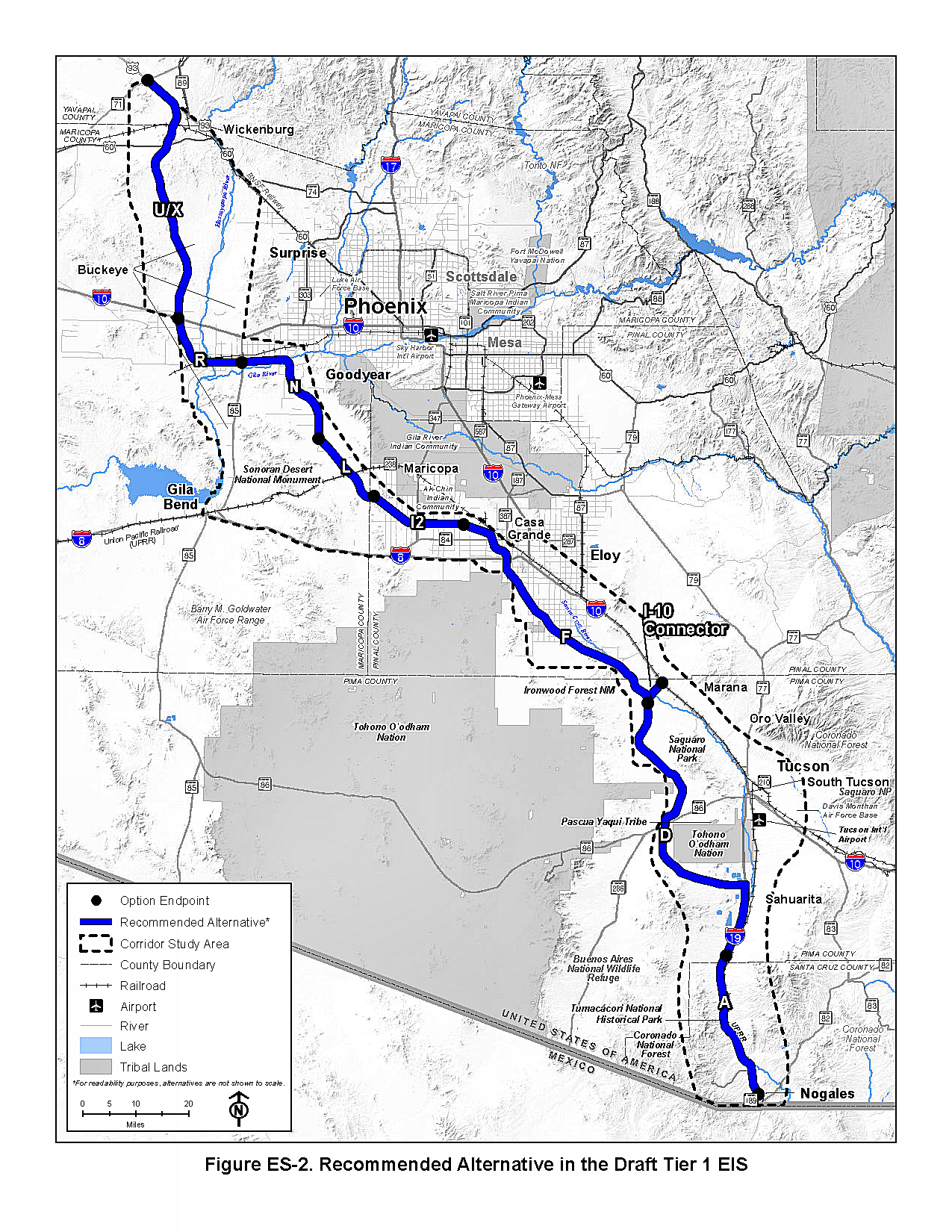
The proposed alignment of the I-11. including the alternative that takes it around the west side of Tucson. (Courtesy of the Arizona Department of Transportation)

The proposal by Rep. Matt Gress, R-Phoenix, would direct the Arizona Department of Transportation to ask the Federal Highway Administration to consider a stretch between Casa Grande and Wickenburg for separate approval from the main project. That, Gress claims, would expedite the necessary studies that have been halted over litigation over whether state and federal highway officials ignored environmental concerns when they mapped out a route for the segment between Casa Grande and Nogales.

But Gress is running into opposition from those who question both his tactics and the need for a new interstate highway. 

“This is a very expensive proposition,” said Sen. Mitzi Epstein, D-Tempe.
The current estimated price tag for building the proposed stretch of road from Nogales to Wickenburg runs anywhere between $3.1 billion and $7.3 billion.

And it’s not just initial costs, said the Tempe Democrat, but ongoing maintenance. Even if federal officials picked up 90% of the construction costs — what has been the practice in the past — the state is still expected to maintain the road.

“We don’t take care of the freeways and the roadways we have now,” she said.

Sen. Brian Fernandez of Yuma agreed. He pointed out that lawmakers have not raised the state’s 18-cent-a-gallon gasoline tax — the primary source of dollars into the Highway User Revenue Fund that pays for road repairs — since 1990.

Fernandez further added that the roads outside Maricopa County, where voters have approved a local sales tax for transportation projects, “vary in degrees from decent to really, really terrible.”

And it’s not just Democrats raising questions.

“We can’t keep up our own roads,” said Sen. Vince Leach, R-Tucson. Beyond construction and even maintenance costs, he said the state remains on the financial hook to build the connections between the freeway and existing roads.

Despite the objections, Gress’s proposal made it out of the Senate Committee on Appropriations, Transportation and Technology on a 6-4 party line vote.

But even with committee approval the future of the plan remains in doubt. Even Sen. David Farnsworth, who chairs the committee and voted for the bill, said he is unsure whether he will support it when it reaches the full Senate.

“We have a lot of other needs,” said the Mesa Republican.

Another mapped route of the I-11, including the two alternatives for going either through or around Tucson. (Courtesy of the Arizona Department of Transportation)

What’s driving Gress’s proposal for a new interstate highway is a 2022 lawsuit by the Center for Biological Diversity. The Tucson-based group along with the Coalition for Sonoran Desert Protection, the Friends of Ironwood Forest, and the Tucson Bird Alliance, contend that state and federal officials, in planning an alignment of the road, did not do the proper and legally required environmental studies.

Much of the focus is on where to build the road through — or around — Tucson.

One option being considered is to co-locate I-11 along existing stretches of I-19 and I-10, at least through the area of Picacho Peak. That likely would mean widening I-10 through Tucson.

From Picaco Peak, an entirely  new highway would be built to the north and west.

But there also is the option — actually labeled at one point as the preferred one — to have I-11 divide off from I-19 north of Green Valley. Then the road would head west around the San Xavier Reservation and then cut north near Tucson Mountain Park and Saguaro National Park, both points of contention.

“Every Arizonan should be deeply concerned about the thinking of Federal Highway and ADOT here, that they would run a major interstate between a national park and a national monument and right smack through really culturally rich, archaeologically rich valley that’s important to tribes,” said Russell McSpadden, the Southwest conservation advocate for the Center for Biological Diversity. And there’s something else. That route also runs directly through what’s known as the Tucson Mitigation Corridor.

That corridor is not new. It actually goes as far back as the 1980s as part of the development of the Tucson leg of the Central Arizona Project.

Part of the reason for its creation was to minimize disruption to wildlife during aqueduct construction. But it also prohibits future development in the 4.25 square mile area to “preserve this fragile desert habitat from urbanization and maintain an open wildlife movement corridor.”

Foes last year won a temporary reprieve when the Federal Highway Administration agreed in a court filing to re-evaluate its environmental impact statement and concluded there was no problem with the proposed location of I-11. That now requires the agency to decide whether its original decision remains valid “or a supplemental or new analysis and new decision is needed.”

As part of the agreement with highway foes, the federal agency also will allow a 60-day public comment period after it has reached a decision.

More to the point, it agreed to take no further action to advance planning work on the highway.

The most recent status report, filed on March 16 with the court, said the Federal Highway Administration anticipates it will complete its reevaluation sometime this fall. But agency lawyers told the judge they cannot provide a date for a final report.

It is that uncertainty — with no firm date of completion — that is behind the bid by Gress to push ahead by asking the feds to divide the project into two segments.

One would be the more controversial one between Casa Grande and Nogales. That, he said, would remain undisturbed by the legislation.

Gress contends, however, segmentation would free up progress on the stretch between Casa Grade and Wickenburg.

But Sandy Bahr, president of the Grand Canyon Chapter of the Sierra Club, said what Gress is pushing is based on a flaw in his reading of the lawsuit.

She said the litigation is not limited to what is occurring around Tucson.

It also questions the northern segment — the part Gress wants to separate because he thinks it can be expedited — because the proposed route runs adjacent to the Sonoran Desert National Monument. There are allegations it would cut off access for some animals to the area.

Bahr told lawmakers there’s also a larger question of whether a new freeway between Nogales and Wickenburg makes sense and is needed. Issues of additional air pollution aside, she said it would promote more urban sprawl — and do so at the benefit of those who own land near the proposed freeway.

“It would destroy pristine Sonoran desert, harm threatened desert tortoises, harm wildlife,” she said. Bahr said that the pending lawsuit also alleges that state and federal transportation officials, who have advanced the freeway as necessary for commerce, did not consider alternatives like rail.

Gress, however, said there is bipartisan support, not only for the project but for his proposal to break it into segments to allow some work to start. He cited a letter that was signed by seven of the state’s U.S. representatives as well as Sen. Mark Kelly, all asking the governor for segmentation.

“All this is saying is: ADOT, apply to the Federal Highway Administration for segmentation,” Gress said.

Still, even he acknowledged that the move, if approved by the feds, wouldn’t necessarily clear the way for construction of the road. Gress said none of that keeps foes from mounting additional challenges to the Casa Grande to Wickenburg segment.

If the bill is approved, it would have to be signed by Gov. Katie Hobbs. And, until now, the governor has sought to stay out of the legal fray.

She told Capitol Media Services in 2024, even after the lawsuit was filed, that she would not use her power to direct ADOT to scrap a proposal that could route Interstate 11 west of Tucson next to Tucson Mountain Park.

The governor also has shown she is hesitant to get in the middle of a fight between business interests that want a new freeway — including some landowners in the area whose property would become more valuable — and the potential damage to the area.

“Every project is battling environmental groups,” Hobbs said at the time. “We have to balance progress and sustainability.”

The Governor’s Office said this week she has nothing more to add.

There actually already is work being done on Interstate 11, billed as a piece of what will connect Mexico through Nogales to Canada.

Nevada already has built a stretch between Las Vegas and the Colorado River. And in Arizona, there is work going on to improve U.S. 93 which runs between Wickenburg and the Nevada state line to widen it and eventually make it into part of the highway.

Trump admin. sues Ariz., Con.., Ill. over prediction markets

Key Points:
  • All three states have taken action against Kalshi or Polymarket
  • Prediction market operators say they should be regulated by the CFTC
  • There are at least 30 lawsuits between state regulators and industry operators

The Trump Administration is suing three states in an attempt to push back on a wave of lawsuits from state gaming regulators who say prediction market platforms Kalshi and Polymarket are violating their state gambling laws.

Kalshi and Polymarket, which are both based in New York, say they should be regulated by the Commodity Futures Trading Commission since they are registered with the agency as contract markets where users can buy contracts on the outcomes of games.

The operators maintain they are not gambling sites and users are not betting on the outcome of sports games, but rather operate more like derivatives markets, which are overseen by the CFTC.State regulators disagree, saying the companies should be beholden to the same state gaming laws as any other betting company.

The Trump Administration on Thursday filed lawsuits against ArizonaConnecticut and Illinois seeking to override the state statutes.

The majority of state lawsuits have involved Kalshi, which has been sued by state gaming regulators and attorneys general. Kalshi is facing lawsuits from eight states and two tribal governments: Arizona, California, Connecticut, Illinois, Massachusetts, Michigan, Nevada, Washington, and the Ho-Chunk Nation in Wisconsin and three tribes in California.

The company has sued 10 state regulators: Arizona, Connecticut, Iowa, Maryland, Nevada, New Jersey, New York, Ohio, Tennessee and Utah. The total number of cases is at least 30, not including class action lawsuits.

Polymarket, by contrast, currently only faces lawsuits against gaming regulators in Nevada and Massachusetts but also faces several class action suits in states including California and New York, as well as scrutiny from federal lawmakers over questions of insider trading.

Courts have been split in the legal fight between state regulators and prediction market operators, but states have mostly had the advantage to date. Judges for the most part have sided with state regulators and have refused Kalshi’s attempts to have the cases moved to federal court, ruling that the issue pertained to state law.

The Trump administration in recent weeks has grown more aggressively vocal in backing the nascent industry.

Historically, the CFTC has been reluctant to approve markets that resemble sports betting or gambling. That posture remained true at the beginning of the second Trump administration as well, though the president’s son, Donald Trump Jr., has long been a proponent of the industry and serves as an adviser to both Kalshi and Polymarket.

In his confirmation hearing, CFTC Chair Mike Selig said he believed it best to leave the issues to the courts but has since changed his tune. Last month in a video, Selig announced the CFTC would be filing a friend-of-the-court brief “to defend its exclusive jurisdiction over these derivative markets.” He followed it with an opinion piece published by The Wall Street Journal.

In a statement Thursday announcing the lawsuit, Selig said his agency would continue to “safeguard its exclusive regulatory authority over these markets and defend market participants against overzealous state regulators.”

“This is not the first time states have tried to impose inconsistent and contrary obligations on market participants, but Congress specifically rejected such a fragmented patchwork of state regulations because it resulted in poorer consumer protection and increased risk of fraud and manipulation,” Selig said.

A spokesperson for Kalshi declined to comment on the lawsuit to State Affairs.

A spokesperson for Polymarket told State Affairs in a statement: “Prediction markets are federally regulated financial instruments, and we applaud the CFTC for taking action to defend these important markets.”

A spokesperson for the Arizona Department of Gaming said the agency is aware of the lawsuits filed by the CFTC but could not provide any additional information beyond that. A spokesperson for Arizona Attorney General Kris Mayes also declined to comment.

Arizona took the unprecedented step last month of filing criminal charges against any prediction market platform when it charged Kalshi. Mayes filed 20 counts against the company, with four related to election wagering. Kalshi previously said in a statement to State Affairs the charges were founded on “paper thin arguments.”

The Illinois Gaming Board referred comments to the governor’s office. A spokesperson for Illinois Gov. JB Pritzker told State Affairs the Trump Administration is “carrying water for companies driving well-documented and lucrative insider trading schemes.”

“These firms are making record profits while exposing Illinoisans to gaming products with no basic consumer protections or oversight,” the spokesman said. “This is a blatant attempt to sidestep the State’s jurisdiction and put profits ahead of consumers. Illinois isn’t backing down — we will continue to fight to protect Illinois consumers.”

The Connecticut Department of Consumer Protection, which oversees gaming in the state, declined to comment on pending litigation. Connecticut Attorney General William Tong in a statement to State Affairs said the Trump Administration was “recycling industry arguments that have been rejected in district courts across the country.”

“These contracts are plainly unlicensed illegal gambling under time-worn state law, and we will aggressively defend Connecticut’s commonsense consumer protection laws,” he said.

Update: This article has been updated to include a statement from the Connecticut Attorney General.

Emma Kinery is a State Affairs national reporter covering state politics and policy out of our Washington, D.C. office. Contact Emma Kinery at ekinery@stateaffairs.com or on X @EmmaKinery.

RELATED

You don't have credit card details available. You will be redirected to update payment method page. Click OK to continue.