Sign In



 Free Newsletter
At 35, I thought I understood America. Then came Sept. 11.
By Alison Bethel//September 11, 2026//
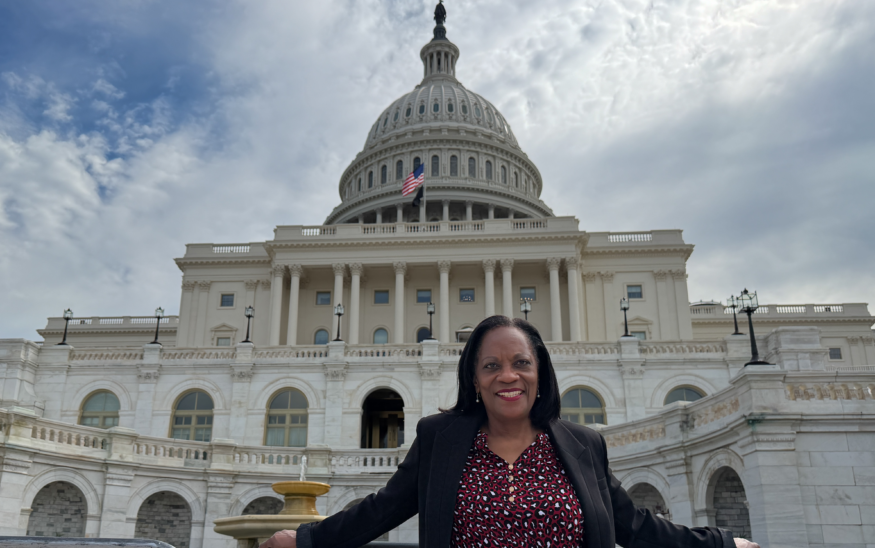
Alison Bethel visits the U.S. Capitol on Sept. 10, 2026. (Credit: Erik Schelzig)
At 35, I thought I understood America. Then came Sept. 11.
By Alison Bethel//September 11, 2026//


WASHINGTON — Twenty-five years ago, I thought I understood America.
I was 35 years old, Washington bureau chief for The Detroit News, living in an apartment on 16th Street and working out of the National Press Building in downtown D.C. I had spent my career asking questions about government and politics and the people who wielded power. I was a journalist. I thought I knew my country.
I believed America had gotten past the worst of its racism. I believed that despite our differences — racial, religious, political, economic — we were fundamentally one people, bound by similar values and a respect for the different ways our neighbors chose to live.
I believed we were safe.
Then came a beautiful Tuesday morning in September.
I wrote last year about the details of that morning: the suit I had laid out for work and abandoned for jeans when I realized what was happening; my blocked-in car; my hurried walk nearly 14 blocks toward the National Press Club, arriving at the bureau before anyone else; the phones that rang but couldn’t connect; the television carrying images that seemed impossible even as we watched them happen.
I don’t want to retell that story.
What interests me now is what I didn’t know that morning.
I didn’t know that people could simply go to work on a beautiful day — maids and doctors, secretaries and executives, restaurant workers and elevator repairmen — and suddenly find themselves inside history.
They weren’t soldiers going off to war. They were people going to work. Some had dropped children at school. Some had kissed spouses goodbye. Some were probably late. Some were probably thinking about what they would have for lunch.
And within minutes, America as we knew it would change forever.
When journalists cover history, nobody rings a bell and announces that history has begun.
You’re simply doing your job on a Tuesday morning.
That’s what we did.
I was running a Washington bureau. My reporters were stranded outside the city as trains stopped and streets closed. I sent one straight to New York. We called sources. We tried to confirm what was happening. We wrote.
The magnitude of it didn’t truly hit me until a couple of days later, when the journalist in me finally made room for the human being.
I watched images of people around the world rallying in support of the United States. They gathered in public squares and outside embassies. They left flowers and signs. They mourned people they had never met in a country that had not always been particularly kind to theirs.
I remember feeling part of something much larger than myself.
And then my most senior reporter, a man well into his 60s, broke down in tears.
He had been doing what journalists do. Working. Calling. Reporting. Moving to the next thing.
And then he stopped.
So did I.
In those days, I thought I was witnessing the most unifying moment of my lifetime. Americans lined up to give blood. Strangers treated one another with a gentleness that seemed almost sacred. The world reached toward us.
I thought: Together, we will move forward.
I believed it.
A quarter-century has complicated some of those beliefs.
I spent 11½ years of my life living outside the United States, and distance gives you a different view of home. I came to understand how little many Americans know about the rest of the world — and sometimes how little we know about one another.
I came to understand more clearly that America is not universally loved, and to think more deeply about what our country has done beyond its borders and how those actions look to people who did not grow up pledging allegiance to our flag.
Sept. 11 also taught me that America was not invincible.
And those of us in journalism have to be willing to examine our own performance in the years that followed.
We were journalists. Skepticism was supposed to be part of the job.
But patriotism complicated journalism after Sept. 11.
Some journalists were reluctant to ask the hardest questions because they did not want to appear sympathetic to the people who had attacked us. At a moment when scrutiny mattered enormously, questioning the government could be interpreted as questioning America.
And too often, we looked away.
People were profiled and detained. In the years that followed, people were tortured and held without the kind of due process Americans consider fundamental to justice.
We demanded justice for what had been done to Americans. We were not always as demanding about justice for what was being done to others.
That is difficult for me to write. It should be.
Journalism isn’t supposed to be comfortable. Our obligation is not to make our country look good or bad. It is to ask questions, particularly when the answers are inconvenient and when fear makes the questions unpopular.
If I could tell that 35-year-old bureau chief one thing now, it might simply be this: Never be afraid of the question.
There is something else I understand now that I couldn’t have understood then.
I still spend my days, right here at State Affairs, immersed in politics, policy and the people who wield power. But today, I oversee journalists covering those things from statehouses across the country rather than from a Washington bureau. The view has changed. The responsibility hasn’t.
My responsibility that Tuesday was to get the story right.
Today, I understand that I have another responsibility: to remember.
There are young journalists I lead today who cannot remember Sept. 11. Some weren’t yet born. I don’t particularly need them to understand what it looked like when the planes hit. There is plenty of footage for that.
I want them to understand what the room felt like. What Washington sounded like. What nobody knew. What everyone feared. And what reporters did anyway.
I want them to understand that the people who died that morning had simply gotten up and gone to work.
And I want them to understand that history doesn’t always knock before it enters the room.
Sometimes it arrives on a beautiful Tuesday morning.
At 35, I ran the Washington bureau of a hometown newspaper from the National Press Building. Newspapers from cities and states around the country maintained Washington reporters whose job was to help people back home understand their government. Much of that journalism is gone.
The country, too, has changed.
But I have not stopped believing in America.
I still believe this is one of the greatest countries in the world, a place where extraordinary things are possible regardless of your pedigree, your race or your gender. I believe Americans are among the most generous people on the planet. I believe most people are good, and when someone is hurting, most of us will reach out a hand.
Above all, I believe in God.
And despite everything, I still believe that when the worst happens, Americans will rally. I know because I have seen it.
I saw people line up to give blood for strangers. I saw a veteran journalist finally stop working long enough to cry. I saw people half a world away embrace a country that wasn’t their own.
At 35, I thought my job was to record it.
At 60, I understand that part of my job is to carry it forward.
Because eventually eyewitnesses become sources. Sources become history. And journalists are among those entrusted with carrying the story across that line.
So, 25 years later, I remember.
And I still believe.
Alison Bethel is the chief content officer and editor-in-chief for State Affairs. She is based in the company’s Miami headquarters.