Please ensure Javascript is enabled for purposes of website accessibility

Arizona campaigns enter the homestretch

Key Points:
  • Arizona’s pivotal midterm election is entering its final week
  • The state’s voters can have a big impact on national politics, and vice versa
  • The numbers show an advantage for Democrats, but the margins are likely to be slim

Arizonans will learn in just over a week whether Democrats’ 2022 sweep of three top statewide offices was a fluke or a real sign the state is no longer blood red.

And with all statewide offices and congressional seats up for grabs, the state’s voters have a real chance to decide whether Democrats take control of the Legislature and U.S. House for the last two years of Donald Trump’s presidency.

As voters start returning their mail ballots, Democrats are seeing a surge in returns while Republicans are underperforming, sending in their completed ballots at slower rates.

Nearly 28% of Democrats have already returned their mail ballots, compared to a bit more than 23% of Republicans. Independents, who make up more than a third of all registered voters, appear to be sitting on their ballots, with fewer than 13% mailing them back as of Oct. 24, according to Stealth Analytics.

Nearly 90% of Arizona’s 4.37 million voters use mail-in ballots instead of going to a local polling place.

But that doesn’t guarantee an easy Democratic victory, as those numbers tell only part of the story.

While the percentage of ballots from Republicans lags behind Democrats, the GOP has far more members in Arizona. So even with the slower return, Stealth Analytics said each party has a nearly equal share of the more than 884,000 ballots returned by the end of last week.

And even if those who wait until election day are a minority, the 2022 election showed they tend to skew Republican.

High gas and food prices, an unpopular war being felt at home, and concerns about aggressive federal immigration enforcement efforts are helping Democrats and boosting party leaders’ belief that they can win back not only the U.S. House but possibly also the Senate.

Some are even convinced they can win control of the state Legislature. Democrats haven’t controlled the state Senate since 1990 and haven’t held the House majority since 1966 — a full 60 years.

What the polls say

Polling earlier this month by HighGround, a public affairs and campaign firm that has surveyed Arizona voters for decades, shows a historic shift toward Democrats in Arizona, with as many as 20% of Republicans backing the other party’s candidates. Its polling showed Democrats ahead in all five top statewide offices. 

HighGround President and CEO Chuck Coughlin, now registered as an independent after leaving the GOP in 2018, said the polling results took him aback. Still, he warned that turnout and the GOP’s natural voter-registration advantage could tighten the numbers as Election Day nears. 

“We were all caught a little unaware of how difficult the cycle had become” for Republicans, Coughlin said.

“And there’s really no reason to believe, given the president’s narrative and his tour schedule, that they’re fighting the tactical fight,” he said. “They have a full-on house fire going on, and they see it as well.”

The Democratic Party’s wins in the governors, secretary of state, and attorney general races in 2022 built a firewall against GOP control of all branches of state government, the first time since former Democratic Gov. Janet Napolitano resigned to join the Obama Administration in 2009. Although their victories were tiny, polling by HighGround and others shows all three are doing better with voters this year.

Hobbs won by just 17,000 votes in 2022, while Attorney General Kris Mayes won by a historically slim margin of just 280 votes that year. Secretary of State Adrian Fontes bested his opponent by the largest margin of the three top officials, outpolling Republican Mark Finchem — who campaigned on the disproven claim that election fraud led to Joe Biden’s 2020 win — by more than 120,000 votes.

All are seeking re-election in the Nov. 3 general election and face Republican challengers Andy Biggs, Warren Petersen and Alexander Kolodin, respectively. 

National issues top of mind

Samara Klar, a political science professor at the University of Arizona in Tucson, agrees that Democrats are poised to do well on Election Day despite the GOP’s voter registration advantage of 34.8% to 28.3%, or 6.5 percentage points. Democrats have added nearly 30,000 registered voters since the August primary, while Republican registration is flat. Independents have also surged, adding more than 37,000 voters.

Those numbers should still put the GOP ahead, but she said independent voters are breaking for the Democrats. Klar credits their campaigns with eschewing liberal politics.

“Democratic campaigns in Arizona have been very disciplined about portraying a centrist moderate ideology, whereas the Republican campaigns in Arizona have not done that,” she said.

“They have moved further to the right side of the spectrum in order, presumably, to appeal to their more conservative base,” Klar said. “But given that a full third of Arizonans identify as independent, it’s really the Democrats’ more moderate strategy that seems to be winning.”

She said that, for the first time in recent election cycles, some Republicans are trying to move somewhat toward the center. But so far it hasn’t persuaded moderate voters.

“There is more of a strategic choice to move away from him, but the candidates themselves are really inextricably tied to Donald Trump,” Klar said.

And the national political mood is hurting the GOP across the board.

“I think actually immigration could have been a really strong issue for them to run on in 2026, if it hadn’t been for what many see as excessive force by ICE,” Klar said. “But it’s been fully overshadowed by the economy,” she said. “Absolutely overshadowed by gas prices, food prices, cost of living, and that is just making it very hard for Republicans to run any kind of winning message.”

Arizona’s effect on Congress

In Congressional District 1, which covers the northeast Phoenix suburbs, former professional football kicker Jay Feely hopes to maintain Republican control of the seat vacated by GOP Rep. David Schwiekert, who made an unsuccessful run for governor in August’s GOP primary. He faces Democrat Amish Shaw, an emergency room physician who previously served in the state House. 

Shaw won the primary despite lacking Democratic Party support. Part of that may be that he is known at the Capitol as a moderate centrist who sometimes crossed over to support GOP bills in the Legislature.

In CD6, encompassing parts of Tucson and all of southeastern Arizona, incumbent Republican Rep. Juan Ciscomani is trying to hold the seat against former U.S. Marine drill instructor JoAnna Mendoza. 

Ciscomani touts himself as Washington’s most bipartisan congressman, although his record shows consistent support for Trump’s policies. Mendoza is focusing her messages on lowering consumer costs, job growth, border security and immigration reform

Both races are incredibly tight and hard-fought, Klar said. Although the national picture clearly shows Democrats doing well, she’s not convinced that will carry over in Arizona, from top of the ticket down.

“I think that Arizona is much more competitive than the national picture,” she said.

“I think nationally, Democrats are going to do well,” Klar said. “Seems as though they’ll take over the House. They may take over the Senate.”

But the picture, she said, is different at the state level.

“Arizona specifically is a much, much tighter electorate, and there’s more Republicans in Arizona than there are Democrats,” Klar said. “That is just an indisputable fact, and it’s hard to get around.”
Healthcare drives Arizona’s job growth, but can employers keep up?

Key Points:
  • The healthcare industry is driving much of Arizona’s growth, but employers can’t keep up with demand
  • Healthcare jobs accounted for more than half of the 22,700 non-agricultural jobs added between September 2025 and September 2026
  • Arizona could face a shortage of 76,000 healthcare workers over the next decade

PHOENIX — Mike Renaud says he would hire 20 physicians and 100 mental health therapists tomorrow if he could find qualified candidates.

Renaud, president and CEO of Valle del Sol, which provides primary and behavioral healthcare in Arizona, said the organization has increased its staff by 15% over the past year but still needs more workers to meet demand.

“We would grow faster, but we don’t have enough of the clinical people here in Arizona to hire,” Renaud said.

His experience illustrates a challenge for Arizona’s economy. Healthcare is providing much of the state’s job growth, but employers need workers and money to keep expanding.

Arizona added 22,700 jobs outside agriculture between September 2025 and September 2026, including 12,500 in healthcare and social assistance, according to the Arizona Office of Economic Opportunity. That means the healthcare industry accounted for more than half of the state’s overall job gains.

The numbers reflect the rising demand for care in Arizona, but meeting that demand requires enough people willing and able to do the work.          

Doug Walls, OEO’s labor market information director, said Arizona’s growing and aging population is driving demand for healthcare, including more frequent and specialized services. 

At the same time, slower hiring in other industries has made healthcare a bigger part of the state’s job growth, he said.

“It’s a little bit of both,” Walls said.

Healthcare and social assistance employment grew 2.6% through September from the same period last year, matching the annual pace OEO predicted. The long-term forecast, however, gives other industries a larger slice of the pie.

The agency expects healthcare and social assistance to add 113,466 jobs between 2024 and 2034, about a quarter of the state’s overall job growth.

The forecasts predict overall job growth after accounting for job losses. Employers must also replace workers who retire or leave, so they will need to hire more people than the growth figures alone suggest.

Walls said the forecast assumes the rate at which employees in the industry leave will stay about the same as demand grows. 

Still, he said, difficulty finding new workers and employee burnout are long-standing problems in the healthcare industry.

At the Greater Phoenix Chamber’s Economic Outlook event Oct. 1, business and healthcare leaders discussed the industry’s growth and challenges going forward.

Mark Whalen, Banner Health’s chief enterprise growth officer, said the nonprofit is investing in clinics and technology intended to give medical staff more time for patients. Finding workers remains a challenge.

“One challenge is having the workforce to meet the growing demand,” Whalen said.

A healthcare shortfall on the horizon

The Greater Phoenix Chamber Foundation’s 2023 workforce report estimated that Arizona could face a shortage of 76,000 healthcare workers over the following decade.

Keeping future doctors from leaving Arizona is part of the shortfall, said Dr. Daniel Derksen, director of the Arizona Center for Rural Health at the University of Arizona.

After medical school, doctors continue their training in supervised positions called residencies. Arizona needs more of those positions, Derksen said, because many graduates who leave the state for training don’t return. 

“We really haven’t kept up with the residency slots that we need for our population,” he said.

Derksen suggested encouraging more students from rural and tribal communities to pursue healthcare careers through loan repayment programs. He said those efforts could help bring workers to the communities that lack them the most.

Some training programs are helping people find work. OEO’s 2025 review of ARIZONA@WORK adult training programs found health-related training had the strongest effect on employment after participants left the program.

After accounting for the differences in people’s backgrounds and local job markets, the agency estimated that completing health-related training was linked to about 14 more people working for every 100 participants, compared with those who did not start or complete training.

That suggests training programs can help, but it remains unclear whether they meet employers’ needs.

Todd Sanders, the Greater Phoenix Chamber’s president and CEO, said its foundation works with high schools, community colleges and universities to prepare workers.

“There is a dire need for more talent, and we are squarely focused on that,” Sanders said.

Medicaid cuts aren’t helping

Hiring also depends on whether hospitals and clinics can afford more workers, especially in rural communities.

If patients lose Medicaid, the government health insurance program for low-income people, hospitals and clinics may face bills patients cannot pay.

“These safety net clinics and hospitals already run on very tight margins,” said Derksen, director of the Arizona Center for Rural Health.

Under the 2025 One Big Beautiful Bill act, some adults in Arizona’s Medicaid program will face work requirements and have to prove twice a year that they still qualify for coverage. Those changes begin in January 2027, according to Arizona’s Medicaid agency.

The need for more doctors and therapists shows the challenge behind Arizona’s job forecasts. Filling those jobs would also support workers in other industries.

Dr. Michelle Gourdine, chief medical officer at CVS Caremark, said at the economic outlook event that access to care helps people stay healthy enough to work, providing an economic boost.

“Health and economics are deeply interconnected,” she said.

———

This article first appeared on Cronkite News and is republished here under a Creative Commons Attribution-NoDerivatives 4.0 International License.

Turning Point app tracks likely conservative voters who haven’t returned ballots

Key Points:
  • A new mobile app from Turning Point USA shows people who are likely to vote conservative and have not returned their ballots
  • Anyone can download and use the app as it’s intended
  • A similar app from Democratic organizations needs more authorization to use
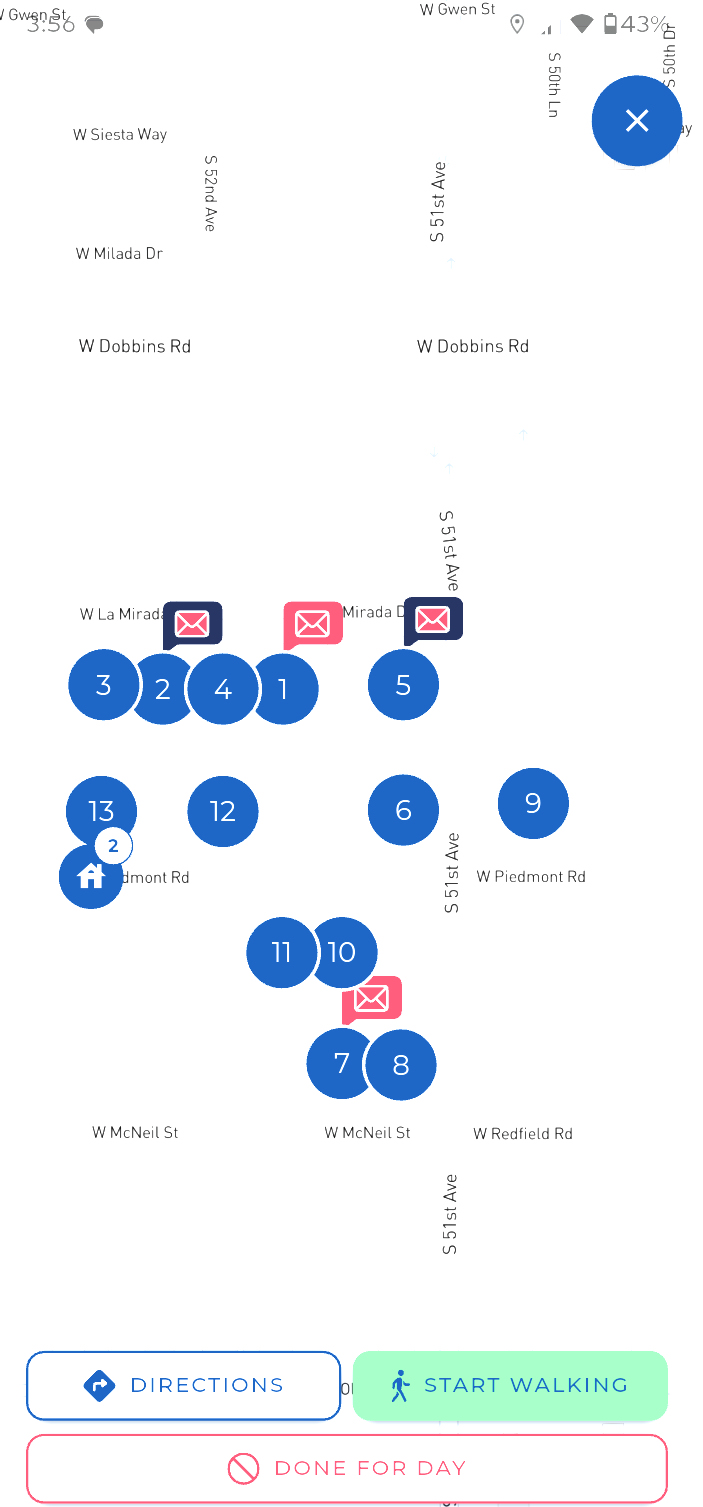
A map on a Turning Point app telling volunteers who they should contact in any given neighborhood to get out the vote — and return early ballots — for candidates the organization supports. (Screenshot by Howard Fischer)

PHOENIX — A publicly available app provides insight into who a conservative group sees as people likely to vote with their side.

Designed by Turning Point USA, the organization founded by Charlie Kirk to promote conservative candidates, the TPAction mobile app is specifically meant to aid volunteers who “chase” ballots. They use it to find people in a given neighborhood who have asked for early ballots but have not yet returned them, according to county election records.

But not just anyone with an unreturned ballot.

“It identifies who we want to vote,” said Tyler Bowyer, the chief operating officer of Turning Point USA, when asked about it.

And how does the organization do that?

“Why would I tell you that?” he responded in a chat on social media, followed by “LOL” — laughing out loud. “I mean, it’s basic logic who would determine our targets.”

But Bowyer declined to answer any more questions.

There’s nothing illegal about all of this, as voter registration records are public.

And lists are available regularly of those who ask for and have returned early ballots. That’s why those emails, text messages and phone calls people get on behalf of candidates and issues tend to stop once the ballot is returned.

Democrats have a similar program called MiniVAN that enables campaign organizers to send out volunteers — just like Turning Point — to find those voters it has identified as likely supporters whose ballots may be sitting unopened on the kitchen table.

But there’s a key difference.

While the MinVAN app can be downloaded to cell phones, actual voter information becomes available only when the user is linked to a specific list. And that list is not publicly available, but is under the control of the organization that controls the list.

That’s not the case with TPAction.

It takes only a name, address and phone number to sign up and activate the app once downloaded from either Google Play or the App Store.

And one option on a menu that appears when you sign in and click the arrows in the upper right is to “chase ballots.”

Click on that and you get a menu that tops off with “voters near me.”

That first turns up a list of neighbors within a couple of hundred yards — at least those who Turning Point believes is worthy of their attention — complete with their names, addresses and whether they’ve returned their early ballots. You may or may not be on that list.

There’s also an option to click on the map to show you exactly where they live from your position.

But you’re not limited to snooping about just the folks in your area.

At the bottom of the map is a button labeled “done for the day.” That not only releases the list back to Turning Point but clears the map for the next time.

And, more to the point, you can then reopen the app — and the map — from wherever is your new starting point. And that produces a list of people in that area who Turning Point wants to pursue.

The app also has other options to allow users to make phone calls directly to those on the list. It even provides information like the target’s gender, age and party, and whether that person is on the early voting list — meaning someone who asked for a ballot by mail.

And even direct texts are an option.

You don't have credit card details available. You will be redirected to update payment method page. Click OK to continue.