Any given day, you can walk by the Crumbl and find a line of eager cookie eaters lining up out the door. Our cookies have become a teen sensation that Gen Z can’t seem to get enough of.
You know what Gen Z also can’t get enough of? Tapping to pay with their credit cards.
Most of my customers pay with their credit card, which is good for them and good for me. The safe, quick and easy transaction process is critical for my high-volume small business to keep customers happy and the line moving. So, when lawmakers push legislation that claims to help small businesses like mine by introducing changes to how I interact with credit cards, I take notice.
Molly Ashton owns and operates Crumbl Cookies locations in Queen Creek and Mesa.
That’s exactly what’s happening with HB2629, a bill that would change how credit and debit cards work in Arizona. Supporters say it will save businesses money, but the truth is it’s a giveaway to massive corporate retailers like Walmart and Target at the expense of small business owners like me.
Simply put: businesses, big and small, pay banks and credit card networks a processing cost to run credit and debit cards, and thereby shift all payment and fraud risk away from the countless small businesses accepting credit card payments, like mine, to the banks and credit card networks. The processing cost also ensures transactions go through quickly and seamlessly without the hassles or risks of doing business with cash or check. And as a small business owner, I fully understand the value in banks and local credit unions helping ensure that my business is running smoothly and safely.
The proposed law won’t just cut into these benefits; it will also make it harder for small businesses to handle transactions efficiently.
HB2629 would carve out the tax portion of a purchase from the total amount when it comes to processing. That may sound harmless, but it would create a logistical nightmare for small business owners across the Grand Canyon State.
Current credit card networks run the entire transaction as one amount. The change being proposed would potentially require two different transactions, one for tax and one for the transaction amount. That means less convenience for my customers and more expenses for me because in order to comply with the new legislation, businesses will need costly software upgrades. That’s an unnecessary burden for small businesses already operating on razor-thin margins.
And this isn’t just conjecture. We’ve seen this play out in other states.
In Illinois, where a similar bill passed, small businesses are expected to save an average of just $56 per year. Meanwhile, the biggest retailers, with entire teams dedicated to navigating new regulations, stand to benefit the most.
What’s more, these kinds of laws are often the first step toward broader restrictions on credit card rewards programs. Airlines, unions and consumer advocates have already sounded the alarm about how similar policies could gut rewards points that families and businesses alike rely on. In fact, I even use my credit card rewards points to give back to my employees — funding lunches and even helping my manager and her family take a well-deserved trip – opportunities that could disappear under this legislation. In other words, this bill isn’t just bad policy — it’s a step toward diminishing the rewards programs people like me and my customers have come to rely upon.
Small businesses employ half of Arizona’s workers and drive our economy forward. Yet, new regulations threaten to pile on costs, add red tape and give corporate giants another advantage.
Do we really want Arizona to be next in line for that kind of chaos? I’m biased, but I’d say don’t let the cookie crumble in our state.
Molly Ashton owns and operates Crumbl Cookies locations in Queen Creek and Mesa.
A bill that aims to strengthen the state’s animal cruelty laws and clearly define suitable conditions for pets is moving through the Legislature with bipartisan support.
The bill, SB1234, aims to clarify what constitutes inhumane conditions for domestic animals, redefine what it means to provide the appropriate food, water, and shelter, and add a misdemeanor charge for failing to provide an animal with medical attention to prevent unnecessary suffering.
The law was prompted by an animal cruelty case in September 2023, when 55 disabled dogs were seized from a Chandler home. The homeowner, April McLaughlin, was arrested on multiple charges of animal cruelty, fraud and theft.
McLaughlin was taken into custody and indicted, but it took three weeks for the Chandler Police Department to get a search warrant for the property and rescue the animals.
“The reason it took so long is because the language is very lax in its description of animal abuse, especially around suffering and food, shelter and water,” said Dr. Steven Hansen, president and CEO of the Arizona Humane Society.
The Humane Society treated the injured dogs that were rescued from the home, but seeing the condition of the animals took a personal toll on many of the workers at the organization, Hansen said.
“There were several dogs with fractured limbs, and bone was exposed, and had been exposed for a very long amount of time, and they were paralyzed dogs, so they actually didn’t feel their fractures, which is just awful,” he said. “You can imagine…there were tears in our hospital when those dogs were coming in.”
Hansen worked with Sen. Shawnna Bolick, R-Phoenix, to craft the bill. It is modeled after a similar bill introduced last year by Sen. T.J. Shope, R-Coolidge, which stalled in the Legislature. The current bill passed the Senate Regulatory Affairs and Government Efficiency Committee unanimously on Feb. 20, cleared the Senate Rules Committee, and is now awaiting consideration by the Senate Committee of the Whole.
The updated bill requires that water be drinkable, food be appropriate for the species and fit for consumption, and shelter be structurally sound and sized to protect a dog from injury while allowing the animal to stand, move around freely, and maintain normal body temperature.
It also raises the threshold for what’s considered proper food, water and shelter for animals.
“Right now, animals just have to have water,” Hansen said. “It can be a mud puddle. It can be a quarter of an inch with algae growing in it, with feces in it. That technically passes as water.”
One of the most important aspects of the bill is a change in language that holds someone accountable for not providing medical care that would prevent “unreasonable suffering” as opposed to “protracted suffering,” he said.
“It’s an average person’s understanding of what suffering is. So it’s intensity versus length of time, and it would allow a search warrant to be written sooner on these egregious cases,” he said.
Bolick said the bill was crafted to provide more tools for law enforcement to quickly rescue animals and prosecute animal abusers.
“That was the impetus behind this, because law enforcement, they weren’t able to do anything,” Bolick said. “This will hopefully get them to where they need to.”
The bill doesn’t target homeless people with pets or farm animals. It’s only intended to focus on the most egregious cases of animal abuse, Hansen said.
“It is not your average ‘my dog has an ear infection’,” he said. “That would never rise to the level of a case under this legislation or any legislation.”
In Arizona, water is the lifeblood of our rural economies, where agriculture, industry, small businesses and families all depend on reliable water supplies. Right now, Arizona stands at a critical crossroads in managing our water resources. Now, we have an opportunity to change that. It’s why we, leaders from across the state, are proud to stand together — Republicans and Democrats alike — to forge a modern, collaborative path to addressing Arizona’s water challenges. The Rural Groundwater Management Act represents a long-overdue step toward securing Arizona’s water future. This initiative creates certainty, opportunity and security for everyone who calls rural Arizona home.
Prescott Mayor Phil Goode
Water is not a partisan issue — it is a fundamental resource that sustains our communities, our economy and our way of life. Last time we checked, there wasn’t Democratic water and Republican water. There’s only Arizona water, and it’s important that our communities have the opportunity to control our growth and our future. Rural Arizona, in particular, faces unique challenges. Communities are grappling with dwindling groundwater supplies, water security risks and a lack of viable management options. Without action, these challenges threaten the livelihoods, property rights and economic prospects of thousands of Arizonans.
Local Choice, Local Solutions
Rural communities are best positioned to understand their own water needs. One-size-fits-all mandates do not work for Arizona’s diverse landscape. The policy we are advancing — built on the foundation of the bipartisan Governor’s Water Policy Council — prioritizes local control. It provides the tools and flexibility necessary for rural Arizonans to guide their own water futures while respecting the character of each community.
As mayors, we understand this firsthand.
This initiative finally offers rural Arizona what our urban counterparts have benefited from for decades: a framework for sustainable water management that does not impose rigid, bureaucratic restrictions. Instead, it empowers communities to make decisions tailored to their unique challenges and opportunities.
Modernizing Water Management for Arizona
By creating an alternative management framework, we are equipping rural Arizona with forward-looking strategies that balance economic vitality and resource protection. The city of Prescott has been a leader in water conservation, but the Prescott Active Management Area safe yield goals are impacted by other municipalities and county-exempt well users who don’t adopt the same efforts. We can’t conserve our way to safe yield. We need a broad policy statement that protects the balance of interests between business development, agriculture and rural communities.
This is about working together, not imposing solutions from the top down.
Protecting Water and Property Rights, Safeguarding the future
Willcox mayor Greg Hancock
Water policy in Arizona must uphold our deeply held values of property rights and individual responsibility. Any solution must strike a balance between protecting personal ownership and ensuring long-term sustainability. This bipartisan proposal does just that. As local leaders, we have long sounded the alarm about out-of-state and international interests over-extracting Arizona’s groundwater in a rapidly damaging manner.
Creating Prosperity for Rural Arizona
Economic prosperity and responsible water stewardship are not mutually exclusive. We can and must achieve both. By securing our water future, we are paving the way for growth that is sustainable, responsible and beneficial for all.
The time for action is now. We waited long enough for a fair and effective water management option. We have the opportunity to make 2025 the year that the Legislature finally delivers the tools and flexibility our communities need. Future generations should not have to choose between economic opportunity and environmental responsibility. With this approach, they won’t have to.
Phil Goode is the mayor of Prescott and Greg Hancock is the mayor of Willcox.
Kris Mayes generally receives positive media coverage every time she files a new lawsuit, including the flurry of suits she has filed against the new administration. But regardless of whether one agrees with Mayes’ efforts or not, there can be no real dispute about her extraordinarily poor track record in court. Mayes’ tough talk is not backed up by actual results. Let’s peek behind Mayes’ rollout of press releases and look at her real record.
Timothy La Sota
Since it is her most recent legal failure, let’s start with how Mayes was the lead attorney general on the lawsuit seeking to shut the new federal Department of Government Efficiency down, one of a flurry of lawsuits against the new administration that she has been a part of. A Clinton appointed federal judge delivered a staggering blow to Mayes, denying the injunction Mayes sought.
Mayes’ failed lawsuit against fellow Democrat Gov. Katie Hobbs and the Legislature on the state budget is another glaring loss. Mayes flipped out when her office’s slush fund was defunded in the bipartisan budget, and she sued her fellow Democrat over it. Mayes promptly lost and was accused by Gov. Hobbs of filing a frivolous lawsuit. Facing an obvious award of attorney’s fees, Mayes caved in and agreed to pay attorney’s fees rather than fight about it in court. Of course, it is we, the taxpayers, not Kris Mayes, who are on the hook for attorney’s fees that came courtesy of her temper tantrum.
The city of Phoenix learned the hard way that one relies on Mayes’ legal advice at one’s peril. Mayes wanted to allow cities to adopt prevailing wages. The only problem was a state law prohibiting that. Mayes’ “fix” was to simply write an attorney general’s opinion that pretended the prevailing wage law did not apply. Phoenix acted on Mayes’ advice, was promptly sued and lost.
Mayes also targets local governments that she dislikes. Mayes sued Cochise County seeking to interfere with the way it runs elections. But what Cochise County was doing was perfectly legal, as reflected by the fact that a number of other counties operated the same way.
Mayes promptly lost in court and was excoriated by the judge for attempting to introduce irrelevant political attacks into the lawsuit. And Mayes just lost another round against Cochise County. Her attempt to assist the secretary of state and a county officer to seize powers that are by statute given to the board of supervisors was rejected by the Arizona Supreme Court.
Mayes’ losses show what happens when a lawyer allows politics, rather than the law, to dictate their decisions and legal advice. Who can forget Mayes’ ridiculous investigation into Donald Trump for comments he made criticizing Liz Cheney? Not coincidentally, the investigation was announced with fanfare right before the election and quietly dropped afterward. A number of down ticket Democrats were not the least bit amused, as they realized that Mayes’ overt and ham-handed use of her office for political purposes bolstered Republican turnout.
Mayes has also targeted the Apache County attorney, indicting him. He subsequently won re-election but because of the indictment he could not take office. Lacking a county attorney, Apache County was pressured by Mayes’ office to award a no-bid $650,000 contract to prosecute felonies to the person who had been the complaining witness for Mayes’ criminal charges. Everything Mayes touches turns into a mess.
Mayes’ alternate electors criminal prosecution has also been a disaster. It has already failed in its essential purpose, which was to hurt Donald Trump politically. Most recently, Mayes suffered a major setback in court as the judge ruled that the defendants had made the initial showing that Mayes brought the charges to retaliate against the defendants for exercise of their constitutional rights.
Now Mayes will have to prove a legitimate ground for the prosecution, which will be difficult. Mayes sat on this case for well over one year, waiting until close to the election to bring the charges. It has also been revealed that Mayes is taking her cues on the case from a shadowy, far left-wing group. Now, in desperation, Mayes is seeking Jack Smith’s file on the alternate electors. Even the Biden Administration refused to give her those files, undoubtedly because they viewed Mayes as an opportunist of questionable competence, and a potential political liability.
When she is not mucking things up, Mayes is attacking private businesses that she does not like, all the while refusing to do the job she is paid to do. Mayes has refused to enforce laws she disagrees with, and along with the governor, tried to dismantle the death penalty. Mayes even blocked the execution of killer Aaron Gunches, who for decades has actually demanded to be executed. Granting Mr. Gunches’ his wish should have been easy, but Mayes couldn’t even do that.
Mayes is long on splashy announcements that garner media coverage, but if we look at her actual win-loss record, which receives insufficient press attention, it is abysmal. Given the fights Mayes has picked, her lack of success is fortunate for Arizona. Mayes’ failures are not surprising since her fealty is to politics, not the law.
Tim La Sota is a Phoenix lawyer who specializes in government practice, including election law, lobbying, regulatory, administrative and licensing law, land use, and specialized litigation involving governmental entities as clients as well as adversaries.
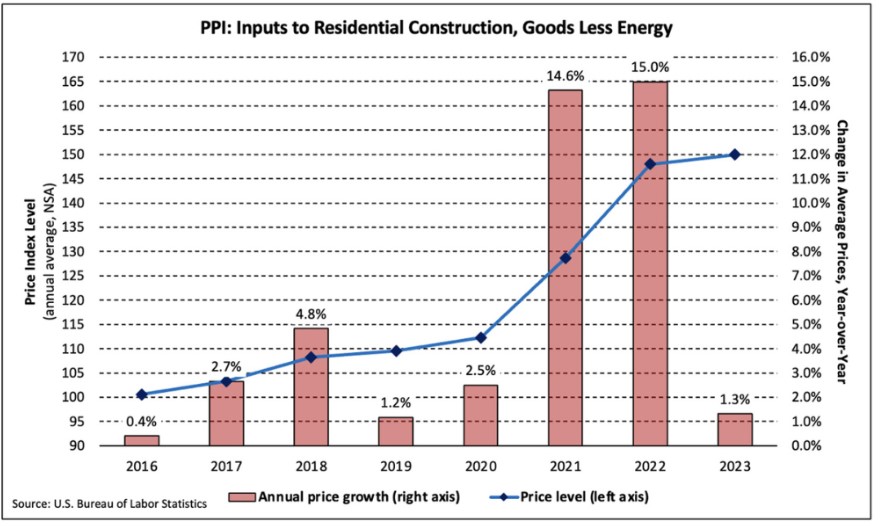
A series of very unusual economic recessions (Great Recession; Covid-19 Recession) and the following expansions changed the financial model for homebuilding. Heightened costs of labor and materials, combined with some complex financial issues, led to housing price escalation in Arizona, across the nation, and across the globe to other well-developed countries.
Arizona’s cities and towns did not cause the breakdown of the financial model for housing development, nor did they cause the housing price escalation that has been realized across the globe. Local government entities also did not influence the Federal Reserve Board to make such bad decisions that led to inflation further increasing, near zero cost access to money influencing investor purchases, and the current “Golden Handcuffs” of mortgage rates below 3.0% that is restricting housing sales.
Nick Ponder
Of course, making such arguments would be either purposefully misleading, or implies a lack of knowledge or bias among the advocates.
The correct explanation is that larger-scale macroeconomic influences negatively impacted housing affordability, and that cities and towns are helping to remedy the problem. This is not an opinion, it is an economic fact.
Fixing housing affordability problems requires developers to partner with local government entities, not scapegoat the cities and towns of impacting global housing price escalation.
WHY IS THE PROBLEM NATIONAL & INTERNATIONAL?
The housing crisis is a macroeconomic issue, not a microeconomic issue. This is why blaming zoning is a misguided analysis of the origin of the crisis and solutions to the crisis.
When you look at this in a macro sense, the housing crisis is not a micro Arizona problem but rather a macro national issue and, in many cases, an international issue. In Arizona, in particular, housing remained affordable immediately before Covid but after 2020 several shocks and factors made the housing market unaffordable.
Let’s look at several variables:
Great Recession of 2008 and subsequent slow recovery
Post Great Recession under-building of housing after excessive overbuilding
Growing trend of corporate ownership in housing
COVID work from home culture allowed people to move to places with lower costs of living (AZ); we have always been growing rapidly.
Californians moving to AZ had higher AMI to compete with Arizonans
Supply chain congestions created significant inflation in materials costs
Changes in workforce participation inflated labor costs
Rapid reductions followed by increases in mortgage rates by the Federal Reserve froze people in their homes
These eight variables combined with other Arizona market challenges like increasing land costs, labor costs, and regulatory challenges have pushed housing costs up by over 60%. None of these issues have to do with newly restrictive zoning! But these issues can be marginalized with better partnering between the development community and local government entities rather than the misleading and false information campaign currently being deployed by the same members of the development community.
GREAT RECESSION
Arizona was in a housing boom before the Great Recession. However, when the economy collapsed, we were hit harder and our housing industry was slower to recover. The virtual shutdown of the housing industry created a growing challenge that would be realized after Covid when several other variables came into play.
Development is on the rise. Since January 1, 2020, Arizona ranks 6th in the nation in total units permitted despite being 14th in population. We have permitted 315,000 units and constructed 249,000 of those units.Additionally, in Maricopa County alone Arizona communities have approximately 110,000 units in the pipeline and with an assured water supply certificate just awaiting construction. The 110,000 permitted units in Maricopa County are enough to satisfy today’s housing shortage.
COVID-LINKED INFLATION
The Covid pandemic created inflationary pressures in multiple ways. First, it created pressures in many individuals seeking larger homes with more space for home offices and outdoor space, inspired by greater flexibility in where they could locate as a result of telework opportunities. The beginning of the pandemic reflected a low interest rate environment that fueled competition and pushed up prices.
In addition to the initial competition created by low interest, the addition of government stimulus and the inability of people to travel or dine out inspired using disposable income on home renovations, appliances, furniture, and other products and materials used for housing.
Prior to the pandemic certain materials prices were already on the rise driven by trade disputes overseas. Those rising prices were followed by the pandemic, which saw an increased demand in all material and product areas.
One additional item often not cited is Arizona’s area median income was lower than that of California. Because of the transient nature of the new workforce, people moved from Silicon Valley and Los Angeles to Phoenix-metro during the pandemic and they brought their Silicon Valley salaries. This provided Arizonans with yet another additional challenge in an already competitive market.
INTEREST RATES
Housing is a ladder. People moving out of their starter homes and into a forever home make way for those in apartments to move into a starter home. Those moving out of a forever home and into a 55+ community make way for those moving from a starter home to scale into their forever home, and so on.
While Covid started with historically low interest rates the hot inflation that followed in 2021 was met with increased interest rates. Many Americans had already locked in at 3% interest rates. With interest rates spiking to 7% this has locked people into their homes breaking the housing ladder.
CORPORATE HOME OWNERSHIP
Since the Great Recession private equity and corporate interests have been purchasing significantly more units in the Arizona housing market. These investment opportunities diminish the supply of starter homes, competing with first-time homebuyers and increasing rents 25% or higher above their pre-sale rents.
In Phoenix-metro, 20% of the single-family rental housing units are owned by large corporate owners such as Invitation Homes (Blackstone), Tricon, Progress, and FirstKey. These entities serve as market manipulators, able to offer full cash purchases with short closing periods and no inspections; options a traditional first-time buyer cannot offer.
In addition the corporate ownership of single family homes, many communities in Arizona have been subjected to the exposure of corporate ownership in the short term rental (STR) market as well. In 2016, legislation was pursued to preempt local governments in Arizona from limiting the use of STRs in cities and towns. At the time, testimony spoke to the sharing economy and the need for the widow to rent a room in her house or the veteran to rent his home when he was deployed overseas.
Arizona became the first and only state in the country with a statewide preemption on STRs and became a testing ground for corporate ownership in the market. Today, upwards of 20% of the homes in some communities are STRs with many owned by corporations. In other communities the numbers may only be 1% to 5% but those are units that take away from individuals seeking shelter.
Today, 60,000 units in Arizona are consumed in the STR market. Further, there is a new trend in housing seeking fractional ownership of homes similar to a share in the stock market. This fractional ownership model is another way corporations keep individuals from owning homes and capitalize on the housing shortage.
Perhaps if government wants to incentivize first time individual home buying they should consider reducing the incentive for corporate ownership of individual family homes. It has often been said with worldly wisdom that if you want less of something you tax that something. Since individual homebuyers are being pushed from the market by corporate ownership entities one would consider the tax policy which treats both types of ownership identically rather than differently.
MULTIFAMILY SALES
Sales of multifamily units are at a 40-year low in the United States. Condos and townhomes are more affordable than single family homes. However, due to federal FHA regulations and, more importantly, challenges with state construction defect laws, developers are choosing to rent these units (build-to-rent) rather than sell them due to risk concerns and insurance costs, pushing sale prices higher.
Phoenix-metro has become one of the hottest markets for build-to-rent communities. Not placing these shared-wall units for sale robs Arizona first-time home buyers of a low cost options.
LAND EFFICIENCY
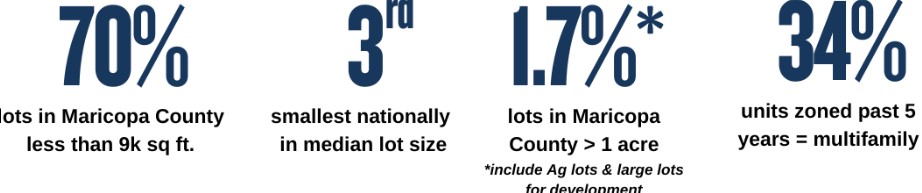
Arizona has limited private land. For that reason we’re are extremely efficient with the land we have. Arizona has the 3rd smallest median lot size in the nation and today, in response to limited private land, we are building smaller than we ever have.
John F Long built Maryvale and his first development averaged 9,100 sq. ft. per lot. Seventy percent of all lots in Maricopa County are smaller than his first development.
The average Maryvale lot is around 6,500 sq. ft. Today our growing communities are routinely building homes on lots smaller than the Maryvale lots of the 1950’s and 60’s.
While our communities remain committed to being efficient with the limited land Arizona has available for development, we must also create diverse options for our residents. Arizona residents want options for small, medium, and larger lots that allow them to climb the housing ladder within their same community. We need space for apartments but also lots that value the agrarian history in our communities.
Creating a one-size-fits-all option that cuts out local input and smart community planning is not what Arizona residents want.
If the State truly wants to incentivize first-time homebuyers and builders they could consider amending the State Constitution to prioritize the sale of some of the 9 million acres of the land they own for that very purpose. Providing more land for such developments would help incentivize the supply of starter homes in the State.
AGE OF OWNERSHIP & AFFORDABILITY
In recent discussions about the average age of ownership for first-time homebuyers there have been some anecdotal suggestions that in the past first- time homebuyers frequently obtained their first homes in their mid-twenties. However, data proves otherwise. While it is accurate the price have increased due to these macroeconomic forces and the age of ownership for first-time homebuyers has correspondingly increased, the average age has been over 31 years of age since 1981.
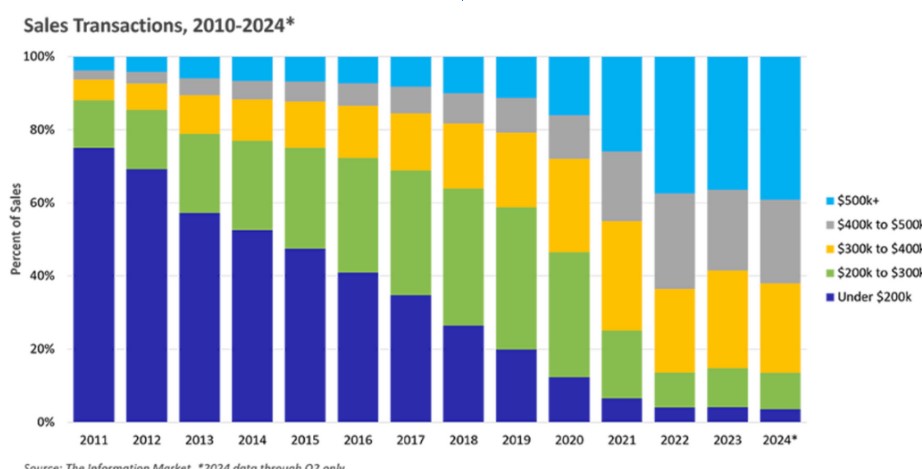
Data from the Maricopa Association of Governments, specific to the Maricopa County planning area (includes City of Maricopa, Casa Grande, Marana, Coolidge, and Florence) housing remained affordable despite the development communities under-building following the Great Recession. Through 2019 nearly 60% of all homes in the MAG region sold for under $300,000 and 80% were under $400,000.
While these market-driven forces have created the housing challenges that we have today, Arizona communities have been at the forefront of policy solutions in their communities to increase housing units. Arizona communities have reduced lot sizes, minimized setbacks, supported legislation to restrict approval timeframes, providing programs to invest locally in affordable housing, supporting the state Low Income Housing Tax Credit (LIHTC) program, and many more.
Arizona municipalities, residents, and developers have built incredible, vibrant communities that are attracting businesses and people from across the globe. The answer to this point-in-time macroeconomic housing crisis is not to treat so flippantly what we’ve taken so much care, resources, and patience to curate.
We look forward to supporting more locally driven solutions to the housing challenge that keep in place the essential 3-legged stool of municipal planners, developer input, and resident input.
MYTH vs FACT
Cities do not allow carports
Many cities allow carports and after checking with them developers have not requested to build a carport or a home w/o a garage in at least the past decade.
Cities have outlawed small lot homes
Cities are required by the Legislature to go through the general plan process. Lot sizes in units per acre are set forward in the general plan. We are building smaller than we ever have today.
Cities mandate carriage lights on homes
The city in question does not require streetlights. The $100 carriage lights take the place of thousands of dollars in streetlights. Lighting houses provides neighborhood deterrents for property crimes.
Cities require private streets
Cities do not require private streets. If a road is not built to spec the city will require the street to be “private” rather than conveyed to the city as it may not meet standards for public safety or public works traffic.
Cities require neighborhood parks as amenities, that should be the role of the city
40 cities in Arizona do not have a primary property tax. Other cities keep property taxes very low. Those taxes are kept low by requiring, for a nominal cost in the construction of a home, small neighborhood parks rather than large taxpayer funded regional parks.
8 QUICK TOOLS TO FIX HOUSING
Now that we have level-set the REAL reasons for the housing crisis that is macroeconomic in nature and not only hit Arizona but the nation, let’s talk about potential solutions. We believe there are 8 easy solutions to address the current housing challenges:
Tax Increment Financing (TIF)
Arizona is the ONLY state in the country that does not allow TIF. In many states it is used to build infrastructure which reduces taxpayer costs (impact fees) or is also used for affordable housing projects.
Local tools (infill property tax freeze)
In 2024 the League proposed an effort to freeze local property taxes for 7 years on infill housing projects to allow those developments to pencil out for builders.
League Starter Home bill
A pragmatic approach that maintains the 3-legged stool between developers, residents, and municipal planners.
SB1698, HB2834
Restrictions on corporate mass ownership
SB1209
Removing local constraints on short term rentals
HB2308
Extending LIHTC
HB2660
Correcting construction defect challenges
We are at a 40-year low in multifamily home sales in part because of this issue.
HB2713
Inclusionary zoning prohibition repeal
As part of the adaptive reuse bill from 2024, HB2297, developers were required to include 10% of the units as affordable. Some allowance for inclusionary zoning at the local level would aid in affordable and workforce housing.
HB2595
Nick Ponder is senior vice president for Governmental Affairs at HighGround
You don't have credit card details available. You will be redirected to update payment method page. Click OK to continue.

 Sign In
 Free Newsletter