Sign In


Upcoming Event
 Free Newsletter

Judicial review process begins ahead of 2026 retention elections
Kiera Riley, Arizona Capitol Times//October 12, 2025//
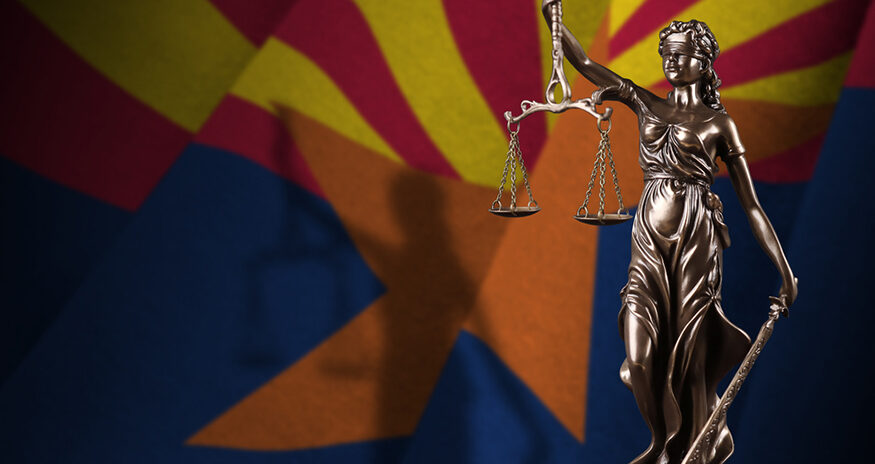
(Deposit Photos)
Judicial review process begins ahead of 2026 retention elections
Kiera Riley, Arizona Capitol Times//October 12, 2025//


Key Points:
-
Public comment hearing set for Oct. 24 on dozens of Arizona’s judges
-
2024 abortion ruling and campaign efforts tested voter sentiment
-
Civics group, justice and review commission anticipate less contentious cycle
A process to grade judges on their performance, with the ultimate goal of helping voters decide whether they should remain on the bench, is underway. This leaves one justice, 16 court of appeals judges and 72 superior court judges facing new scrutiny ahead of their 2026 retention elections.
With the Commission on Judicial Performance Review gearing up for the next election and a higher profile retention election in the rearview, a Supreme Court justice and the leader of a voter education group predict a smoother cycle than the last one.
In 2024, two justices, Justice Clint Bolick and Justice Kathryn King, faced novel and fairly well-funded ouster campaigns after ruling to uphold a statewide abortion ban.
Bolick and King appeared alongside a measure to create abortion protections in the state’s Constitution, as well as a legislative referral to limit voter input on retention elections by requiring a vote only for judges deemed to be performing below standards.
And, all in all, the ballot created a crossroads — something to gauge how people perceived judicial decisions and independence, as well as the ability to weigh in on those nominated to the bench. The lead-up prompted some concern about the politicization of a judicial nomination and voting process, which was thought to be a firewall against pitfalls in direct elections.
But in the end, Bolick and King stayed on the state high court, and voters roundly rejected the attempt to curtail the scope of judicial votes. Soon after, those perceiving a wrong with the initial Arizona Supreme Court decision on abortion passed the measure made to remedy it.
“It really was a perfect storm,” Bolick said. “If judicial elections were going to become a political litmus test, last year would have been the year that that happened … if it wasn’t going to work in 2024, I really don’t see it working going forward.”
In 2026, one Supreme Court Justice, Justice John Lopez, two Coconino County judges, ten Pima County judges, six Pinal County judges, 16 Court of Appeals judges and 54 Maricopa County judges are up for retention.
In preparation, JPR is adhering to the statutory tradition of reviewing appellate judges and Superior Court judges working in counties operating under the merit selection system.
Commissioners survey litigants, witnesses, victims, jurors, court staff and attorneys who appear in judges’ courtrooms. Then, the commission collects public input on judges and scours disciplinary records, recordings of proceedings, opinions or orders, and case management statistics. After all the groundwork, the commission votes on whether a judge “meets” or “does not meet” the judicial performance standards and issues a report to the public.
As JPR gets to work, so do civic organizations working to fill in the gaps in voter information.
Cathy Sigmon, co-director of Civic Engagement Beyond Voting, said her organization plans to recreate Gavel Watch, a nonpartisan voting guide on judges, with the same intention of conducting detailed research on judges up for retention to identify any overt bias that may be influencing the bench.
“Every judge brings their own frame to the bench, their own experiences, education, perspective, past political activity,” Sigmon said. “And what we look for is the extent to which that is used to bend the intent of law.”
Currently, Sigmon sees no major political issue that could influence voters ahead of 2026 as abortion did in 2024.
“We have come a little distance from the abortion issue, not that it is a passing or trivial consideration,” Sigmon said. “But in looking over the list, nothing has really jumped out at me yet. I really feel it’s a clean slate.”
Bolick said he saw the 2024 election results as a voter endorsement of an independent judiciary, a message that he hopes sticks.
And he notes that the assurance against political weaponization in 2026 begins with JPR and the merit selection system, highlighting both the vetting conducted by judicial nominating commissions and the ongoing review of performance, which includes surveys, research and public comment on the back end.
“The system has proved to work, and the commission has really held itself to a high standard in evaluating judges,” Bolick said. “I have no reason to think that it will not continue to work well in the future.”
A public comment hearing is scheduled for Oct. 24 regarding justices, Court of Appeals judges, and Superior Court judges in Maricopa, Pima, Pinal and Coconino counties.