Sign In
Upcoming Event
 Free Newsletter

Immigration enforcement continues despite government shutdown
Jamar Younger Arizona Capitol Times//October 17, 2025//
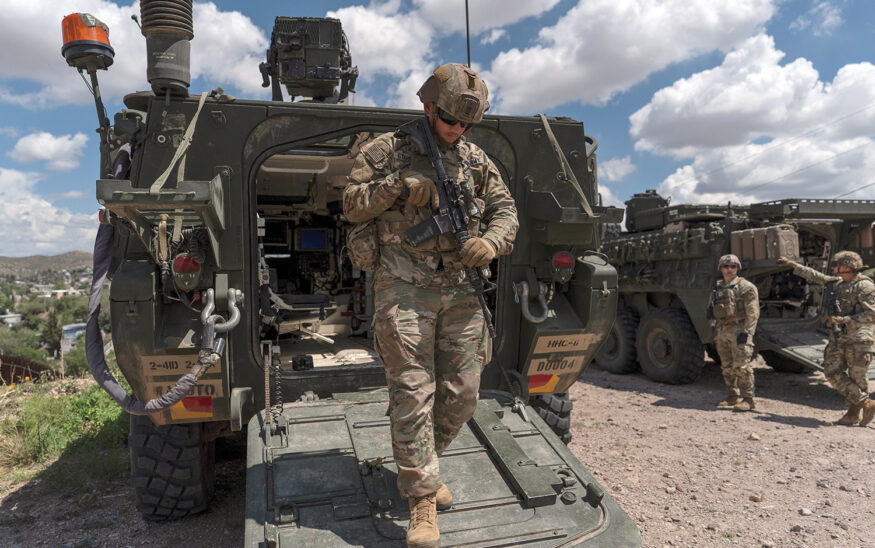
U.S. U.S. Army Spc. Jerimiah Starcher exits a Stryker combat vehicle after demonstrating the Long Range Advanced Scout Surveillance System in Nogales, Ariz., Tuesday, July 22, 2025. (AP Photo/Jae C. Hong)
Immigration enforcement continues despite government shutdown
Jamar Younger Arizona Capitol Times//October 17, 2025//


Key Points:
-
Federal agents and military personnel are considered essential personnel
-
CBP website says about 3,700 agents are in the Border Patrol’s Tucson sector
-
Immigration courts have remained open during the shutdown
Federal agents and military personnel are still conducting immigration enforcement operations along the Southwest border in Arizona and across the country during the federal government’s shutdown.
Agents from U.S. Immigration and Customs Enforcement and U.S. Customs and Border Protection have continued enforcement operations, supported by military personnel from the Joint Task Force-Southern Border, who assist federal agents patrolling the border in Arizona and surrounding states.
The agents and military personnel are deemed essential workers, meaning they’re called to work without pay during federal shutdowns.
U.S. Customs and Border Protection didn’t specify how many agents are working in Arizona, but the CBP website says there are about 3,700 agents in the Border Patrol’s Tucson sector.
The Joint Task Force-Southern Border, composed of personnel from the U.S. Army, Marines, Navy and other agencies, has had more than 10,000 service members who have either deployed or will deploy to support border operations.
The U.S. Northern Command activated the Joint Task Force-Southern Border in March, comprising active duty and National Guard military personnel from across the country who are working along nearly 2,000 miles of the border with Mexico.
“Even during previous shutdowns, this was considered to be an essential function of the government that continued,” said Ira Mehlman, spokesman for the Federation for American Immigration Reform, a non-partisan organization that seeks to reduce immigration to what it deems a manageable level.
Although the shutdown hasn’t affected border and immigration enforcement operations, it has touched other parts of the country’s immigration system.
Immigration courts for both detained and non-detained cases have remained open during the impasse, which marks a departure from previous federal shutdowns, said Aaron Reichlin-Melnick, a senior fellow with the American Immigration Council, a non-partisan organization that advocates for fair immigration policies.
In previous shutdowns, non-detained courts — for people who aren’t held in custody — have suspended operations until the government reopened, but that hasn’t been the case during the current impasse.
“The Trump administration, in their second term in office, has deemed the immigration courts essential, which means immigration judges and others are continuing with normal hearings and without pay, as is the case with other parts of the immigration system,” Reichlin-Melnick said.
Another difference from previous shutdowns is the availability of the E-Verify system, which has resumed functionality after a temporary suspension earlier this month. The system allows employers to confirm employment eligibility in the United States.
In addition, federal immigration enforcement agencies could have extra financial backing from H.R. 1, dubbed the “One Big Beautiful Bill,” to help sustain operations if the shutdown lasts for a prolonged period, which is also different from previous shutdowns.
“I don’t think we are going to see any significant impacts on the Trump administration’s enforcement operations or the legal immigration system, given that those are deemed essential agencies or are insulated from the shutdown for various reasons, such as receiving their funding through fees or through the funding shifted from the One Big Beautiful Bill act,” Reichlin-Melnick said.
Department of Homeland Security Assistant Secretary for Public Affairs Tricia McLaughlin credited the bill for allowing U.S. Immigration and Customs Enforcement to continue hiring and training agents.
“Thanks to the Trump Administration’s signature piece of legislation, the One Big Beautiful Bill, we will continue to hire, train, and deploy law enforcement across the country to make America safe again,” McLaughlin said in a statement.
However, the biggest current impact of the shutdown involves agents who are working without a paycheck.
“The essential workers who are at their job … they will get that money back, but I’m sure it’s difficult for people in the short term, and that was true in the past shutdowns as well,” Mehlman said.
Agency officials have expressed frustration with the shutdown, blaming Congress for putting their agents at risk without pay.
“The reality is that political gridlock in Congress forces thousands of CBP employees to risk their lives without pay, even as assaults against our officers have skyrocketed,” said CBP Commissioner Rodney Scott in a statement. “The men and women of CBP stand the line regardless, but they should never be treated as pawns in political games.”
McLaughlin joined other federal officials in blaming the Democrats, who have clashed with the Republican majority in Congress over extending health care tax credits and passing a short term funding bill.
“They might put politics first, but we won’t; the deportations will continue,” she said. “We will continue to put the safety of the American people FIRST.”