Sign In
 Free Newsletter

Arizona Republicans reignite push for Florida style elections
Jakob Thorington Arizona Capitol Times//November 22, 2025//

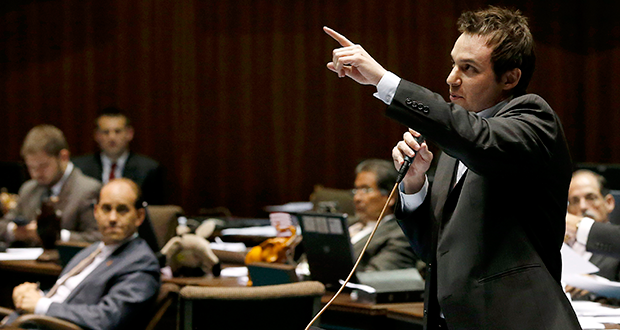
State Rep. Alexander Kolodin, R-Scottsdale, speaks during a House session on April 23, 2025, at the state Capitol. Kolodin has been a key figure in the push to reform Arizona’s election law in the shape of Florida’s. (AP Photo/Samantha Chow)
Arizona Republicans reignite push for Florida style elections
Jakob Thorington Arizona Capitol Times//November 22, 2025//


Key Points:
-
Arizona Republicans propose Secure Arizona Elections Act
-
Measure requires 7 p.m. Friday deadline for early ballots
-
Democrats claim the measure is a voter suppression tactic by Republicans
Arizona Republicans who want to speed up and secure state election results are planning to subvert the state’s Democratic governor by pushing a controversial election measure to voters on the 2026 general election ballot.
GOP lawmakers in both chambers at the Capitol prefiled identical resolutions that they say would make the state’s elections more secure. The resolutions, Senate Concurrent Resolution 1001 and House Concurrent Resolution 2001, are both titled the Secure Arizona Elections Act. The provisions are similar to Florida election laws.
The measure would require all early ballots to be submitted by 7 p.m. the Friday before an election and require voters to provide identification when casting their ballots. It also requires voters on the Active Early Voting List to confirm their ballot-delivery address each election year.
“Arizonans are tired of excuses and chaos on Election Day,” said the measure’s sponsor, Rep. Alexander Kolodin, R-Scottsdale, in a statement. “The Arizona Secure Elections Act gives voters clear rules, strong identification standards, and the confidence that only citizens are taking part in our elections. These are straightforward reforms that put voters first. They ensure our elections run on time, follow the law, and earn the public’s trust. I look forward to sending it to the ballot so the people of Arizona can make it the law.”
During the 2025 legislative session, Gov. Katie Hobbs vetoed House Bill 2703, a GOP proposal that carried several similar election reforms, including the 7 p.m. Friday deadline for early ballots and the address verification requirements for Active Early Voting List voters.
In her veto letter, Hobbs wrote she was unwilling to speed up election results at the expense of restricting Arizona citizens’ freedom to vote and warned that HB2703 would “effectively” end the Active Early Voting List.
If the measure is approved as a resolution by both the House and the Senate, Republicans would be able to ask voters for approval of these new election rules directly rather than seek the governor’s signature.
The House resolution is cosponsored by several Republicans affiliated with the Arizona Freedom Caucus who have been pushing for faster election results and stronger voter identification requirements.
Sen. Shawnna Bolick, R-Phoenix, is sponsoring the Senate measure as a top priority for Senate Republicans that would also prohibit foreign donations in state elections.
“Election integrity is paramount to maintain our Republic,” Bolick said in a statement. “For years, voters have asked for reforms that protect their voice and restore confidence in the system. It’s time we give them the chance to secure those protections permanently.”
The ranking Democrat on the Senate Judiciary and Elections Committee, Sen. Analise Ortiz, D-Phoenix, told the Arizona Capitol Times that she believes both the mirror resolutions are written vaguely and could lead to voter suppression in 2026.
“I think that we’re going to see these voter suppression efforts amplified this year because I think Republicans are terrified by the election results that we saw in Virginia and New Jersey,” Ortiz said. “Arizona Republicans are reading the tea leaves and are recognizing the only way they can win is to cheat and that’s what they are trying to do.”
Ortiz said she was alarmed by a particular provision that states that votes shall not be cast or accepted after poll closing times on general election day. She said such language could be interpreted to not allow people standing in line past the deadline to vote at a polling place on election day.
Kolodin told the Arizona Capitol Times that it is not his intention with the measure and that the resolution does not do that. It would also guarantee that all qualified voters have a right to vote in person at a conveniently located polling place.
The founder of the state’s Freedom Caucus, Sen. Jake Hoffman, R-Queen Creek, accused other Republicans at the Legislature of attempting to kill the Arizona Secure Act in a Nov. 18 post on X due to the address verification requirements of the bill.
If the measure were to make it to the ballot, Ortiz said she believes voters would be unlikely to pass it, but anticipated a well–funded campaign leading up to the election.
“If voters understand this, there’s no way it’s going to pass,” she said.
A housing organization in the state is warning new federal homelessness rules could push more Arizonans onto the streets.
The U.S. Department of Housing and Urban Development last week announced $3.9 billion in competitive grant funding for federal assistance to local homelessness programs, taking a different approach from former President Joe Biden’s “housing first” model for individuals experiencing homelessness to transitional programs with enhanced drug-treatment requirements, mandatory use of a federal immigration-verification system and a focus on “self sufficiency” rather than the “perpetuation of slush funds.”
The Arizona Housing Coalition warned in a Wednesday news release that the new rules for grant funding could negatively impact tribal and rural communities which depend on long-term housing options.
According to the coalition, Arizona cannot meet the new rule requirements currently. One of the rules requires full statewide participation in federal sex-offender reporting systems but Arizona’s law enforcement and tribal police agencies use different reporting systems that don’t connect to federal systems. Many tribal and rural areas also don’t have 24/7 detox and inpatient treatment facilities set up in accordance with the new rules.
“Our members see the reality every day,” said Nicole Newhouse, Housing Coalition Executive Director Nicole Newhouse said in a statement. “Some rural counties don’t have a detox bed, an inpatient center, or a crisis team within 100 miles. You can’t require services that don’t exist and then punish communities for not having them. That doesn’t solve homelessness — it makes it worse.”
The new federal grants also cannot be awarded until May 2026 and some contracts in Arizona end earlier than that date, which could result in some people losing housing services.
The coalition is pushing for Congress to extend all existing HUD grants for one additional year while local communities work to meet the new grant requirements.
According to the federal housing department, about 90% of homelessness grants supported housing first programs and transitional housing programs never received more than 2% of annual grant funding during Biden’s presidency.
The new rule changes would also substantially increase competition for grant funding, rising from about 10% of projects to 70% under the Trump administration.