Sign In
Upcoming Event
 Free Newsletter

State budget facing ‘cliff in federal funding’
Howard Fischer, Capitol Media Services//December 1, 2025//
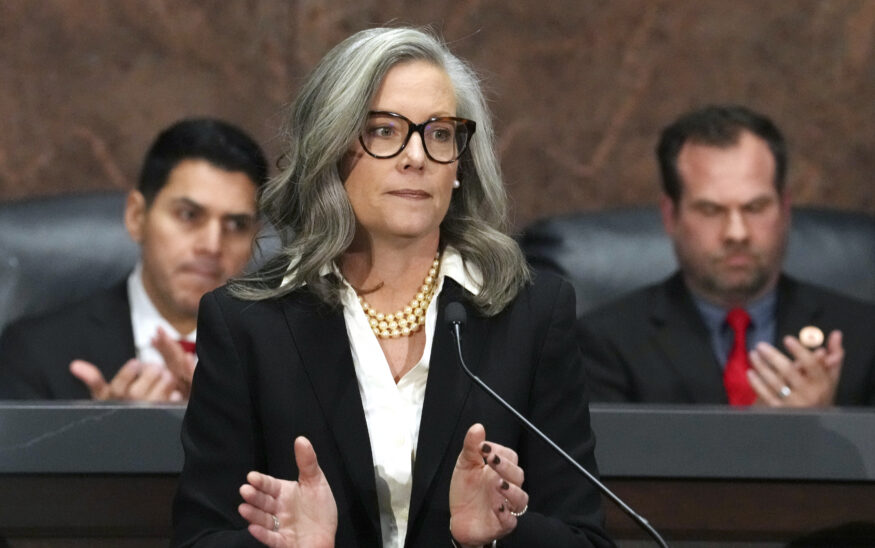
FILE - Arizona Democratic Gov. Katie Hobbs, center, applauds for those affected by the Los Angeles area wildfires as she gives the State of the State address in the House of Representatives at the state Capitol with Speaker of the House Rep. Steve Montenegro, R-Litchfield Park, left, and Senate President Warren Petersen, R-Gilbert, flanking the governor on Jan. 13, 2025, in Phoenix. (AP Photo/Ross D. Franklin, File)
State budget facing ‘cliff in federal funding’
Howard Fischer, Capitol Media Services//December 1, 2025//


Key Highlights:
- Despite uncertain economy, Gov.Hobbs determined to cut taxes
- Curbing universal vouchers for private and parochial schools is in Hobbs’ sites
- The governor didn’t provide details on what programs and services will be cut
PHOENIX — Gov. Katie Hobbs is defending her proposal to cut personal income taxes by more than $200 million even as the state faces an uncertain financial future.
“The state is facing a challenging budget,” the governor said Monday, with not just an uncertain economy but cutbacks in federally funded programs. Even Ben Henderson, her budget director, said the state faces a looming “cliff in federal funding unlike anything in recent history.” But Hobbs said she remains determined to cut taxes — even if it reduces state revenues — saying that Arizonans also need financial relief.
“I hear over and over again ‘things are unaffordable’ and this is making it easier on them,” Hobbs continued. “And I think we owe it to them to deliver that.” But the governor provided no immediate answers on which services, now being provided with state tax dollars, she would cut to make up the difference.
“You will see that when we unveil our budget in January,” she said. “But this is something that we have calculated into the budget that we will present.”
Still, Hobbs admitted she does have one program in her financial sites: Curbing the system of universal vouchers that provides taxpayer dollars — an average of $7,400 a year — to attend private and parochial schools.
The Democratic governor has attempted every year since taking office in 2023 to cut back the program. When outright repeal failed, she tried last year to impose income limits, eliminating vouchers for families who earn more than $200,000, something she claimed would save $150 million a year. That didn’t even get a vote. “It doesn’t mean that we give up the fight,” Hobbs said. And she contends that news reports about the program, ranging from questionable purchases made by parents of home-schooled children to the absence of income limits, will bring the public around.
“Nobody intended for our education dollars to be spent this way,” Hobbs said, with the cost of vouchers, known as Empowerment Scholarship Accounts, now approaching $1 billion. But House Speaker Steve Montenegro said any such plan remains a non-starter. “House Republicans remain focused on strengthening the program and protecting parents’ rights to guide their children’s education,” the Goodyear Republican said. “Parental choice will not be reduced on our watch.”
There is Republican support for what’s in the governor’s program, which is a partial carbon copy of what Congress approved earlier this year: Larger standard deduction for those who don’t itemize, an additional $6,000 reduction in taxable income for Arizonans 65 and older, and no tax on tips or overtime.
But GOP lawmakers also want the things in the “Big Beautiful Bill” incorporated into the Arizona tax code, things that Hobbs has not included. That includes allowing businesses to write off the cost of new equipment faster to reduce their taxable income and a big tax break for the wealthiest Arizonans who itemize their taxes.
All that carries an estimated $337 million price tag according to legislative budget analysts; just the part Hobbs wants would cut state revenues by about $215 million. Here, too, Montenegro said Hobbs is wrong to pick and choose which parts of the federal law the state should incorporate into the Arizona tax code.
“Gov. Hobbs’ insistence to tax items the federal government leaves untaxed would raise everyday costs and drive employers elsewhere,” he said. Instead, Montenegro said, the Republican-controlled Legislature will send her “a responsible conformity bill that gives taxpayers the certainty and relief they need.”
Whatever happens needs to happen soon. GOP lawmakers have asked the governor to convene a special session for Jan. 19, to run concurrent with the regular session that starts the same day.
First, the state Department of Revenue needs to prepare the forms Arizonans use to compute their taxes and file them by the April 15 deadline. And Hobbs already has directed the agency to incorporate changes — at least those she wants — into those forms.
But Arizonans seeking to get a jump on tax filing who use those forms before the Legislature has approved the new provisions do so at their own risk: If the final deal negotiated between the governor and lawmakers doesn’t match, they will have to file amended returns.
There’s also the fact that most legislation does not take effect until 90 days after the end of the session. Absent a two-thirds vote of the House and Senate, legislation approved in a regular session would not take effect until this summer or fall, far too late to help tax filers. But if the changes are approved in a special session, the 90-day clock starts running once that special session adjourns, which could occur before the end of January. And that means the changes would be in effect by the April 15 deadline and the Department of Revenue could finalize the tax forms even before that date.
Hobbs said a special session is “on the table” in her talks with legislative leaders. “We need to get this done quickly before people start to file,” she said. With apparent bipartisan support for some sort of tax cuts in 2026 — it is an election year for Hobbs and all 90 lawmakers — that leaves the question of how much and for whom. Hobbs does not dispute that what she wants is not original. In fact, every piece of it comes from the federal HR 1, which was approved in July, and includes provisions affecting the 2025 tax year.
“I’ve been critical of HR 1 that included these tax cuts,” she acknowledged Monday. Hobbs opposed not just reducing federal revenues, which could indirectly affect Arizona, but also provisions that would increase costs here, such as the state having to pick up more of the cost of administering the federal food stamp program.
“But we’re taking advantage of things that benefit Arizonans, like this tax cut,” she said, cherry picking the provisions she likes. One big ticket item on her list is increasing the standard deduction for those who do not itemize by $750 for individuals — up to $15,750 — and by twice that amount for married couples filing jointly. That alone would cut state revenues by about $45 million.
But that’s just part of it. Reducing state income tax on overtime carries a $76 million price tag this year, with eliminating tax on tips costing another nearly $24 million. Then there’s almost $54 million to allow seniors who meet certain income limits to reduce their taxable income by an additional $6,000, above and beyond existing deductions for those 65 and older.
And her plan also would allow buyers of new cars built in this country to deduct sales tax on their purchases, something that is expected to immediately reduce state revenues by nearly $13 million next year. That leaves what else is in HR 1 but not in what the governor calls “my Middle Class Tax Cuts Package.”
For example, the federal law allows businesses to immediately expense — and deduct — all of their research and development expenses. Having Arizona follow suit, a measure many GOP lawmakers here support, would cut another $50 million in revenues according to legislative budget analysts. Then there’s another 100% depreciation allowance for property used for manufacturing and similar activities; conforming Arizona law to that would cost more than $45 million a year. And finally, it would increase the deduction that could be taken on what people pay in state and local property, income and sales taxes from $10,000 to $40,000 a year. That would mainly affect the wealthiest, who would itemize their taxes.
“You’re going to see the Republicans wanting to push the entire tax package,” Hobbs said of those provisions. But the governor said she wants to see how the GOP lawmakers want to “pay for tax cuts for corporations and billionaires.”