Sign In




 Free Newsletter
Senate OKs ballot measure to double lawmaker salaries
Howard Fischer, Capitol Media Services//March 12, 2026//
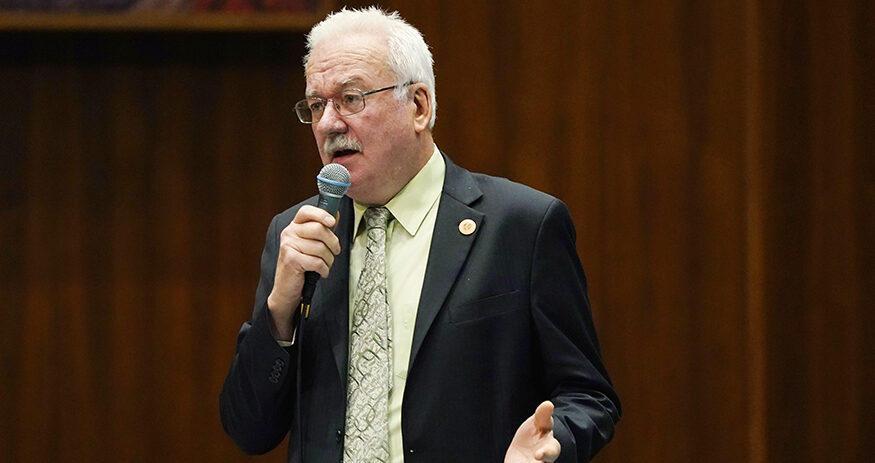
Rep. John Kavanagh, R-Fountain Hills, speaks during a vote on the Arizona budget, June 24, 2021, at the Capitol, in Phoenix. (AP Photo/Ross D. Franklin, File)
Senate OKs ballot measure to double lawmaker salaries
Howard Fischer, Capitol Media Services//March 12, 2026//


Key Points:
-
Majority of Arizona state senators want to double their pay
-
Senators claim higher pay will attract more diverse candidates
-
Proposed pay hike would be tied to the consumer price index annually
A majority of state senators want to ask voters to double their pay.
And the claim is that Arizonans may get a better — or at least broader — choice of people to represent them.
The 20-9 vote March 11 to send the issue to the November ballot came on a proposal by Senate Majority Leader John Kavanagh who has argued that voters can be convinced it’s time to revisit the current $24,000 salary, first enacted in 1998.
Under the Arizona Constitution, legislative pay can be altered only if there is a recommendation from the Commission on Salaries for Elective State Officers – and then, only if voters ratify that proposal. But every effort since 1998 to hike salaries has been rejected at the ballot box.
So the Fountain Hills Republican is trying something different.
He wants voters to scrap the constitutional provisions about commission recommendations and voter approval. In its place would be an amendment saying that salaries would be adjusted every year based on changes in the cost of living as measured by the consumer price index.
More to the point, if the proposal is approved, first by the House and then by voters, that would put future increases on legislative pay on automatic and make it the last time that lawmakers would need to go to voters for authorization.
But what is not obvious is that Kavanagh worded his SCR 1020 so that the indexing would begin based not on the current salary – assuming the measure is approved – but would instead be computed from that 1998 increase. And that translates into an immediate pay boost of more than $48,000, according to an inflation calculator from the U.S. Bureau of Labor Statistics.
Sen. Mitzi Epstein told colleagues that a pay hike is justified. She said while Arizona is supposed to have a part-time Legislature, the reality is that it can take 60 hours a week.
And it’s been years since lawmakers have adjourned in April as the rules suggest.
“The compensation needs to be there so that we can recruit people to do the job who are not already able to pay their way,” said the Tempe Democrat. Epstein, who is not seeking re-election, said she wants to be part of that recruitment process.
Closely linked to that, she said, is having a Legislature that is more reflective of the population.
“We cannot reach that representation goal unless we are providing a salary that you can live on,” Epstein said. “And $24,000 a year is not livable unless, in my case, you are already living on retirement savings.”
Sen. Mark Finchem agreed that a higher salary would lead to a more diverse Legislature.
“That means Joe Average can leave a job, or take a sabbatical for a couple of years, run for office, serve, and then go back to his job, without sacrificing that median home income for his family,” said the Prescott Republican. Finchem, who is seeking re-election, previously served in the state House for eight years, left to run unsuccessfully for secretary of state, and then moved to Prescott, where he won a successful bid to represent the area in the Senate.
Sen. Lauren Kuby, in her first term in the Legislature, echoed the sentiment.
“We certainly want people of all incomes to have the opportunity to run for office,” the Tempe Democrat told Capitol Media Services afterwards.
But she should not bring herself to support the measure.
“Why is this a priority when Arizona’s working families are struggling for fair wages?” asked Kuby.
She also noted it is now nine weeks into the 2026 legislative session.
“And we haven’t centered our attention on real struggles and issues affecting our communities,” Kuby said. “If there were a performance evaluation from our constituents, not sure how well we would score.”
Also voting against the measure was Sen. Jake Hoffman, who had his own set of reasons. The Queen Creek Republican told Capitol Media Services he isn’t buying the argument that higher salaries will result in a larger pool of qualified contenders.
Consider, he said, the congressional salary of $174,000 a year.
“Yet Congress limps along with approval ratings barely above 20%,” he said. And Hoffman, first elected in 2022 and seeking another term in November, said that California and New York legislatures, with salaries of $132,000 and $142,000 respectively, “have become poster children for overreach, bureaucracy, and policies many view as outright fascist and authoritarian.”
“Raising pay … simply entrenches career politicians, rewards incumbency, and further disconnects them from the people they claim to serve,” he said. “Proposals to increase pay for politicians only produce higher pay for politicians, nothing more and nothing less. Period.”
Sen. J.D. Mesnard said he’s not against the concept.
“It’s not a terrible idea,” said the Chandler Republican who was first elected to the Legislature in 2010. He also is not seeking re-election and would not be affected by what voters decide.
But he, too, voted against the measure, questioning whether it makes sense to set up a system that gives lawmakers an automatic cost-of-living increase every year.
“That’s a little bit more generous than most employers provide,” Mesnard said.
He also has a practical concern: Would voters, learning that approval of the measure would immediately double legislative salaries, be willing to go along?
Kavanagh, for his part, said he’s not worried about that. He said it’s just a matter of explaining to voters that this really shouldn’t be seen as doubling legislative pay.
The way Kavanagh sees it, when voters approved the last pay hike in 1998 – an increase from $15,000 that had been in effect since 1980 – they thought that $24,000 was an appropriate wage for that time. All his measure does, he said, is ask voters to adjust the current wages to match that level.
Kavanagh, first elected in 2006 and hoping for yet another two-year term, also said the proposal is fair: It is structured so that if there is deflation and the consumer price index drops, legislators’ salaries would drop the following year.
The measure now goes to the House.
History of legislative pay:
– Original 1912 Arizona Constitution: $7 per day
– 1932 initiative – $8 per day.
– 1958 referendum – $3,600 per year
– 1968 referendum – $6,000 per year
– 1980 salary commission recommendation approved by voters – $15,000
– 1998 salary commission recommendation approved by voters – $24,000