Sign In




 Free Newsletter
Arizona home builders want to reduce housing prices by eliminating city standards
Bob Christie, Capitol Media Services//April 21, 2026//
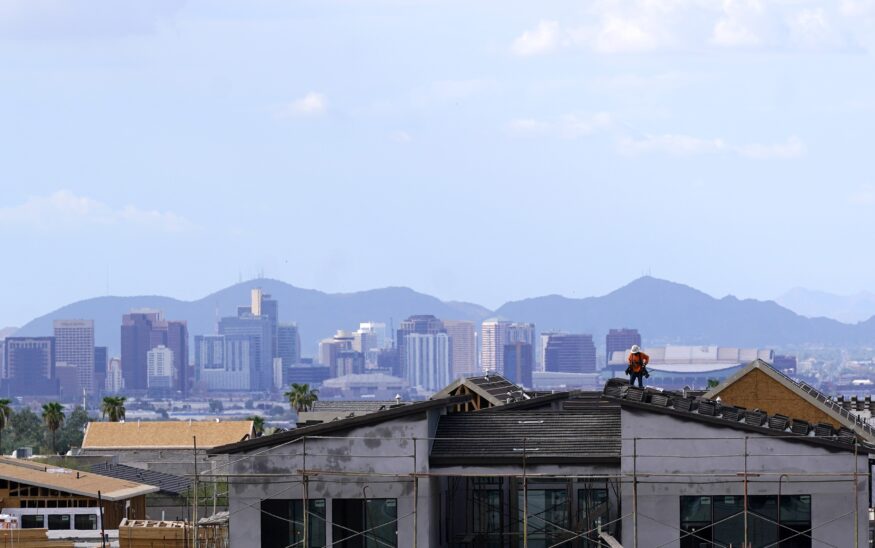
In this Aug. 12, 2021, file photo with the downtown skyline in the background, a roofer works on a new home being built in a new housing development as expansive urban sprawl continues in Phoenix. (AP Photo/Ross D. Franklin, File)
Arizona home builders want to reduce housing prices by eliminating city standards
Bob Christie, Capitol Media Services//April 21, 2026//


Key Points:
-
Arizona House proposal aims to lower housing prices by blocking city design standards
-
Proposal would remove requirements for garages, patios and fencing in new homes
-
Critics argue the bill could lead to poorly built homes
They’re either ensuring more affordable homes, or they’re building junk houses.
That’s the basic breakdown of a proposal awaiting a vote in the Arizona House that would upend decades of municipal design standards builders are required to follow to develop new housing tracts across the state.
The proposal is the latest effort by builders and housing advocates on both sides of the political aisle to address high housing prices for single-family homes.
The method? Block cities and towns from requiring everything from garages, paved driveways, backyard patios or fencing between new homes or even main streets. That also includes any city or town standards requiring specific exterior designs, exterior lighting, roofing pitches, floorplans or exterior color requirements.
Also gone would be any requirements for developers to put in neighborhood parks, common areas or landscaping that would require a homeowner’s association and its associated fees.
Without those new rules, proponents argue home buyers face being pushed out of a market now averaging nearly $500,000 for a new home.
Opponents argue cities are best suited to making decisions on zoning, standards for new home development and neighborhood character, and that blocking their longstanding rules for new homes could see poor quality homebuilding that doesn’t stand the test of time.
They also note there’s nothing in the proposal requiring builders to pass on the savings to buyers, meaning big national builders could just pocket the savings they see from making cheaper-quality homes.
Sen. Shawnna Bolick, R-Phoenix, is the main sponsor of Senate Bill 1431, this year’s iteration of a measure previously dubbed the “Arizona Starter Homes Act.” The proposal failed in the past two legislative sessions but has seen new bipartisan momentum this year while moving through the chambers.
Bolick argues her bill is a much needed stopgap for rising home prices — prices which she says her own adult children cannot afford. More importantly, she says new home buyers are willing to forego the amenities for a more affordable home.
“I can tell you, having 20 year olds and meeting with their friends over the weekend, they are all struggling,” Bolick said on March 2. “Because when they go and look at different communities, there are a lot of things in those developments on even a smaller house that they don’t want.”
The average age of a first-time home buyer has soared in the past 20 years and a December survey by the National Association of Realtors put it at an all-time high of 40. The same report showed that first-time buyers dropped to a record low of 21%, a drop of 50% since 2007, driven down by low inventories of budget-priced starter homes.
The toughest part of the bill’s journey so far has been the Senate, where Bolick faced a potentially dead measure had she not reached out for support.
Sen. Lauren Kuby, D-Tempe, argued against the measure, noting her previous work with an Arizona State University center focused on housing affordability.
“And that work that I did with the university reinforced a core truth — that neighborhoods are not just collections of houses,” Kuby said. “They must include the social determinants of health, be it parks, walkable streets, green space, gathering places and safe, connected communities, all with the goal of creating healthy communities.”
“So I believe this bill broadly preempts local building standards and imposes a one-size-fits-all state mandate,” she said. “Cities and towns should retain the ability to require thoughtful design and shared amenities like small green space.”
Another Democrat, Sen. Analise Ortiz of Phoenix, strongly supported the bill, calling it “a common-sense measure” and bemoaning the fact that, at the time, it was failing.
“You know, we consistently talk about the need to pass measures that will make home ownership more affordable and make Arizona more affordable,” Ortiz said. “This bill will do that.”
And she noted that the idea is bipartisan.
“If you look across the country, you have Democratic governors and Republican governors both agreeing that this is the type of policy that, in a common-sense way, will drive down the cost of home ownership,” Ortiz said.
Bolick then urged senators to change their minds and back the measure — with the promise that the bill before them wasn’t necessarily the final product.
“We are still working on potential amendments, so if you don’t love the bill, that’s wonderful,” she said, promising changes in the House. “We had a bill that was totally different last year, and I did say that I would continue to work in the House on the bill.”
Those changes, however, never happened in the House.
Bolick never asked for any amendments during a hearing of the House Commerce Committee. And none came this past week, when the measure passed on a voice vote of the full House with no changes.
A formal vote is needed before the measure goes to Gov. Katie Hobbs for her to consider.
The measure still contains the bones of last year’s proposal, preempting cities from requiring many amenities like fencing and garages, but gone are the most contentious issues, requirements that cities approve lot sizes as small as 3,000 square feet and setbacks of just 10 feet from the street.
Cities are united in opposition, with dozens of representatives, including from Tucson, signing in in opposition.
Nick Ponder, a lobbyist for several cities and for the League of Arizona Cities and Towns, told a Senate committee earlier this year that the measure presents a false choice, with many proponents presenting it as a proposal letting homebuyers decide about amenities, while those decisions are actually made by developers long before buyers enter the picture. He also noted that precluding city requirements for open space, stormwater retention and small community parks shifts those responsibilities to the broader community.
And those items and city design standards more broadly aren’t what is driving up costs, he said.
“It is the land value that is driving up costs,” Ponder told a Senate committee earlier this year. “Maricopa is more affordable — but it is more affordable because it is a little farther away.”
“It always goes back to the key tenet of real estate: location, location, location,” Ponder said.
At that same hearing, Sen. Brian Fernandez, D-Yuma, said he doubted home prices would fall if the bill passed.
“Making housing affordable should be our goal — I just don’t know if this does it because I think that the prices will just rise with the markets,” he said. “This is all supply and demand. (As) these houses become available, Black Rock or some group will buy them up, and then they’ll just keep them and sell them when they’re able to make a bigger profit on them.
Also gone is a provision making it only apply to cities with population over 70,000 people — so if enacted and signed by Gov. Katie Hobbs, Bolick’s proposal would apply statewide.