Sign In
 Free Newsletter

23 more speciality license plates possible, but not for LGBTQ+ students
Jordan Gerard, Arizona Capitol Times//April 18, 2026//
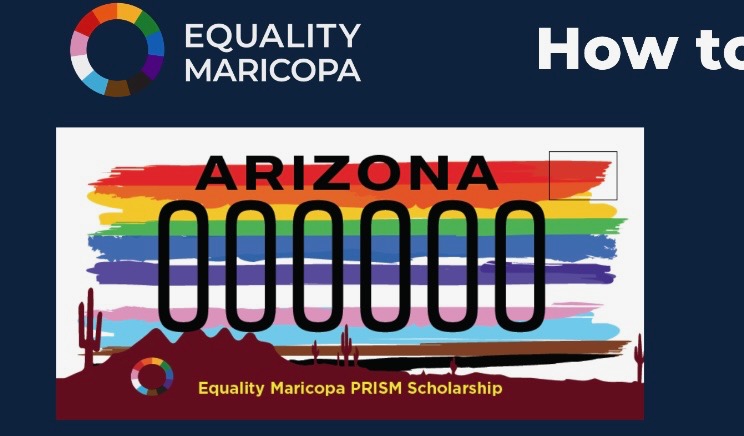
The preliminary design for the specialty plate that Equality Maricopa seeks. Donations from the plate would go toward scholarships for students attending college. The design is subject to change. (Submitted by Equality Maricopa)
23 more speciality license plates possible, but not for LGBTQ+ students
Jordan Gerard, Arizona Capitol Times//April 18, 2026//


Key Points:
-
An omnibus bill could bring 23 new specialty license plates to Arizona drivers
-
License plate revenues support local organizations, typically apolitical
-
A proposed specialty plate that would support LGBTQ+ students attending college was never heard in committee
Arizona’s specialty license plates were designed to raise money for a wide range of causes, but a new proposal to add 23 more plates to the state’s roster is testing the political limits.
A proposal to create a plate that would honor late activist Charlie Kirk and send donations to the nonprofit conservative organization Turning Point ignited a mix of support and criticism before it met Gov. Katie Hobbs’ veto.
The governor said his assassination was tragic and a horrifying act of violence and spoke against political violence, adding, “I will continue working toward solutions that bring people together, but this bill falls short of that standard by inserting politics into a function of government that should remain nonpartisan.”
At the same time, efforts to create a specialty plate that would benefit LGBTQ+ college students attending Maricopa Community Colleges have also been repeatedly rejected by Republican lawmakers for the past four legislative sessions.
Now, 23 more specialty license plates are coming through the Legislature, supporting causes like honoring military Bronze and Silver Star recipients, skin cancer prevention, students recycling used technology and finally, a Grand Canyon license plate.
But one question remains: How many skirt the political line?
Rep. Lorena Austin, D-Mesa, has been trying to pass a specialty plate that would show support for the LGBTQ+ community and help support college students with scholarships. The bill has never been heard in committee. Austin said it’s because the group who would pay the implementation fee supports the LGBTQ+ community.
“It is discriminatory to exclude this one bill every single year simply because it’s from an LGBTQ+ organization, which is really sad. Like it’s freedom and justice for all except you and freedom for anyone to put anything on their car except you,” Austin, who is non-binary and prefers they/them pronouns, told the Arizona Capitol Times. “That’s literally what is being relayed to us as a community that we are less than and we are not deserving of showing our pride.”
As a member of the LGBTQ+ community, Austin has seen the struggles that some students face. Some don’t have family support or financial assistance to help with college, Austin added.
“Scholarship opportunities for underserved communities are either taken very quickly, and then there’s just not enough,” Austin said. “Whatever opportunity we can give for a student to get through school, I don’t know why we wouldn’t take it.”
In this year’s effort to see an LGBTQ+ plate, Rep. Betty Villegas, D-Tucson, filed House Bill 2719, but it was never heard in the House Transportation and Infrastructure Committee. Rep. Leo Biasiucci did not return a request for comment on why the bill was never heard.
However, when lawmakers started asking about the group that would benefit, they didn’t give the bill a hearing, Austin and Villegas said. In contrast, Villegas pointed out that the Charlie Kirk license plate bill at least made it to the governor’s desk.
“That’s a big problem for me. We don’t have a voice,” she said.
Arizona already has two specialty license plates that could be considered political.
One is the “In God We Trust” plate, which donates funds to the Alliance Defending Freedom, a nonprofit organization founded in Scottsdale that defends religious liberty. According to the Department of Transportation, the plate was approved in 2011 and available to the public in 2012. During the last five years between July 2022 and March 2026, the plate has raised $1.15 million. The organization did not answer questions by deadline about their plate.
Arizona also has the “Choose Life” plate, which donates funds to the Arizona Life Coalition, a nonprofit organization in Phoenix that supports pro-life efforts. It has raised $86,600 over the past five years. The coalition did not respond to a request for comment about their plate.
The advocacy group behind the LGBTQ+ license plate is Equality Maricopa and its current president, Jay Franzen, who said his nonprofit organization has existed since the early 2000s in different iterations. Previously, they were an employee affinity resource group operating within the Maricopa Community Colleges district.
But when President Donald Trump signed an executive order that directed universities and colleges to disband their Diversity, Equity and Inclusion efforts, Equality Maricopa “divorced” the district and became a nonprofit. Now they advocate and bring awareness to LGBTQ+ issues.
They’ve been waiting for a specialty plate for years and have the $32,000 implementation fee raised and ready to go, Franzen said. They also have a preliminary design, which is subject to change amid Arizona Department of Transportation approval.
“We’re just getting stonewalled because we’re a queer organization,” he said. “It will never make it out of committee because it doesn’t have enough support from the other side of the aisle.”
The LGBTQ+ license plate isn’t part of House Bill 2127, which is an omnibus bill with 23 specialty license plates. Rep. Neal Carter filed that bill, but did not respond to requests for comment about that bill or the LGBTQ+ plate.
The Arizona Capitol Times reached out and confirmed several plate proposals that would receive the donations if the bill is signed, the $32,000 implementation fees are paid and the plate design is approved by the Arizona Department of Transportation.
The organizations are only identified by criteria in the bill language, not by name. People can choose to pay $25 for a specialty plate, with $8 going to the State Highway Fund and $17 going to the nonprofit organization sponsoring the plate.
Maricopa Community Colleges didn’t comment on the license plate but said in a statement they welcome support from community partners and organizations that help students access and succeed in college.