Sign In
 Free Newsletter

Declining student enrollment prompts call to repurpose Arizona schools
Howard Fischer, Capitol Media Services//January 2, 2026//
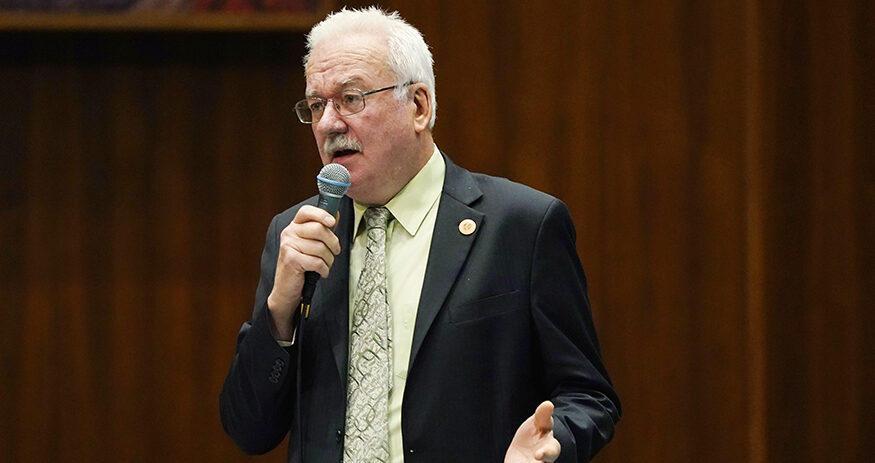
Rep. John Kavanagh, R-Fountain Hills, speaks during a vote on the Arizona budget, June 24, 2021, at the Capitol, in Phoenix. (AP Photo/Ross D. Franklin, File)
Declining student enrollment prompts call to repurpose Arizona schools
Howard Fischer, Capitol Media Services//January 2, 2026//


Key Points:
-
Arizona has a shortage of affordable rental housing and too many schools
-
Sen. John Kavanagh proposes converting schools into affordable housing for teachers and critical workers
-
Declining student enrollment and rising charter schools contribute to surplus school properties
Arizona has too few affordable rentals.
And it has too many schools.
Now, Sen. John Kavanagh thinks he’s found a way to convert the two problems into a solution: Allow those schools to be sold off or leased to be made into housing for teachers and other government and critical workers.
The idea, said the Fountain Hills Republican, may sound far fetched.
He acknowledged that school buildings were designed and built with a specific purpose in mind, providing classrooms, offices, and bathrooms scattered throughout. But Kavanagh said there’s no reason they cannot be repurposed.
“That’s an architectural question,” Kavanagh said.
“There was a time when people said they could never do that because only the core of the building had plumbing, and all that stuff,” Kavanagh said. “They’re converting office buildings right now to residential.”
The problem starts with the declining number of children in Arizona public schools.
Some of that is a demographic change: Families are starting later and having fewer children.
But the explosion of charter schools also siphoned off many children from traditional neighborhood public schools. And, more recently, lawmakers decided to make taxpayer-funded vouchers available to any parent to send a child to a private or parochial school, or to use the funds — an average of $7,400 a year — for home schooling.
That’s reflected in the numbers.
The most recent figures from the state Department of Education show total enrollment in traditional public schools at 868,690. That compares with 928,526 five years ago and 962,277 a decade ago.
All that has left some districts — particularly those in already built up areas — with more schools than they need.
Tucson Unified School District, for example, lists 15 schools as surplus. While some are leased to others, such as the community college system or charter schools, others are listed for sale.
The Kyrene Elementary School District voted earlier this month to close two middle schools and four elementary schools.
In Gilbert, the board is set to vote in January on whether to close Pioneer Elementary school.
And four elementary schools in the Amphitheater Unified School district could be closed next year due to declining enrollment.
Kavanagh said he sees no downside to his plan for schools to make their unused properties available.
“It gets them some extra cash, solves workforce problems, and it takes empty buildings off their hands,” he said. “I mean, it’s a win for everybody.”
The senator said he sees it in his home community.
“They’ve lost two schools in Fountain Hills,” he said.
Nor does Kavanagh believe that many communities, like his, will need to hang on to them for future growth.
“We’re almost built out,” he said, with little prospect of an influx of young families with school-age children.
As crafted, his SB 1080 would allow school districts to enter into partnerships with private entities to sell or lease their buildings or land to provide “affordable housing for critical workforce sectors.
That includes firefighters, peace officers, emergency medical services personnel, hospital workers, health care employees, childcare workers, direct care workers, and teachers and school employees.
None of this is automatic.
Districts would need an independent analysis of the property’s fair market value and the economic impact of the proposed project. Then there would be a public meeting where the board would consider community input.
There also would be a 45-day period for additional public comment. And, finally, it would take a two-thirds vote of the governing board to approve the deal.
Any funds, Kavanagh said, could be used to maintain and upgrade remaining school facilities.
Less clear is whether such plans could be stifled because of existing zoning.
On the one hand, Kavanagh said schools are often in areas where there is already commercial or multi-family development. He said the kind of apartments he envisions should fit right in without running afoul of that.
But Kavanagh conceded that plans could run into problems if the school building being sought for conversion into an apartment complex is in the middle of a bunch of single-family homes where existing residents could object.
No date has been set for a hearing on his measure.
Some districts already have been finding their own ways to create affordable housing.
Flagstaff Unified School District transferred property it owns near Sinagua Middle School to the city with the specific goal of facilitating the development of affordable housing on the 18.8 acres site.
And school districts in Vail, Prescott and Chino Valley have decided to build “tiny homes” on school property for their teachers.