Sign In
Upcoming Event
 Free Newsletter

Pressure mounts at Capitol to extend Proposition 123
Kiera Riley, Arizona Capitol Times//January 10, 2026//

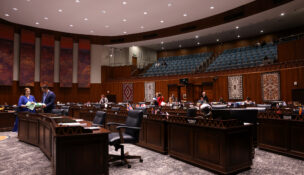
(Pexels)
Pressure mounts at Capitol to extend Proposition 123
Kiera Riley, Arizona Capitol Times//January 10, 2026//


Key Points:
-
Proposition 123 is on Legislature’s radar, but no clear details on reaching consensus
-
Democrats seek clean renewal, Republicans still aim to tie in school choice
-
Conversations come amid tight budget, capital funding lawsuit and ESA opposition
The debate surrounding Proposition 123, the now-lapsed education funding mechanism drawing dollars from the state land trust fund, has reemerged as a slow scramble to compromise this session.
What’s more, there is no complete plan from the Republican majority, Democrats, the governor or the broad spectrum of education groups on how to continue funding raises for Arizona’s teachers.
After two sessions of false starts and stalls, lawmakers and stakeholders have yet to fully reconvene on Prop. 123, all while pressure to pass some type of extension rises.
A projected budget deficit, a court judgment requiring further school facilities funding and finger-pointing at the now $1 billion Empowerment Scholarship Account program converge, putting the education funding measure somewhere near center stage.
Democrats, public education groups and the governor are initially leaning toward a clean extension, but one senator leading the charge has said the plan is to resume negotiations on the topic of controversy lawmakers left off on last session — school choice.
“This is a live wire that I’m assuming is a priority, or should be a priority, to every legislator down there,” Marisol Garcia, president of the Arizona Education Association, said.
Prop. 123, approved by voters in 2016, followed the courts’ finding that the Legislature failed to fund education in step with inflation.
The measure increased the distribution rate from the Permanent Land Endowment Fund from 2.5% to 6.9% for ten years and granted districts discretion to spend the dollars where needed.
Efforts to extend Prop. 123 in some fashion began at the end of 2023, with the Republican majority taking the lead and unveiling a plan to use the funds solely to raise teacher salaries.
Public education groups, Democrats and the governor followed with their own proposal to increase the distribution rate and expand the scope of spending. Then, a stalemate put conversations off until the 2025 session.
Republicans, holding tight to their teacher pay plan, then started bringing Empowerment Scholarship Account advocates and charter schools into the fold.
And though no final language ever materialized in either chamber, the session ended with talk of Republicans incorporating constitutional school choice protections and charter deregulation into Prop.123, both nonstarters for the governor, Democrats and public school groups.
Prop. 123 expired at the end of last fiscal year, leaving the Legislature to backfill around $300 million from the general fund to make up the difference. And, now, as a new session dawns, focus has returned to the measure, though again with sparse consensus on provisions or new ways forward.
Gov. Katie Hobbs flagged it as a priority for her office this session.
“It’s a way to just give more dollars to our public schools that need it without costing taxpayers anything,” Hobbs said. “I think what I hear from Arizonans, and thankfully, it sounds like Republicans have gotten the message too, is that we need to do what we can to lower costs.”
Hobbs said she had not yet been directly involved in any conversations, but stressed the need to push the issue amid the current fiscal climate, pointing specifically to ESAs.
“Given our budget situation, I can’t imagine wanting to leave money on the table that’s going to help fund public schools, especially given that they haven’t been willing to make any reforms to the now billion-dollar ESA entitlement program,” Hobbs said.
To start, Sen. J.D. Mesnard, R-Chandler, plans to start circling back.
“Once you take a few months off, people’s minds can change, or they have questions they didn’t have before, or they have new thoughts,” Mesnard said. “At this point, I’ve got to regroup with various members, various stakeholders out there and gauge their temperature.”
But Mesnard clarified this does not necessarily mean starting from square one.
He ended last session near a final draft and an initial filing, but ultimately saw the issue swallowed by the budget process.
“It’s that last 10% that people really drill into and get worked up over… (we’re) trying to achieve that, quote unquote, perfect version. It may not exist, but we continue to try to get there,” Mesnard said. “We’re not starting from scratch. I’d say we’re starting from a very good place.”
School choice protections will remain part of the conversation, encompassing both the ESA program and charter schools, according to Mesnard.
Jenny Clark, founder of school choice advocacy group Love Your School, said she would attend any Prop. 123 stakeholder meetings to which she was invited.
A spokesperson for the Goldwater Institute declined to comment on the matter, as did the president of the Arizona Charter Schools Association, Jake Logan.
In the House, Rep. Matt Gress, who initially led the charge in the chamber last session, said leadership is still gauging member interest in Prop. 123.
“Republicans have been very interested in raising teacher pay while protecting school choice, and I know that’s been a big disagreement with the Governor’s Office,” Gress said. “We’ll know more about where the House stands later this month. “
House Minority Whip Nancy Gutierrez, D-Tucson, said Democrats plan to fight for a clean continuation of Prop. 123 and to hit any school choice provisions with a hard no.
“That’s $300 million a year that had to come from the general fund, that should be coming from this fund of state land sales,” Gutierrez said. “Why wouldn’t the Republicans want to free up $300 million of spending? Again, they are not the party of fiscal responsibility.”
Garcia also made the case for a clean extension.
“The districts have been extremely thoughtful and transparent about how the money is used, and most importantly, it is used based on what each district needs,” Garcia said. “We know a program works. Why won’t we continue it?”
She noted maintaining the funding measure is crucial, given future strain on the state budget and the court-ordered obligation on the state, though on appeal, to fully fund capital budgets after a judge ruled current funding failed to meet the constitutional minimum.
And Garcia noted the ongoing opposition to the ESA program’s expansion, which is close to 100,000 students and is eclipsing $1 billion.
“Before we start saying, well, everything has to be cut. The reality is, we know the biggest program that needs to be cut in education, and it’s the non-public education families that we’re paying for their kids to go to private schools,” Garcia said.
Garcia said the inclusion of school choice protections ultimately threw a wrench in the negotiating process. But, she said, the union is still looking to return to the table.
“We’re going to have to reestablish them and continue to build some bridges and places that we know are not normal,” Garcia said. “But I’m also hopeful that it is an election year, and in my experience in this work, every election year people love to say they support public education because it gets them elected.”
Mesnard is hoping to get more from stakeholders beyond the non-negotiables.
“I’d rather get feedback on — here’s what we care about and what would earn our support — as opposed to earn our opposition,” Mesnard said. “I’m going to listen more carefully. Ultimately, I welcome any feedback, as I always have.”
And, overall, Mesnard said he does not want to put a proposal out there until it’s sound.
“I’m trying to, frankly, be even a little more cautious, given that I don’t like the starts and stops of the past, and I fear if we do that anymore, people, even if they want Prop. 123, can be like, this isn’t going anywhere, and they’re not even think about it,” Mesnard said.
“If I got one more card to play on this, I’m going to play it at a very key moment. I don’t know when that will be, but I’m hoping for an opportunity.”
Gress also added the need for foresight beyond the Legislature, with any measure requiring final approval from the voters.
“We’re doing it because we want to pass the measure, not just to say we passed something in the Legislature,” Gress said.