Sign In
 Free Newsletter

Employers in Arizona may soon face heat safety requirements
Howard Fischer, Capitol Media Services//January 5, 2026//
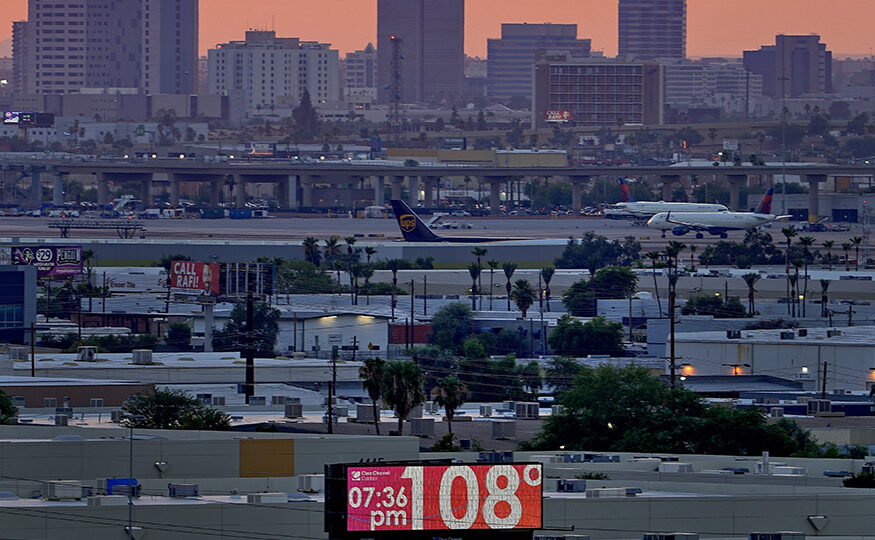
A sign displays an unofficial temperature as jets taxi at Phoenix Sky Harbor International Airport at dusk, July 12, 2023, in Phoenix. (AP Photo/Matt York)
Employers in Arizona may soon face heat safety requirements
Howard Fischer, Capitol Media Services//January 5, 2026//


Key Points:
-
Arizona moves to adopt heat safety requirements for employers
-
Recommendations include access to water, shade, and rest for workers
-
Arizona employers would also be required to develop heat illness prevention plans
Arizona appears finally ready to adopt some specific requirements for employers to protect their workers from excess heat.
Recommendations from a special task force, released earlier last week, would require companies to develop plans to ensure their employees have access to water, shade, and rest. They would mandate that employers train their supervisors and workers about the risks of heat exposure.
What came out of what Gov. Katie Hobbs called the Workplace Heat Safety Task Force, however, does not include hard-and-fast standards, such as what employers must do when the temperature reaches a specific point. Instead, the recommendations — and, for the moment, that’s all they are — say are designed to be flexible, particularly in requirements for rest breaks.
The next step is for an advisory committee of the Arizona Division of Occupational Safety and Health to review the recommendations, hold a public hearing on Feb. 4, and develop its own proposal. That, in turn, gets forwarded to the Industrial Commission of Arizona, the agency charged with protecting worker safety.
But if guidelines similar to these are adopted by the commission, they would be far more comprehensive than what the state has now.
Commission Chairman Dennis Kavanaugh said the problem to date is that Arizona has had no objective standards for determining whether workers are being subjected to excessive heat.
Instead, he told Capitol Media Services, all his agency has had to work with is a general — and non-specific — duty of employers to provide a “safe workplace.” More to the point, there is nothing in the rules that tells employers exactly what they have to do to provide shade, water, rest periods, and even training and acclimatization for new workers.
“Sometimes, that can be amorphous,” Kavanaugh said
And that, said Kavanaugh, can make it difficult to cite employers who may be placing their workers at risk.
“I think it’s a positive step forward,” he said of the recommendations. “I think the approach is generally good.”
Still, Kavanaugh has concerns about the fact that, even if the recommendations are adopted, whether as guidelines or more formal rules, they may lack specificity.
“The logical question is, how can we enforce this?” he asked. “You want employers and workers to know what the rules are, what you need to do to stay in compliance to increase the chances you’ve got a safe workplace.”
But what that also means, said Kavanaugh, is that employers need to know exactly what they must do to avoid legal trouble. And that, he said, can mean spelling out what is required.
“If you do A, B and D and didn’t do C, and somebody got hurt, you are aware of it,” Kavanaugh said. “It makes it easier to prove a violation.”
That’s something Kavanaugh understands.
Before becoming a member of the commission, he was its chief counsel. And that meant he and his staff had to pursue charges against companies accused of failing to maintain safe workplaces.
The recommendations include some general standards.
For example, it says employees must have “ready access to potable drinking water at no cost.”
It must also be located “as close as practicable and reasonable” to where employees are working, be free from dirt or contamination, and be cool — ideally 59 degrees, according to the guidelines.
Another part of the recommendations calls for “adequate shade” in any natural or constructed structure that blocks direct sunlight. It also says employees “should be encouraged” to take cool-down rests in shaded areas where water should be available.
And they say workers should be allowed, without penalty, to take rest brakes in the shade “when they feel the need to do so to prevent overheating.”
All that is supposed to be in a “heat illness prevention plan” that each company must develop.
Kavanaugh said that’s good, but wonders if it goes far enough.
It starts, he said, with the currently unanswered question of whether those plans will have to be filed with the commission. What makes that important, Kavanaugh said, goes to the ability to cite a company that isn’t even complying with its own plan.
Members of the 24-person task force could not be immediately reached for comment. Hobbs released the recommendations late Wednesday — New Year’s Eve — even though the document shows it actually was prepared on Dec. 16.
Instead, the governor’s office did supply prepared statements from several task force members.
Jason Sangster, business manager of Ironworkers Local 75, called the recommendation “a win for Arizona workers.”
“By implementing these changes, we are making sure all workers can return home safely to their families after a hard day’s work in the Arizona heat,” he said.
David Martin, president of the Arizona Chapter of General Contractors Association, said his organization “has historically been cautious about one-size-fits-all regulations.” Martin said he appreciated being given “the chance to bring a practical, on-the-ground construction perspective into the conversation.”
And Phil Smithers, director of safety and environment at Arizona Public Service, said the recommendation “provide a flexible set of best practices … while supporting the need to restore power quickly to our customers.”
Those comments address the exceptions built into the recommendations, including emergency operations to protect life or property, or to restore essential services like utilities and communications.
There also is an exception for “incidental heat exposures” where employees are not required to work in the heat for more than 15 minutes in any 60-minute period.