Sign In
 Free Newsletter

Hobbs and lawmakers push for early special session on tax conformity
Jakob Thorington Arizona Capitol Times//January 9, 2026//
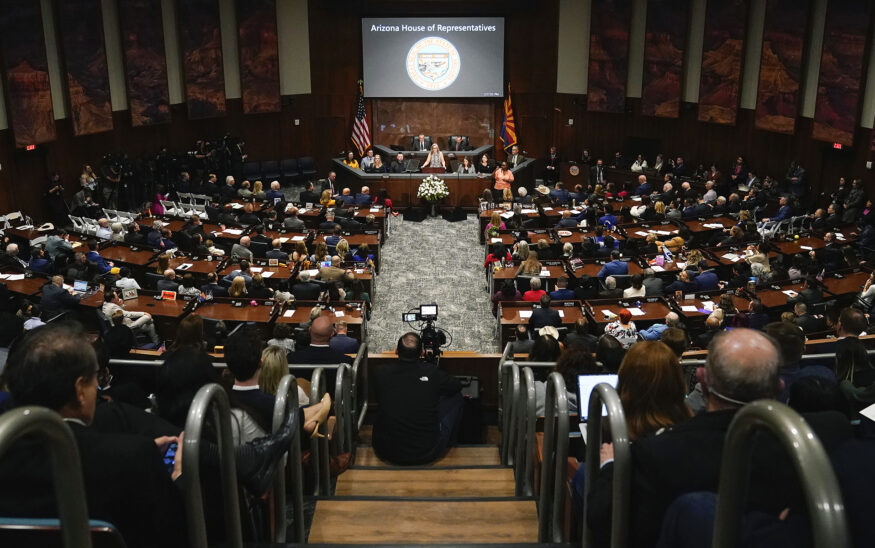
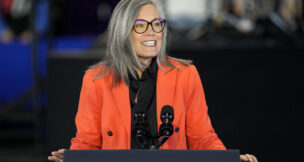
Arizona Democratic Gov. Katie Hobbs delivers the State of the State address at the state Capitol, Monday, Jan. 8, 2024, in Phoenix. (AP Photo/Ross D. Franklin)
Hobbs and lawmakers push for early special session on tax conformity
Jakob Thorington Arizona Capitol Times//January 9, 2026//


Key points:
-
Arizona lawmakers consider special session for federal tax code conformity
-
Governor Katie Hobbs and House Republicans support the special session
-
Arizona’s budget stabilization fund may be tapped to cover the shortfall
A special session could be on the horizon immediately after the state Legislature’s opening day as lawmakers are considering conforming to the federal government’s tax code.
Republican legislators and Gov. Katie Hobbs have said they’d be willing to call a special session at the beginning of the regular legislative session to address the tax issue as Arizona faces uncertain budget implications over the next few years.
“The Arizona House stands ready to act and we are prepared to end the confusion on day one,” House Republicans said in a November joint statement. “To give taxpayers certainty heading into the upcoming filing season, we urge the Governor to call a special session on tax conformity on the first day of the legislative session beginning January 12th.”
Hobbs, a Democrat, signaled she also wants the state to conform to the federal tax code quickly with a Nov. 20 executive order that updates tax forms for the upcoming year to include the higher standard deduction passed into law by the federal House Resolution 1 — “The One Big Beautiful Bill.”
In a Nov. 20 statement, Hobbs said: “Arizona must provide relief for families who are seeing the cost of living increasing and struggling just to get by. While I’ve taken this important step to cut taxes for the middle class, there’s still more work to be done. I encourage the Legislature to join with me to immediately codify my Middle Class Tax Cuts Package to increase the standard deduction, support our seniors and allow everyday Arizonans to benefit from tax deductions on tips, overtime and car loan interest when paying their state taxes.”
Staff on the Joint Legislative Budget Committee estimated in December that conforming to the reconciliation bill could reduce the state’s general fund revenue by $1.15 billion over three years through fiscal year 2028.
During a Finance Advisory Committee meeting on Oct.9, JLBC Director Richard Stavneak said the state’s cash balance is expected to be positive through the next three years, with a lowest ending balance projection of $67 million available in the general fund through 2028, which would be insufficient to continue many one-time projects that are being funded in this year’s budget and grossly insufficient to cover conforming to H.R. 1.
Currently, the state is spending $580 million in one-time projects, and some spending items are anticipated to continue for more than one year. The state is paying $195 million to subsidize health insurance for state employees. That line item is considered one-time, but budget analysts also call it “ongoing one-time” because it’s funded every year.
“Relative to our $67 million balance, we’ve already outlined what I believe to be a lot of stress points about what’s going to be competing for that $67 million, like the $1.7 (billion) stress points in the form of H.R. 1, of tax and spending issues, as well as ongoing one-time spending,” Stavneak said.
Arizona has $1.6 billion in its Budget Stabilization Fund, also known as its “rainy day fund.” The House Minority Appropriations Committee Chairwoman, Rep. Stephanie Stahl Hamilton, D-Tucson, told the Arizona Capitol Times that lawmakers have discussed tapping into the rainy day fund, even if it’s not enough to cover the $1.7 billion the state may need.
“I’m a little more troubled than I normally am,” Stahl Hamilton said. “We’re going to have to work hard this session,” she said. “This budget’s going to be a lot more challenging and problematic than what we’ve seen in years past.”
Senate Majority Leader John Kavanagh, R-Fountain Hills, said he thinks the budget will be easy to pass since there won’t be much room to spend.
“The revenue forecast foresees a lean but speedy budget,” said Kavanagh.
Despite wanting Arizona to conform early, Hobbs has made it clear she will negotiate further tax conformity provisions in the budget that affect high earners and corporations, which is standard practice for lawmakers every year.
The Senate Finance Committee Chairman Sen. J.D. Mesnard, R-Chandler, said in a November statement that Hobbs shouldn’t receive credit for something that was enacted by Republicans in the federal government with her executive order since it conforms to middle-class tax cuts under H.R. 1.
“Let’s be clear. Gov. Hobbs didn’t create these tax cuts — she’s trying to take a victory lap on the GOP’s work,” Mesnard said. “The Legislature remains committed to formalizing the tax relief enacted by President Trump and Congress. I am looking forward to putting together a more comprehensive proposal that aligns and builds upon those reforms in ways that fully benefit Arizona’s hard-working families and small businesses in the upcoming session.”