Sign In
Upcoming Event
 Free Newsletter

Republicans fast-track $1.1B tax cut, governor likely to veto
Jakob Thorington Arizona Capitol Times//January 16, 2026//
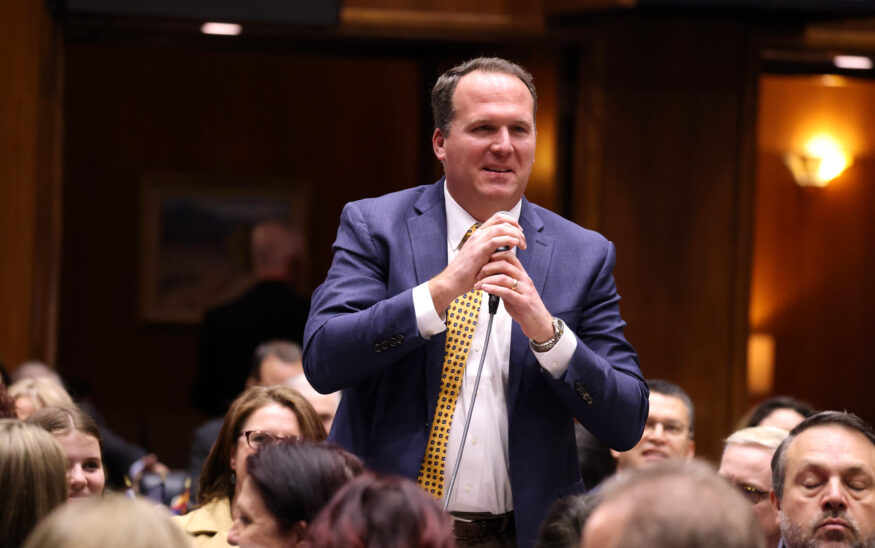
State Rep. Justin Olson speaking with attendees on the floor of the Arizona House of Representatives on opening day of the 57th legislature in Phoenix, Arizona, in January 2025. (Gage Skidmore / Flickr)
Republicans fast-track $1.1B tax cut, governor likely to veto
Jakob Thorington Arizona Capitol Times//January 16, 2026//


Key points:
-
Republican lawmakers passing $1.1 billion tax cut
-
Bill fully conforms state tax code to federal House Resolution 1
-
Republicans claim state has funds to cover anticipated revenue loss
House and Senate Republicans fast-tracked a $1.1 billion tax conformity bill along party lines to beat the state’s tax processing start date of Jan. 26, but Democratic legislative leaders are expecting a veto when it gets to Gov. Katie Hobbs’ desk.
The House and Senate passed mirror GOP tax conformity bills, House Bill 2153 and Senate Bill 1106, on party lines in both chambers on Jan. 15 after moving the bills in a joint House Ways and Means Committee and Senate Finance Committee hearing the day before. The legislation would fully conform the state’s tax code to match the federal government’s House Resolution 1, known as the “One Big Beautiful Bill.”
Fully conforming to H.R. 1 is expected to reduce the state’s general fund by a little over $1.1 billion, according to the Joint Legislative Budget Committee. Republican lawmakers describe the bill as tax relief for Arizonans, but there remains uncertainty about how the state will manage the loss of revenue.
“I’m fully supportive of passing conformity and adopting the Trump tax cuts in Arizona,” said House Ways and Means Chairman Justin Olson, R-Mesa.
Olson said he believes the state has funds to pay for the tax cuts in its $17.5 billion budget that lawmakers negotiated with Hobbs last session — a $1.3 billion increase from the previous year’s budget.
“This is more than double the rate of increase in population and inflation. There is room to absorb these tax savings within this budget and make it easier for hardworking Arizonans to make ends meet,” Olson said.
In her State of the State address, Hobbs said she is supportive of some of the Trump administration tax cuts, including no taxes on tips and overtime, an increased standard deduction from from $15,000 to $15,750 for single filers and $31,500 for joint filers, an additional $6,000 deduction for senior citizens, and deductible interest for car loans on new American-made vehicles.
The governor wanted to take on conversations about corporations and high earners later in the session during budget negotiations, but the Republican measure doesn’t exclude any corporate tax categories in its provision that conforms Arizona’s tax code to the federal government’s.
On Jan. 14, the Governor’s Office said in a news release that Republicans passed their proposal out of committee without any negotiations or communication with Hobbs’ staff. Hobbs also took issue with the bill removing a $6,000 senior tax deduction that she proposed in her Middle Class Tax Cuts Package.
“The Republican majority in the Legislature is hell-bent on giving handouts to the wealthiest Arizonans while hiking taxes on working seniors,” Hobbs said in a statement. “Their proposal gives hundreds of millions of dollars in tax breaks to special interests, removes a tax cut for working seniors, and adds even more handouts to those who are already rich. If Republicans want to give a billion dollar tax break for the wealthy, they must show the people of Arizona how they will pay for it without slashing the vital services our constituents rely on. We need tax cuts for middle-class families now.”
Republicans also want to get a bill signed as quickly as possible. Senate President Warren Petersen, R-Gilbert, said Jan. 15 that he expected the GOP bill to be on the governor’s desk before the end of the week, and the joint committee session for mirror legislation allowed Republicans to expedite the measure to Hobbs during opening week.
Another issue Democrats took with the bill was a provision allowing the state to opt into a federal tax credit program that awards federal tax credits to individuals and nonprofit organizations that make contributions to scholarship-granting organizations.
“These credits primarily benefit families who already have the means to afford private education,” said Rep. Mariana Sandoval, D-Goodyear. “This is yet another mechanism diverting public dollars away from public schools.”
The bill also creates a state subtraction for child and dependent care expenses above what the federal credit covers. Republicans have said this is something both their members and Democrats have asked for.
“For the first time in Arizona’s history, folks that have to pay for child care in order to go to work will be able to deduct the costs associated with that child care expense from their Arizona income taxes,” Olson said.
Senate Finance Committee Chairman J.D. Mesnard, R-Chandler, said he was frustrated that the Arizona Department of Revenue has acted under the assumption of full conformity to the federal tax code despite Hobbs signing an executive order in November directing the department to conform Arizona’s tax forms to the higher standard deductions for single and joint filers in H.R. 1.
The executive order also instructed the department to include instructions for filers on how to apply for tax breaks outlined in Hobbs’ Middle Class Tax Cuts Package.
“It’s bizarre that the governor continues to claim the Legislature is supporting tax cuts for billionaires,” House Appropriations Chairman David Livingston, R-Peoria, said in a statement. “The 2025 income tax forms issued by Gov. Hobbs’ own Department of Revenue fully conform to the expanded State and Local Tax (SALT) deduction, while the House and Senate plan explicitly decouples from it. She has apparently not read our proposal — or reviewed what her own agency is implementing.”
Republicans also expressed frustration that differences in state and local tax deductions in the department’s tax forms and the governor’s plan have caused uncertainty and confusion for filers as they enter filing season. Several Republicans said they wished Hobbs called a special session on the subject in November or December.
“We advocated for a special session to try to get out in front of this. Many states do that,” said Mesnard. “That would have been leadership as well, that we did not see out of the Ninth Floor. So here we are, trying to act with haste, because if you could take nothing away from what the Department of Revenue has said, it’s that the sooner we make decisions, the better for the taxpayer.”
Senate Minority Leader Priya Sundareshan, D-Tucson, said the Legislature doesn’t have to pass a tax conformity bill the first week of session and that lawmakers needed to square how the state was going to pay for the $1.1 billion revenue loss that’s expected from full conformity.
The governor is expected to unveil her executive budget proposal on Jan. 16.
“There’s no plan to balance the budget or to balance anything that would result from the tax cuts proposed here,” Sundareshan said. “That is another hole in our budget that we cannot fill.”
During the joint hearing, Livingston said he was willing to work with Democrats on a “clean” Proposition 123 renewal to return $300 million of annual funding to the general fund to help pay for conformity.
“That’s $900 million over three years. That’s 82% of the cost to this bill alone,” Livingston said. “We can taper this.”