Sign In
 Free Newsletter

Independent Party ‘disruptor’ enters governor’s race
Reagan Priest Arizona Capitol Times//January 28, 2026//
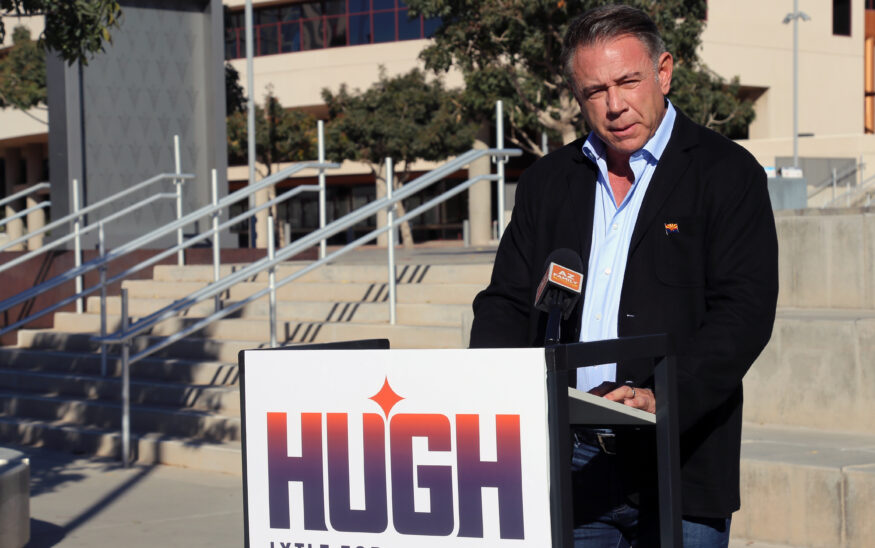
Hugh Lytle, a member of the Arizona Independent Party, delivers his candidacy announcement for the 2026 Arizona gubernatorial race at the Mountain America Stadium in Tempe, Arizona, on Jan. 27, 2026. (Reagan Priest / Arizona Capitol Times)
Independent Party ‘disruptor’ enters governor’s race
Reagan Priest Arizona Capitol Times//January 28, 2026//


Key Points:
-
Hugh Lytle is running for governor as an Arizona Independent Party candidate
-
Independents are unlikely to be elected, but could play spoiler to other candidates
-
Gov. Katie Hobbs’ campaign is most likely to be impacted by Lytle’s candidacy, consultants say
An independent contender has entered Arizona’s competitive gubernatorial race, which could spell trouble for candidates in the state’s two major political parties.
On Jan. 26, local health care executive Hugh Lytle announced he would join a growing pool of challengers to incumbent Gov. Katie Hobbs, but with the backing of the Arizona Independent Party. Three Republicans — business executive Karrin Taylor Robson, U.S. Rep. Andy Biggs and U.S. Rep. David Schweikert — are also hoping to unseat Hobbs.
Lytle is the founder of Equality Health and several other health care organizations offering services to providers. He got his start in the Grand Canyon State as a quarterback at Arizona State University, but was forced to switch gears after breaking his collarbone during a scrimmage.
Lytle describes himself as a disruptor hoping to “bridge the partisan divide” in Arizona and provide voters with more than two options on the ballot.
“The two parties are trapped in a fight that never ends,” Lytle said in a press release announcing his candidacy. “They argue, posture, divide — but they don’t solve the big problems.”
Political consultants and observers agree that independent candidates, whether they’re affiliated with the newly-created Arizona Independent Party or not, still have an uphill battle to get elected in Arizona. But they could have an outsized impact on the governor’s race by siphoning votes from Hobbs or whoever her eventual Republican challenger will be.
Chuck Coughlin, the CEO of HighGround Public Affairs, said he believes Lytle’s campaign is more likely to negatively affect Hobbs than a potential Republican opponent.
“The conventional wisdom is that an independent candidate hurts a Democrat more than a Republican, because Republican voters are more loyal, more conservative, and older, and they tend to stick to their hometown team,” Coughlin said.
And a candidate like Lytle has more potential for causing harm to Hobbs this year because of the “immediate ballot access” provided by the Arizona Independent Party, Coughlin said.
Traditionally, “no party affiliated” has been considered Arizona’s designation for independent voters. Under state law, candidates running without party affiliation have to gather at least 44,539 petition signatures to qualify for the ballot in a statewide race, while candidates running as Republicans or Democrats only have to gather around 7,000 signatures.
Paul Johnson, a former Phoenix mayor, saw an opportunity to skirt the barrier to entry for independent candidates when the No Labels Party fizzled after its 2024 attempt to run a third-party candidate for president. Because No Labels is a recognized party in Arizona, its candidates only have to gather 1,288 signatures.
Johnson became chair of No Labels in 2025, quickly changed the party’s name to the Arizona Independent Party, and began recruiting candidates to run as independents. That name change is the subject of ongoing litigation brought by the Citizens Clean Elections Commission, the Arizona Republican Party and the Arizona Democratic Party, who all argue it will confuse voters who want to register as “no party affiliated.”
Johnson told reporters at a press conference on Jan. 27 that the AIP’s efforts will continue regardless of the outcome of the lawsuits, and the intention isn’t to draw voters away from major party candidates.
“Our goal, clearly, is not to be anti-Democrat or anti-Republican,” Johnson said. “We think both of those groups have something positive to offer, but so do independents.”
Given the tight margins in Arizona races in recent years and the decline in voter registration among Democrats, Hobbs and Democratic incumbents like Attorney General Kris Mayes and Secretary of State Adrian Fontes will need every independent vote they can get. In 2022, Hobbs beat Republican Kari Lake by just over 17,000 votes, while Mayes bested now-Congressman Abe Hamadeh by just 280 votes.
As of January 2026, AIP has 41,484 registered voters — more than enough to have swayed either Hobbs’ or Mayes’ 2022 races. Over 1.4 million Arizonans are registered as “no party affiliated” and might also be interested in a third-party option.
“Some independents are going to be turned off by both the partisan D and the partisan R, and so they’ll vote for the third party candidate, where those votes historically … tend to go to the Democrats,” Coughlin said.
However, Lytle shrugs off the suggestion that his candidacy will only serve as a spoiler for Hobbs or her eventual Republican challenger.
“I would say maybe that’s the case if we had 5% of the electorate, but we don’t,” Lytle said. “Recent Gallup polls show 44% of average Americans at least identify as being an independent, but they have no way to attach who’s their party leader, who’s someone who can represent the interest of independence. So spoiler, no, I think they’re spoiling me.”
Still, Coughlin argued that even though more voters are registering without party affiliation in Arizona, the electorate is still “deeply partisan.” One Democratic consultant, speaking on background, agreed with Coughlin, noting that Arizona’s independents like to split their ballots and vote for a mix of Republicans and Democrats rather than a third-party candidate.
That consultant said it is unlikely that Lytle will pose any real challenge to the major party candidates given the rocky launch of the AIP and its lack of resources.
Coughlin also noted that despite the lower signature threshold for AIP candidates, both major parties will attempt to block them from the ballot in court through petition signature challenges.
“They will use every lever at their disposal to make an independent campaign more and more difficult,” Coughlin said. “But the question becomes, what does an independent campaign have to do to be relevant? And really if you’re getting eight to 10% of the vote, you’re relevant.”