Sign In
Upcoming Event
 Free Newsletter

Phoenix City Council to re-evaluate light rail Capitol extension
Jakob Thorington Arizona Capitol Times//January 28, 2026//
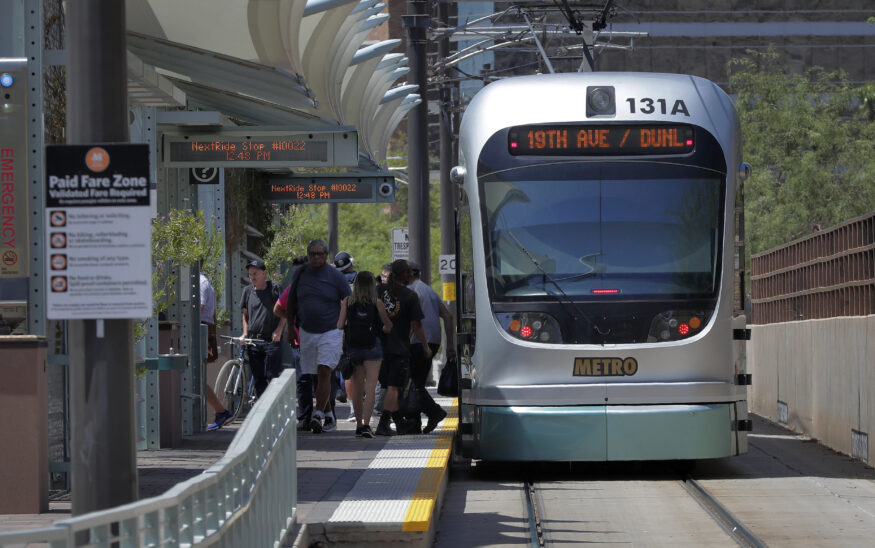
A light rail train stops for passengers, Monday, Aug. 26, 2019 in Tempe, Ariz. (AP Photo/Matt York)
Phoenix City Council to re-evaluate light rail Capitol extension
Jakob Thorington Arizona Capitol Times//January 28, 2026//


Key Points:
- Phoenix residents packed a City Council meeting to discuss a contentious light rail proposal near the state Capitol
- Thousands provided feedback in the months before the meeting
- Phoenix officials voted to alter the light rail extension to avoid the Capitol
Phoenix residents packed a city council policy meeting to decide the future of a voter-approved light rail route to the state Capitol earlier this week.
Thousands of Phoenix residents submitted feedback to the light rail’s operator Valley Metro to weigh in on the project during a three-month feedback period leading up to the Jan. 27 meeting. The city took public comment for more than four hours from residents, high school students, business owners and other community members.
The marathon council meeting started at 2:30 p.m. The next day, with the chamber nearly empty, the council finally voted to re-evaluate the measure.
The plan to bring the light rail to the Capitol has been in the works since 2015, when voters approved the Capitol extension route under the city’s Transportation 2050 plan.
That plan met a setback when Republicans at the state Capitol included language in a Maricopa County transportation sales tax ballot referral — Proposition 479 — that prohibited any light rail expansion within 50 yards of the Capitol using transportation sales tax dollars while the city was planning an extension route on Jefferson Street. That measure also requires approval from the Legislature’s Joint Legislative Budget Committee for contracts to build a light rail station within the Capitol Mall.
The other option councilmembers considered was to proceed directly with an extension route that would then connect to west Phoenix and the Capitol, but several councilmembers didn’t want to stall extending the light rail to west Phoenix because of disputes over the Capitol’s 50 yard rule.
Mayor Kate Gallego said, “For many years I’ve worked to make the Capitol extension a reality. When stakeholder meetings went off the rails, my team and I stepped in to address concerns and find solutions. But every time we clear one hurdle, another pops up.”
Leading up to the Phoenix City Council meeting, several Republicans who helped create and pass Prop. 479 warned city officials that they would oppose any efforts to bring light rail to the Capitol.
“We are united in our opposition to any new light rail extensions. (The) light rail is costly and inefficient; construction has risen to $250 million per mile, while being used by less than 1% of the commuters in the Valley,” House Speaker Steve Montenegro, R-Goodyear, and Senate President Warren Petersen, R-Gilbert, wrote to the City Council in a Dec. 15 letter.
The two Republican leaders also recognized the project would not be funded with Prop. 479 tax revenue. Sen. J.D. Mesnard, R-Chandler, has introduced Senate Bill 1222, which would prohibit the use of any public funds to extend light rail service to the Capitol. Senate Bill 1332 from Senate Majority Leader John Kavanagh, R-Fountain Hills, would also prohibit the state from participating in any light rail construction project before June 20, 2028, and require a comprehensive feasibility review of any light rail expansion in Maricopa County.
KJZZ reported on Jan. 26 that Gov. Katie Hobbs was supportive of the Capitol extension project, and her budget director Ben Henderson urged the city to move forward with its project and said he believed the Arizona Department of Administration has the authority to sell state-owned parcels at or near the Capitol to Valley Metro, who could then proceed with the project without JLBC approval.
Hobbs would likely veto both light rail prohibition bills, as she has been supportive of public transit options, including light rail transportation. However, a Republican governor in 2027 could be more receptive to such a proposal.
Democrats have been supportive of the city’s efforts. House and Senate Democrats sent a letter signed by 18 lawmakers to the city on Dec. 16 urging the city to advance the Capitol and I-10 extensions quickly.
“Our residents deserve the equitable transportation access they voted for in 2015, and again in 2019. In addition, our residents have paid taxes for the last two decades knowing they were investing in light rail for their neighborhoods,” the joint Democratic letter states.
The Phoenix City Council faces an April 20 deadline to approve projects eligible for federal funding through the Capitol Investment Grant. The city currently lacks sufficient funds to cover the full cost of the Capitol extension route and the Interstate 10 west project.
Phoenix officials estimate the total cost of the Capitol extension route to be between $600 million and $650 million. Further westward expansion is expected to raise costs to over $3 billion.
According to city surveys, 53% of more than 8,800 respondents favored moving forward to west Phoenix with or without the Capitol route.
Vice Mayor Kesha Hodge Washington said she believed pursuing a Capitol route would be a disservice to west Phoenix residents and pursuing it would run the risk of litigation or delays from the Legislature.
“The Indian School route gives us more control as a city, and I believe that access to public transportation for the Maryvale residents is too important,” Hodge Washington said.
Kevin DeMenna, a senior adviser at the lobbying firm DeMenna Public Affairs located close to one of the city’s proposed Capitol routes, urged the city council to engage with the Legislature on how light rail could be brought to the Capitol.
“Sadly, the speaker hasn’t received a city briefing. He hasn’t asked for one,” DeMenna said. “My proposal is we go down there and try to make it happen. The area south of the Capitol just calls for this project.”
Gallego expressed some hesitation about working with the Legislature, since their letter stated opposition to using public funds for light rail.
But with Petersen’s campaign for attorney general, DeMenna said there could be a change in Republican leadership and other high-ranking GOP members such as Senate Majority Leader John Kavanagh, R-Fountain Hills; and Rep. David Livingston, R-Peoria, have expressed openness to developing the light rail south of the Capitol.
“I’m not sure Warren Petersen will be Senate President in a few more weeks,” DeMenna said.
Councilman Jim Waring, a former Republican state representative who served with Montenegro and Petersen, had his doubts and worried about potential retaliation from the Legislature.
“I think saying we’re going to go down there and have a meeting, and it’s going to be great, is a fool’s errand,” Waring said.
Councilwoman Anna Hernandez, a former Democratic state senator, said she spoke to Kavanagh, Livingston, and other Republican leaders on the Joint Legislative Budget Committee and said it was reaffirmed to her that they were open to a route that traveled south of the Capitol along 16th Avenue. She said she expected further interference from Republican lawmakers after Livingston told her that bypassing the Legislature would be the “worst” option.
“This light rail extension has faced so many, unneeded barriers,” Hernandez said. “Residents want us to move forward. Seventy-nine percent of the Capitol area residents want the Capitol extension to continue. Voters approved this project. Taxpayers have already paid into it. This was promised to the community and as a council, we have a responsibility to honor that promise.”
The Arizona Public Interest Research Group, a nonprofit that advocates for policy and projects that support public and environmental well-being has supported bringing light rail to west Phoenix to increase public transit options in the area. The group’s Executive Director Diane Brown said the showing of residents who say they use the light rail and wanted its expansion demonstrates the need for expanded public transit options.
“The notion that legislative leaders would acquiesce to Phoenix on the light rail doesn’t track with recent history,” Brown said. “By supporting the most viable light rail option, the Phoenix City Council demonstrated their commitment to advancing public transit.”
Hernandez was one of the two votes against the council’s decision and unsuccessfully offered an alternative motion to proceed with a Capitol route. Councilwoman Laura Pastor joined Hernandez as the other dissenting vote and said she voted for her district’s voters who wanted the Capitol line.