Sign In
Upcoming Event
 Free Newsletter

Arizona won’t cut Colorado River withdrawals without enforceable conservation promises
Howard Fischer, Capitol Media Services//February 3, 2026//
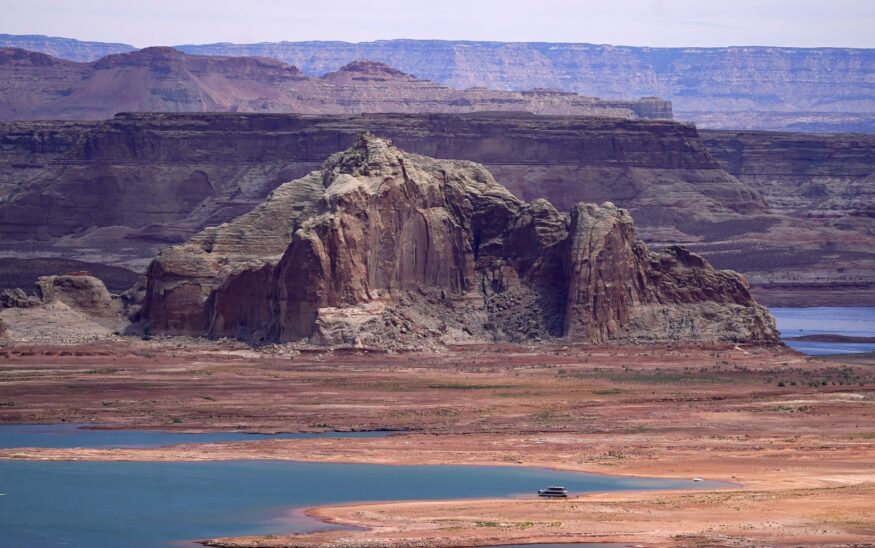
FILE - Low water levels at Wahweap Bay at Lake Powell along the Upper Colorado River Basin are pictured, June 9, 2021, at the Utah and Arizona border at Wahweap, Ariz. (AP Photo/Ross D. Franklin, File)
Arizona won’t cut Colorado River withdrawals without enforceable conservation promises
Howard Fischer, Capitol Media Services//February 3, 2026//


Key Points:
-
Arizona is embroiled in an interstate dispute over access to the Colorado River
-
Gov. Katie Hobbs refuses to agree to any deal unless upper basin states offer firm water conservation plans
-
Arizona has set aside $3 million for potential litigation over water rights
On Feb. 2, Gov. Katie Hobbs made her position on the Colorado River clear. Either the “upper basin” states offer up a firm commitment for water conservation, or she won’t agree to any new cuts for Arizona. But the decision to refuse a deal over the embattled water source would not be without consequence. In fact, it would lead to federal intervention by way of Interior Secretary Doug Burgum, who would impose his own solution on the seven states that draw water from the river.
The caveat? Burgum has so far refused to do more than convene the governors of the affected states. And Terry Goddard, president of the Central Arizona Water Conservation District, which oversees the state’s Colorado River supply, said the options put forward by the Interior Department “are not palatable to Arizona or California,” one of the two other “lower basin” states.
“All Burgum’s done is set us up for litigation,” he told Capitol Media Services. “And I think that’s sad.”
In November, Hobbs asked Burgum to get involved and develop a plan to protect Arizona water users, specifically by requiring conservation in the upper basin states of Colorado, New Mexico, Wyoming and Utah. But on Monday, she did not dispute that — even during Friday’s meeting — all Burgum has done is encourage states to work together.
Still, the governor said she thinks the negotiations don’t necessarily have to wind up in court, even though Arizona has already set aside $3 million for litigation.
“While we didn’t leave with a lot of specifics — the details are to be worked out through negotiation — I think that we came away with hearing that nobody wants to end up in litigation,” Hobbs said. “We want to find a way to get to a deal.”
But Hobbs said that means recognizing that Arizona, which already has agreed to give up 27% of the water it has been getting from the Colorado River, won’t give up a drop more unless there are firm and enforceable promises that the upper basin states will share in the burden.
That theme was echoed by Tom Buschatzke, director of the state Department of Water Resources.
“We need certainty that there are reductions in upper basin usage because that is one of two tools that we have,” he said, drawing attention to historic drought conditions that have meant less water flow.
“You can’t make it snow or rain,” Buschatzke said. “But you can reduce your demand. So that has to be a tool that’s in play at some level.”
At the heart of it is the need to reduce Colorado River use, with some estimates showing that water consumption needs to be cut by up to 3.2 million acre-feet a year. That’s enough to serve more than 9 million homes.
The lower basin states of California, Nevada and Arizona have agreed to trim usage by 1.5 million acre feet, enough to serve about 4.5 million homes a year. And Arizona, which, contractually and legally, has the lowest-priority claims to river water, has to cut its own withdrawals by 27%.
Upper basin states have said they’re willing to voluntarily conserve water, which would mean more water would flow downstream to the lower basin states. But Hobbs noted that it has not yet been put into a formal commitment.
“I shared this with Secretary Burgum and the other basin states,” the governor said. “For a successful negotiated outcome, Arizona and the lower basin cannot and will not be balancing the Colorado River on our own.”
She said the lower basin states are willing to do more only “if our partners in the upper basin states come to the table with reductions of their own.”
That, in turn, leads to the prospect of having all this decided in court.
“The stonewalling from the upper basin has made it very hard to see a non-litigation course in the future,” Goddard said. “If the upper basin continues to say ‘In a time of shortage, we’re not going to save and contribute to the shortage one drop of water,’ I don’t see how we can have a settlement.”
How much Arizona can demand could depend, at least in part, on the other lower basin states all working together.
Cooperation has not always been the rule, with California at times exercising its senior water rights. And even now, the amount of water that Arizona has offered up — about 760,000 acre feet — is on a per capita basis more than California.
But Hobbs believes that despite California’s senior right to the water, the state’s western neighbor won’t sell Arizona down the river, so to speak, to protect its own water interests. She said all three lower basin states have been united since they reached an agreement among themselves in 2023.
“So I feel very confident that we are continuing on a united path to get where we need to be on the Colorado River,” the governor said.
“I think we always have to be cautious,” said Goddard, a former state attorney general, acknowledging that, compared to California, “Arizona has a slightly lower pecking order.”
And he acknowledged the history between the two states.
“Keep your friends close,” Goddard said.
“But we’ve had some very good discussions with the major water users in California,” he continued. “They have a joint interest with us. We’re all part of a growing economy in the West that gets its water from the Colorado River.”
That hasn’t stopped Hobbs from making what she says is the case for why Arizona, despite its lower priority on taking Colorado River water, should have its needs met — and why the Trump administration should pay special attention.
“The most important computer chip manufacturing facilities in the western hemisphere are here in Arizona critical to winning our struggle against China in the AI arms race and at the center of the president’s recent trade deal in Taiwan,” Hobbs said.
And then there’s the fact that the majority of the nation’s winter crops are grown in Arizona.