Sign In
Upcoming Event
 Free Newsletter

Arizona lawmakers propose Swedish rounding system to address penny shortage
Howard Fischer, Capitol Media Services//February 10, 2026//
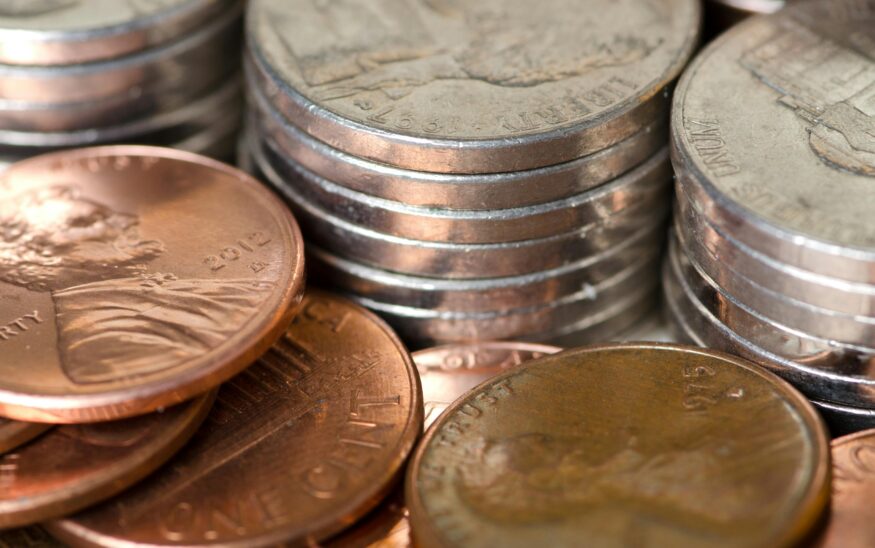
(Jason Deines / Pexels)
Arizona lawmakers propose Swedish rounding system to address penny shortage
Howard Fischer, Capitol Media Services//February 10, 2026//


Key Points:
-
US Mint stopped producing pennies due to economic reasons
-
Stores run out of pennies, leading to exact change issues
-
Merchants must post a notice about cash rounding at the point of sale
Penny for your thoughts?
If you’ve got three, better make that a nickel.
With pennies no longer in production, state lawmakers are moving to set new rules for what happens when the grocery, clothing store or mall outlet price tag ends in something other than a 5 or a 0.
And that could mean, if Senate Bill 1108 becomes law, customers will end up paying a little less — or a little more — than they owe.
You can blame the federal government, not the state, for this one.
The U.S. Mint stopped producing new pennies last November.
It was a matter of economics. Each coin costs about 3.7 cents to produce.
There are still pennies out there, though some may simply be sitting in jars as consumers empty their pockets of small change — and never bother to pick it up in the morning. And the penny remains legal tender.
But the net result is that more stores are giving out exact change because they’re running out of the coins.
Enter Sen. John Kavanagh.
The Fountain Hill Republican is proposing a new law to enforce what has become known as “Swedish rounding.”
Essentially, if the final tab ends up with a 1, 2, 6, or 7, the bill is rounded down to the nearest nickel. Conversely, a bill ending in 3, 4, 8, or 9 is rounded up.
Kavanagh said government intervention — complete with possible civil penalties — is appropriate.
“The problem is that some merchants can consistently round up more than they should,” he said.
For just a couple of small purchases, perhaps at a convenience store, Kavanagh said it probably doesn’t matter much overall.
But pennies do add up.
“Some of these merchants that are dealing with tens of thousands of sales a day can rack up a lot of cash,” he said. “It’s a matter of uniformity and making sure nobody takes advantage of it.”
Anyway, Kavanagh said, it’s not like Arizona is striking out on its own. He said this is “model legislation” crafted by the National Conference of State Legislatures.
“Beyond the consumer protection thing, it’s simple for everybody using the same system,” Kavanagh said.
That’s also why Lisa Bednar, president of the Arizona Food Marketing Alliance, said her members are supportive.
“SB 1108 is a simple, common-sense update that gives retailers clear, consistent rules for handling small-coin shortage at the register,” said Bednar, whose association represents food retailers. What it also does is set the rules of the road so customers, unable to get their change in pennies, are aware of how — and why — a retailer is adjusting the bill.
“It protects customers with fair, transparent rounding that will be uniform across all Arizona businesses while letting businesses keep lines moving and systems compliant,” she said.
And that also includes programming cash registers and other point-of-sale software so that the rounding occurs automatically — and matches what customers expect.
Kavanagh’s bill also includes limits on how these computations can be performed.
Most significantly, rounding occurs not on each item checked out, but only on the final bill. So no matter how much someone purchases, the worst-case scenario is that the final tab will be no more than two cents higher due to rounding.
But SB 1108 also is set up so that consumers who are not using cash avoid that cost — or the savings, as the case may be.
So anyone with a credit or debit card would pay the exact amount. Ditto any electronic funds transfer, mobile payment application or even a check.
And just so there are no questions from customers, the proposal would require merchants to post a notice at the point of sale stating, “Cash transactions are rounded to the nearest five-cent increment pursuant to state law.”
Nothing in the measure makes pennies illegal in Arizona.
But it may be something else convincing merchants, who have long been inching away from pennies, to accept them. SB 1108 does not require retailers to actually accept pennies, and the Federal Reserve Board says there is no federal law mandating that any private business must accept current or coins as payment for goods or services.
Curiously, Kavanagh’s legislation comes several weeks after the House Commerce Committee voted 9-1 to enact a state law requiring merchants to accept cash for goods or services worth $100 or less. HB 2555 would also make it illegal to charge more for a customer who wants to pay cash.
That measure is awaiting House debate.