Sign In


Upcoming Event
 Free Newsletter

GOP plan to eliminate state taxes on home sales sparks Democrat backlash
Howard Fischer, Capitol Media Services//March 3, 2026//
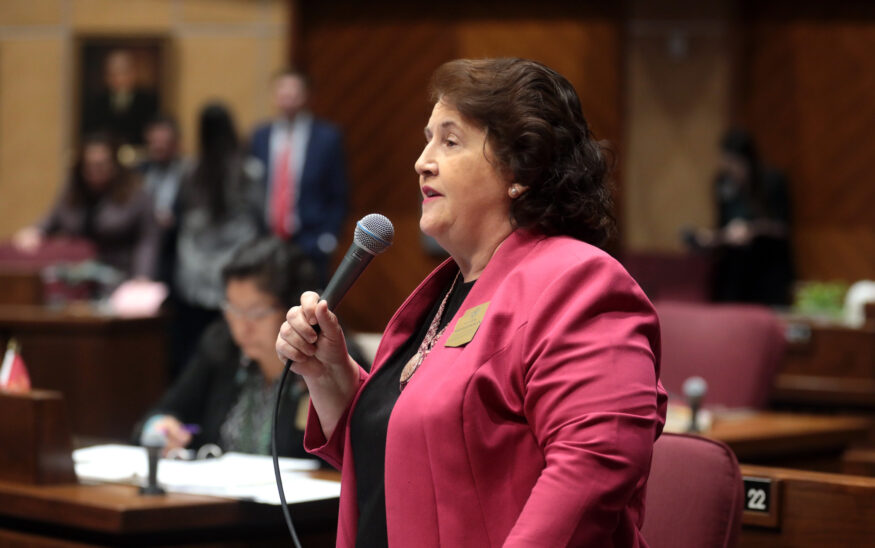
Sen. Mitzi Epstein, D-Tempe, speaks on the floor of the Arizona State Senate at the Arizona State Capitol building in Phoenix on March 1, 2023. (Gage Skidmore/Flickr)
GOP plan to eliminate state taxes on home sales sparks Democrat backlash
Howard Fischer, Capitol Media Services//March 3, 2026//


Key Points:
-
Republican senators approve plan to exempt capital gains tax on home sales
-
Current law exempts first $250,000 of gain for single individual, $500,000 for couples
-
Arizona’s average home price rose from $102,000 in 1985 to over $731,000 now
Republican senators have approved a plan that Democrats say is a gift to those who can afford million-dollar mansions.
Current Arizona law says someone who sells a home has to pay taxes on the capital gains — essentially the difference between the purchase price and the ultimate sales price.
But that law provides an exemption for the first $250,000 of gain for a single individual — double that for couples. So it is only the excess over that which can generate a tax liability.
What SB 1633 would do is create an unlimited exemption. So there would be no state tax at all, no matter how much the home had appreciated.
That bothered Sen. Mitzi Epstein, D-Tempe, who said the existing law works just fine for those in the middle class.
Instead, she argued, this new proposal would work for those who may have bought a mansion for a million dollars and are selling it for twice as much — people she believes do not need such a tax break.
And then there’s the estimated $18 million cost in state revenues a year.
Mesnard, for his part, said he remains convinced that providing relief for only some homeowners but not others would be unfair.
“I think it comes down to a philosophical as well as a practical question,” he told Capitol Media Services.
The first part of that question, Mesnard said, is whether the state should even be taxing someone’s private home in the first place.
Nothing in his proposal would alter the system under which homeowners pay the annual property taxes that fund cities, counties and special districts. Instead, the law sets up a system wherein homeowners pay less on each dollar for the value of their property than those who rent out their homes to others. It would be less than what is paid by the owners of commercial property.
Where it would kick in is when someone sells a home.
“This approach says: If this has been your home for five years, we’re not going to tax you on it,” he said.
That’s already the case under the current law if the net gain — sales price minus purchase price minus the cost of improvements — is less than $500,000. This simply lifts the cap.
That deregulation, for most people, is unnecessary, Epstein said.
“If you buy your home for, say $400,000 and sell it for $600,000, which is a pretty good return, that’s a $200,000 capital gain,” she said.
“You don’t pay any tax on it under current law,” said Epstein. “So middle class America is just fine. You’re not going to be paying taxes when you sell your primary home.”
Things are quite different, she said, in the upper reaches of the real estate market.
“If a billionaire sells a mansion and makes a $2 million profit they should have to pay taxes on it,” Epstein said.
She said that sellers still get the benefit of the current law, with the first $500,000 of profits not subject to tax. That leaves $1.5 million which, everything else being equal, translates out to $37,500 in taxes at the state’s current 2.5% income tax rate.
Epstein said that rate is justified.
“For the typical hard-working Arizonan, your home is your nest egg, one of the biggest investments you have,” she said. “So when you sell it, the law protects the nest egg for the people of Main Street.”
And those with the million-dollar mansions? Epstein said they don’t need the tax break.
Mesnard, however, said this isn’t about the very wealthy.
“While the $500,000 (exemption) sounds like a lot, it hasn’t changed in decades,” he said. And it’s even worse for single people who have to start paying taxes with just a $250,000 capital gain.
There’s also another factor.
There are people in Arizona who bought their homes decades ago.
For example, Macrotrends reports the average price for an Arizona home in 1985 was about $102,000. The most recent number is north of $731,000.
That translates to a $629,000 gain for someone who is choosing to sell now, whether to downsize or for another reason. So the tax for a married couple — again, assuming no improvements or additions to the property that increase the basis on which the capital gains are computed — is $3,225.
“Housing prices have skyrocketed and people can feel trapped in their homes,” Mesnard said. “If they move, they’re going to have this massive tax liability now.”
And that, he said, is bad for the overall housing market because it discourages people from selling and making their homes available for others.
Epstein, however, said she still sees this as a break for the very wealthy. And she said the differential treatment is justified.
“They have used public education, they have used public roads and public safety to make the millions that paid for the home,” she said.
And then there’s the question of overall tax policy.
Arizona used to have a progressive income tax, with rates ranging from 2.59% to 4.5%. That was scrapped when Republican Doug Ducey was governor in favor of a flat 2.5%.
Foes said the change cost Arizona $1.9 billion a year in revenues. But supporters said it actually stimulated the economy.
Epstein, who opposed the flat income tax rate, said that allowing all home sellers to avoid capital gains further erodes the progressive nature of taxes in Arizona and prevents those with more capital from paying their fair share.
The measure now goes to the House.