Sign In
 Free Newsletter

Proposed ballot measures would expand size of Legislature, shorten session
Jakob Thorington Arizona Capitol Times//March 26, 2026//
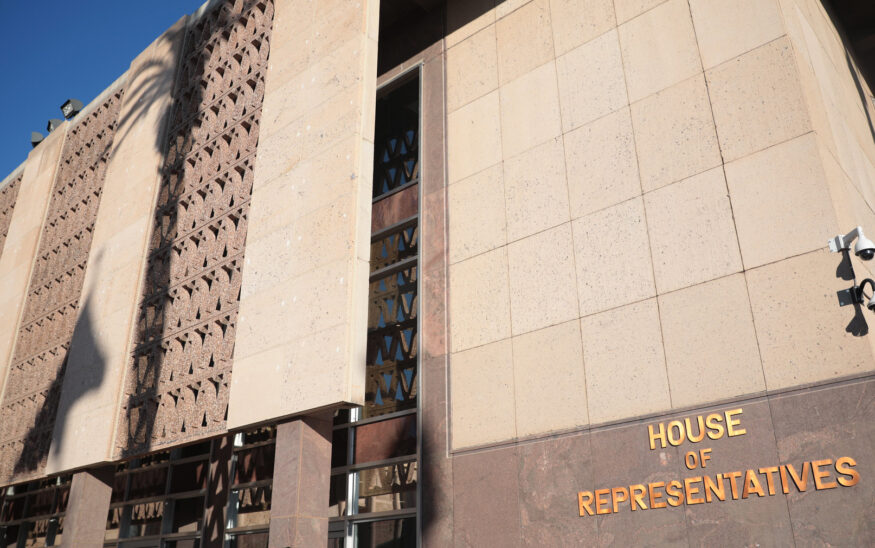
The Arizona House of Representatives building outside the Arizona State Capitol in Phoenix, Arizona. (Gaga Skidmore / Flickr)
Proposed ballot measures would expand size of Legislature, shorten session
Jakob Thorington Arizona Capitol Times//March 26, 2026//


Key Points:
-
Lawmakers are considering a ballot referral to add 30 new House seats
-
If approved, the measure would take effect in 2043
-
Proposal aims to address legislators’ concern about district size and representation
A Republican lawmaker wants to ask voters this November if 30 more members should be added to the Arizona House of Representatives.
The House Government Committee on March 25 passed Senate Concurrent Resolution 1022 5-2, from Sen. J.D. Mesnard, R-Chandler.
SCR 1022 would increase the number of House seats by 30, increasing the total number of seats to 90 members and giving each of the state’s 30 legislative districts three House seats.
The measure passed 5-2, although it wouldn’t take effect until 2043 if it makes it to the ballot and voters pass it.
Arizona formerly had 80 House members and 28 Senate members, but a 1964 U.S. Supreme Court ruling that state legislative districts must have roughly an equal population made the state’s legislative district map unconstitutional. The state went to 60 House members for the following election and it’s been unchanged since.
The average state House size in the country is 110 members.
“Smaller constituencies are more manageable,” Mesnard said. “The smaller your constituency, the less money influence comes into play — even party influence comes into play.”
Arizona has one of the smallest House rosters in the country. Only Alaska, Delaware, Hawaii and Nevada have fewer state House members. In Arizona, each House member represents the second-most people in the country at about 250,000 each, while California state lawmakers represent more people in their districts.
As a legislator in the swing Chandler district of Legislative District 13, Mesnard said it’s more useful for him to raise money for digital advertising to reach more people than it is for him to knock on doors and let residents get to know him face-to-face.
Many rural districts in the state are also very large. Rep. Walt Blackman, R-Snowflake, pointed out that his Legislative District 7 is larger than several U.S. states in the eastern part of the country. LD7 covers Coconino, Gila, Navajo and Pinal counties and is about 35,000 square miles. It is the largest district in Arizona and the second-largest in the U.S.
Many legislators in large Arizona districts find themselves with long drives to get from one end of their district to the other. Rep. John Gillette, R-Kingman, said it takes him four hours to get to the northern part of Legislative District 30 of northwest Arizona from his home and three hours to get to the southern part of the district. LD30 covers La Paz County and parts of Mohave County, Yavapai County and Mohave County.
“I bought a new truck about five years ago. I have over 200,000 miles on that truck and I’m looking for a buyer,” Blackman said.
Rep. Aaron Marquez, D-Phoenix, said he prefers dividing each House district to keep the 60 members of the House, but decreasing the number of people each member represents. Under that approach, “single-shotting” strategies in competitive legislative districts would end, since members wouldn’t share districts.
“I think that’s also better for democracy,” Marquez said.
More members would require more desks on the House floor and more offices in the building. Mesnard, a former speaker of the House, said he believes the current building could fit 30 more members, although it would be a little “cozier.”
With an effective date in 2043, lawmakers would have nearly two decades to determine whether the buildings need renovations and how to accommodate 30 additional members. Lawmakers also receive a base salary of $24,000 annually, so it would cost the state $720,000 to pay 30 additional member salaries, not including travel expenses and per diem payments or anticipated increases in staff sizes.
The Government Committee also passed another Mesnard measure that would move the Legislature’s opening day from the second Monday of January to the fourth Monday of January. That measure, Senate Concurrent Resolution 1025, also passed 5-2.
Mesnard said he thinks a later start date would be better for staff after the holiday break. He also believes it would give lawmakers more time to file bills and actually spend time in initial committee meetings hearing bills.
Currently, most committees spend the first week of session either not meeting or listening to presentations from state agencies or other groups.
“There’s like not a whole lot that’s happening down here, if we’re going to be honest. Lots of presentations in committees that may or may not be interesting to just occupy time,” Mesnard said.
Rep. Stephanie Stahl Hamilton, D-Tucson, said she preferred the earlier start because it helps lawmakers outside of Maricopa County get more time to gather signatures and cosponsors on their bills before the bill filing deadline.
“It is hard to get here and to get signatures in the offseason,” Stahl Hamilton said.
Rep. Justin Wilmeth is sponsoring House Concurrent Resolution 2025, which would force the Legislature to end their yearly session by April 30. Lawmakers haven’t adjourned sine die in April since the 2015 legislative session.
Mesnard said his and Wilmeth’s measures should be consolidated into a single measure if they both have enough lawmaker support to get to the ballot. He was not aware of Wilmeth’s measure when he introduced his measure.
Marquez said he would be concerned about consolidating the measures. It would only give lawmakers 14 weeks to do the people’s business and pass a state budget, unless the governor calls a special session.
“We actually need more time, and maybe more breaks built around holidays,” Marquez said.
Mesnard said he thinks lawmakers could do their business if there was a deadline of April 30, with the session starting two weeks later. He said that even if the session were longer or had a firm end date, he still thinks lawmakers should start the session in late January.