Sign In
Upcoming Event
 Free Newsletter

With execution near, McGill’s defense attorney cites jury misinformation
Kiera Riley Arizona Capitol Times//April 3, 2026//
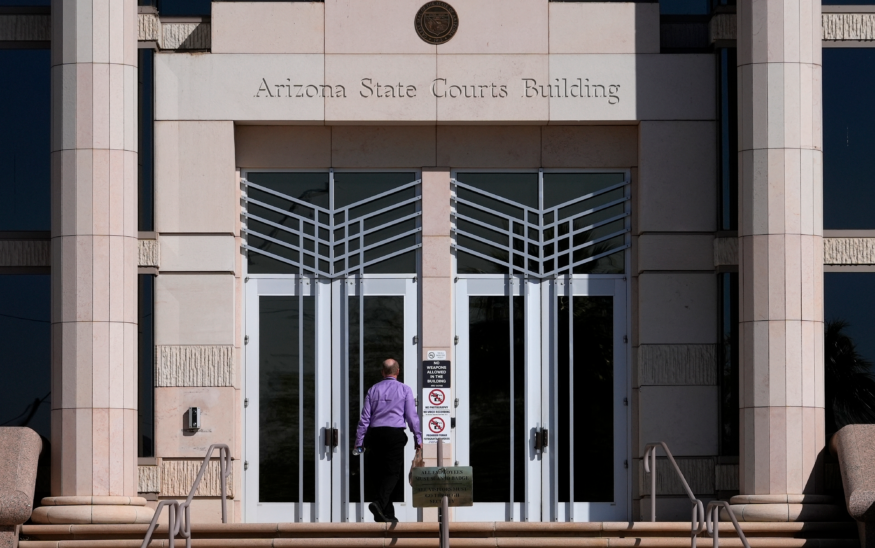
A man enters the Arizona Supreme Court building, Wednesday, April 10, 2024, in Phoenix. (AP Photo / Matt York, File)
With execution near, McGill’s defense attorney cites jury misinformation
Kiera Riley Arizona Capitol Times//April 3, 2026//


Key Points:
-
Jury misinformed on parole eligibility, impacting death sentence
-
Defense cites errors, misconduct, seeks life imprisonment instead
-
Execution warrant issued, attorneys push for new judicial review
Failure to accurately inform jurors on Leroy McGill’s eligibility for parole during sentencing may prove fatal.
With a warrant for execution now active, federal public defenders claim inaccurate jury instruction, allegedly incorrect details of the crime, misrepresentation of a witness and ineffective counsel unduly culminated in a capital sentence in a new postconviction relief filing.
McGill’s attorneys now ask the court to reconsider life in prison, without the possibility of parole as the clock ticks toward a May 20 execution date.
“Were it not for these errors, Mr. McGill would not have been sentenced to death,” attorney Jennifer Garcia wrote.
McGill was convicted for the 2002 murder of Charles Perez, the attempted murder of Nova Banta and two counts of arson of an occupied structure and three counts of endangerment.
In the weeks leading up to the murder, McGill lost his job, and then his apartment, leaving himself and his girlfriend, Jonna “Angel” Hardesty homeless.
The two would occasionally stay with Jack Yates. Yates allowed McGill and Hardesty to stay in his one bedroom apartment, alongside Charles Perez, Nova Banta, Edwin and Kimberly Keith, their two young daughters, and Hardesty’s brother, Jeffrey Uhl.
The apartment was “busy,” and McGill, Hardesty and their housemates often used methamphetamine and marijuana.
One day, Yates’ shotgun went missing. Banta blamed Hardesty and McGill, and Yates kicked the two out of the apartment. McGill and Hardesty then went to stay with Sofia Barnhart, who lived within walking distance of Yates.
On July 13, Banta testified that McGill returned to Yates’ house, walked inside, poured a cup of gasoline on herself and Perez, and lit a match. The fire spread across the house and into adjoining apartments.
Perez died from his injuries, Banta survived, but with severe burns.
McGill was indicted on March 11, 2003. And shortly after, the state sent notice that it planned to seek the death penalty, noting McGill had previously been convicted of armed robbery, created a grave risk of death to others and committed the murder in an especially heinous, cruel or depraved manner.
In November 2004, a jury sentenced McGill to death for the murder of Perez.
Now, federal public defenders claim McGill was denied a fair shot because at trial, jurors were told if McGill was given life in prison, he would eventually be eligible for parole.
At the time of his sentencing, though, the state had abolished parole as a sentencing option.
“Counsel entirely failed to recognize that parole had been abolished in Arizona,” Garcia wrote. “McGill’s venire was repeatedly, erroneously informed by the judge, defense counsel, and the prosecution, that if the jury were to sentence Mr. McGill to life, the judge would decide whether to impose life without the possibility of parole or life with the possibility of parole after 35 years.”
Garcia said the false instruction to the jury regarding his eligibility for parole ultimately swung the verdict toward the death penalty.
“Accurate information regarding a defendant’s parole ineligibility is critical for jurors who would find that the defendant spending the rest of his life in prison would be sufficiently retributive for capital crimes but who would vote for death to ensure the defendant will never return to society,” Garcia wrote.
Beyond parole misinstruction, Garcia further claimed McGill’s trial counsel had failed to challenge or obtain experts to counter the state’s claim that McGill put styrofoam in the gasoline, which he allegedly did to inflict more harm and suffering.
The police never found any physical evidence of styrofoam, but, Garcia said, “the possibility was repeated frequently throughout trial,” and became a major focus in assessing aggravating factors and continues to show up in court records detailing McGill’s crimes to this day.
Garcia adds that trial counsel generally failed to obtain experts to offer mitigating evidence in defense, such as testimony on substance abuse, child sexual assault and brain damage.
The petition raises new claims, too, as Garcia calls the credibility of two witnesses into question.
First, she claims the state failed to disclose the fact Edwin Keith, who placed McGill outside the apartment and claimed he sought some revenge against Perez and Yates, was the suspect of a child molestation case at the time of his testimony.
Justin Johnson, who lived with Banhart at the time of the murder, also testified against McGill and claimed he had called Banhart’s house and effectively admitted the crime to Hardesty and stated that he added styrofoam to the gasoline.
Johnson claimed he willingly went to the police, when in reality, he was arrested on an outstanding warrant before his interview.
He also noted in phone calls from the interview room that he sought to talk to homicide detectives and said he would probably get to “walk out of there.”
Garcia now claims the state failed to correct Johnson’s claim that he had reached out to speak to police, as opposed to the other way around.
In past appeals, McGill has unsuccessfully attempted to raise the ineffective assistance of counsel claim. And the defense previously sparred with McGill’s death sentence given the Supreme Court deemed the state’s death penalty statute invalid at the time of McGill’s crime under Ring v. Arizona.
McGill was never successful, though one judge in the 9th Circuit dissented and found his sentence unconstitutional given the lapse in the law.
The latest motion seeks another round of review by the courts on McGill’s claims, given new information and evidence and his now active death warrant.
On March 6, the Attorney General’s Office asked the Arizona Supreme Court to issue a warrant for McGill’s execution. Under state law, if an inmate has exhausted all his appeals in state and federal court, “a warrant of execution must issue.”
The Arizona Supreme Court issued the warrant on March 26 and set an execution date for May 20.