Sign In


 Free Newsletter

Hobbs pauses Salt River horse removals through 2027
Jordan Gerard, Arizona Capitol Times//August 23, 2026//
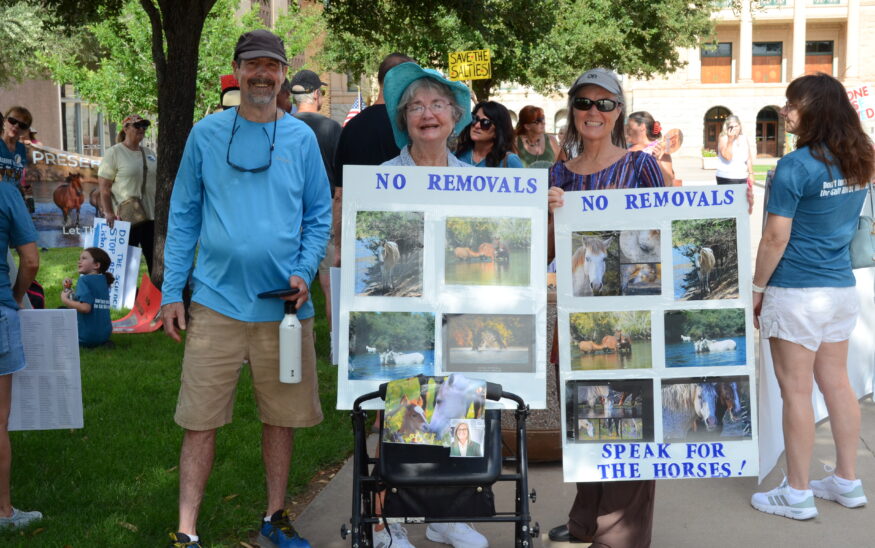
Blake Peterson, left, Leslie Peterson and Amy Knobel protest at a July “Save the Salties” rally at the state capitol. (Jordan Gerard/Arizona Capitol Times)
Blake Peterson, left, Leslie Peterson and Amy Knobel protest at a July “Save the Salties” rally at the state capitol. (Jordan Gerard/Arizona Capitol Times)
Hobbs pauses Salt River horse removals through 2027
Jordan Gerard, Arizona Capitol Times//August 23, 2026//


Key Points:
-
Gov. Katie Hobbs halted removals of Salt River horses and ordered a genetic viability study
-
Horse advocates and lawmakers claim the victory after months of grassroots work
-
A lawmaker questioned the last-minute decisions
Just weeks before 25 Salt River horses were set to be removed, Gov. Katie Hobbs halted the removals and ordered a genetic viability study of the herd.
Advocates for the wild horses celebrated the decision as a major victory after months of pressuring the governor and state agricultural officials.
“We are thrilled with the Governor’s actions because, from the very beginning, more than a decade ago, it has always been our mission to preserve these cherished and historic wild horses for future generations of Arizonans to enjoy,” said Simone Netherlands, president of the non-profit Salt River Wild Horse Management Group.
However, it still falls short of the broader protections some advocates and lawmakers sought, including legislation that would have imposed a three-year moratorium on removals and established specific requirements for the genetic study. At least one lawmaker also questions why Hobbs waited until August to act and whether her plan provides enough accountability.
In February, the Arizona Department of Agriculture and the management group signed an agreement to reduce the herd to about 120 horses in five years. The first removal of 25 horses was scheduled for September.
Many people criticized the target number, including equine geneticist Gus Cothran and wildlife ecologist Craig Downer, who both said earlier this year that it was too low to maintain genetic diversity.
On Tuesday, Hobbs announced she worked with the Arizona Board of Regents to identify funding for a genetic viability study to ensure the herd remains genetically stable and healthy. Arizona’s public universities would conduct the study, and it would be independently reviewed before release. The Board of Regents is expected to vote on it Aug. 27.
The Department of Agriculture also amended the Salt River Horse Herd Management Plan to pause all removals through 2027, giving researchers time to complete the study and allowing its findings to inform future management decisions.
The amended management plan also raises the herd’s target population to about 170 horses. The management group estimates there are now about 267 horses.
“My administration is committed to preserving the health, safety, and integrity of the Salt River Horse Herd as well as the natural ecosystem they rely on,” Hobbs said in a statement.
Netherlands said their 2026 Mid-Year Herd Report documented negative population growth and the success of humane management programs, such as darted birth control.
John Koleszar, who represents the nonprofit group Arizona Sportsmen for Wildlife Conservation, said they respectfully disagree with the governor. His organization represents 33 outdoor recreation communities. He added the horses aren’t native to the area and they mowed down “everything that is even remotely close to habitat.”
“We are disappointed that there was a hold put on removing even 25 horses, but we anticipate that the genetics study will show that there needs to be removal of horses because there’s so much inbreeding already,” he said. “While disappointed, we understand it, and if they need absolute positive proof, so be it.”
The Arizona Farm Bureau declined to comment. The Center for Biological Diversity, Maricopa Audubon Society and Arizona Wildlife Federation did not respond to a request for comment.
Reim questions Hobbs’ decisions
Republican Rep. Cody Reim, whose district includes the Salt River area where the horses roam, said he and advocates called on the state Department of Agriculture earlier this year to use its authority to amend the herd management plan and the contract.
“They made the calls, demanded meetings and kept the pressure on Governor Hobbs until doing nothing carried a political cost. Her administration had the authority to stop these removals months ago. She waited until August to do what we were asking her to do in April and May,” he said in a statement.
Reim wrote a strike-everything amendment to Senate Bill 1199 that proposed a three-year moratorium on population-control removals while a peer-reviewed genetic study was completed. Under his proposal, horses could still be removed for urgent medical needs and veterinary care.
It also required genetic testing to include measures of “effective population size, allelic diversity and inbreeding coefficients.”
Reim was critical of Hobbs’ plan, noting it does not state whether those genetic measures will be required. He also questioned the decision to route it through the public universities. He said Hobbs is giving herself political cover.
“If advocates later challenge the methodology or the study is used to justify more removals, she can blame the universities. We wanted the standards, qualifications and accountability established in law before the study began,” he said.
Hobbs’ plan only stops removals for about a year and a half. It also allows population targets for 2028 through 2030 to be reconsidered after the study, according to the amendment. The horses would have had stronger protections if the governor had acted sooner instead of waiting months and adopting only parts of their plan, Reim said.
“Governor Hobbs can change a management plan today, and it can be changed again tomorrow,” Reim said.
Other advocates want far more sweeping changes, including giving the horses back the land they once roamed.
Arizona resident Trudy Bastman said her land overlooks the Salt River area and she’s been advocating for the horses since former Gov. Doug Ducey signed the Salt River Wild Horse Act. She wants to see them get more land back – specifically the land surrounding Saguaro Lake and the Butcher Jones Recreation Area – a popular place for locals and tourists to cool off, hike and picnic.
“If they do go back and let’s say 100 horses go back to the lake, that takes the pressure off the river, and now we’re saying 170 horses at the river,” she said, adding that she was happy with Hobbs’ recent actions. “There’s only 267 horses. You’ve got 100 of them at the lake grazing over there. There’s more to eat, more room, less damage to the land.”
The horses were pushed to that land in 2014, Netherlands said, but after too many interactions with humans, the management group told the U.S. Forest Service they would move them back to the river.
“It sounds nice, but that land was actually not suitable for the horses because of the drought conditions, because of the ATV use, the target shooting and the crowded conditions at Butcher Jones,” Netherlands said.