Sign In




 Free Newsletter
‘Predator protector’ accusations cast long shadow over governor’s race
Reagan Priest, Arizona Capitol Times//September 29, 2026//
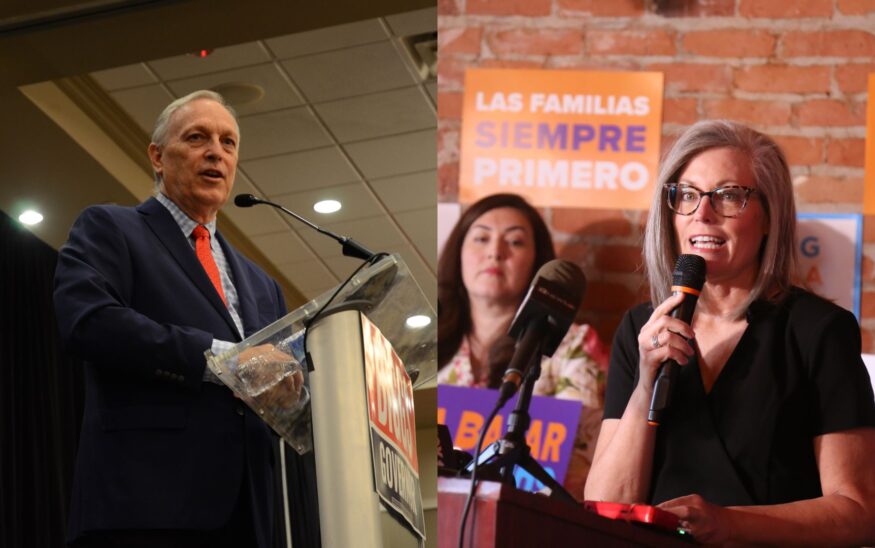
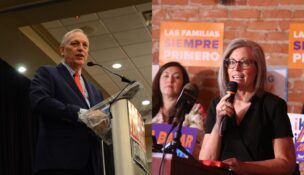
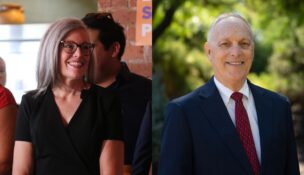
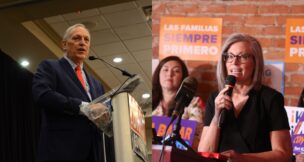
Congressman Andy Biggs to take on Gov. Katie Hobbs in November after he sailed through the Republican primary on July 21. (Jordan Gerard and Reagan Priest/Arizona Capitol Times)
‘Predator protector’ accusations cast long shadow over governor’s race
Reagan Priest, Arizona Capitol Times//September 29, 2026//


Key Points:
-
Gov. Katie Hobbs has run four ads branding Congressman Andy Biggs a “predator protector”
-
Biggs hit back with his own ad claiming Hobbs sided with “predators and pornographers”
-
Consultants say both campaigns are relying on attacks rather than positive messaging on voters’ top issues
While Arizonans rank the cost of living, water resources and healthcare as their top concerns headed into the midterm elections, the state’s gubernatorial candidates are locked in a “predator protector” ad war.
So far, Hobbs’ campaign has cut four commercials hammering Biggs’ legislative action — or lack thereof — on the Department of Justice’s files regarding disgraced financier Jeffrey Epstein and an Arizona police department alleged to still be controlled by Fundamentalist Latter-day Saints leader Warren Jeffs.
Biggs hit back with his own ad accusing Hobbs of vetoing four bills that would have gone after “predators and pornographers.”
Candidates across the country are campaigning on and defending themselves against voters’ concerns surrounding the sexual exploitation of women and children. But Arizona political consultants differ on why the issue has become so prominent in this governor’s race — and whether the negative messaging will resonate with voters whose top concerns lie elsewhere.
Some see the ads as a demand for accountability. Others say the focus on accusations reflects a campaign environment in which candidates spend more time attacking opponents than explaining what they would do in office.
“What are we giving people to vote for these days? I would argue very little, other than objections to the other guy,” said Chuck Coughlin, CEO of HighGround Public Affairs. “And I just don’t think that fuels the kind of political economy we want.”
Stacy Pearson, a Democratic consultant, said Biggs’ votes against releasing the Epstein files have fueled renewed questions about the congressman’s role in blocking a 2013 bill targeting Jeffs’ influence over a local police department.
“You cannot decouple one from the other,” Pearson said.
Several national polls have shown strong public support for releasing the Epstein files. An August survey commissioned by the left-leaning groups Reckoning Action and Courier showed 64% of respondents say issues like human trafficking, pedophilia and sexual abuse of children will factor into their vote for Congress in 2026.
Biggs playing defense
In 2016, Biggs was accused of using his powers as Senate president to kill a 2013 bill aimed at rooting out any remaining ties between Jeffs and the Colorado City Marshals Office in northern Arizona. His explanations for the incident have evolved over his campaign for governor.
In a 2025 interview with Arizona’s Family, Biggs said he couldn’t remember the “procedure” for House Bill 2648, but he did remember the bill itself. He said lawmakers were trying to figure out whether there was sufficient evidence of corruption in the police department.
“He just dwelled on it; he gave a three- or four-minute response on it,” Coughlin said of the interview. “That’s just not disciplined messaging there.”
In August, Biggs told reporters assembled at an Arizona Police Association Public Safety Forum that police groups opposed the bill.
“The Fraternal Order of Police opposed that bill and that bill never came to a vote,” Biggs said.
In a video posted to social media Monday, Biggs added the APA to the groups opposed to the legislation, noting again that it never came up for a vote. But both times Biggs neglected to mention that he had assigned the bill to three separate committees — a move typically used by legislative leaders to sentence proposals to an early death.
Biggs also claimed that Hobbs’ campaign is lying about the risk posed to women and children in Colorado City at the time, noting in his video that Jeffs was already serving a life sentence in a Texas prison by the time HB2648 was proposed.
“She says I refused to protect victims from Warren Jeffs,” Biggs said. “We know that’s a lie; her campaign knows it’s a lie. I will never protect pedophiles from receiving justice.”
But Jeffs was caught several times trying to exert control over his remaining FLDS followers from prison. In 2017, a federal judge found the Colorado City Marshals Office “turned a blind eye to criminal activity involving FLDS Church leaders or members.”
Coughlin argued the Biggs campaign’s inability to shake the issue stems from their own messaging.
“[Biggs] wanted to defend it, not get off of it,” Coughlin said.
To get off the issue, Biggs flagged four bills Hobbs vetoed over her four years as governor. Two would have imposed additional disclosure requirements on convicted sex offenders, and a third would have required those offenders to serve the majority of their court-ordered probation before petitioning for relief.
The fourth, introduced this year, would have required websites publishing “sexual material” to verify the age and consent of all individuals depicted in said material. Hobbs cited free speech concerns when she vetoed the bill in June.
Is Hobbs playing offense?
Pearson praised Hobbs’ campaign for not letting up on the negative ads designed to highlight the Colorado City situation and the Epstein files votes.
“Repetition is key on any political messaging, and it makes perfect sense that the governor’s team wants everybody to be absolutely clear about what Andy Biggs didn’t do to protect young girls,” Pearson said.
But Coughlin isn’t convinced it’s enough to motivate voters.
“Democrats aren’t occupying the space of what they’re for,” Coughlin said. “Instead, 100% of the narrative is how bad those other guys are.”
Hobbs has been criticized for spending too much time looking in the rearview mirror — touting accomplishments from her first term, attacking Biggs’ decades-old votes — rather than making specific promises for her second term on the Ninth Floor.
“Katie Hobbs is smearing Andy Biggs with nasty lies because she has absolutely nothing positive to offer Arizonans now or in the future,” said Drew Sexton, Biggs’ campaign spokesman, in a statement.
Coughlin said it’s a critique that could apply to Democrats nationwide, not just Hobbs.
“It’s a hole in the narrative that [Democrats] think they can apparently ride to Election Day unaccounted for, and maybe they’re right,” Coughlin said. “Maybe they’re right that the negativity towards the Republicans and [President Donald] Trump may be a good enough horse to get you to the finish line, but then what are you going to do come January?”
The governor’s campaign disagrees, arguing that Hobbs has given voters plenty to look forward to.
“Since the start of this campaign, Gov. Hobbs has run on how she’s worked across the aisle to deliver for Arizonans: putting more money back in Arizonans’ pockets by cutting taxes and lowering utility bills, canceling medical debt for nearly 700,000 Arizonans, and cutting red tape to make housing more affordable,” said Michael Beyer, Hobbs’ campaign spokesman, in a statement.
Pearson argues the “predator protector” narrative isn’t driven purely by cynicism in American politics or a desire to win elections, but by a lack of accountability.
“I think the American public’s tolerance for protecting predators is at an all-time low,” Pearson said.