Sign In



Attorney General Mayes sparks turf war with Arizona Corporation Commission
Reagan Priest, Arizona Capitol Times//April 9, 2026//
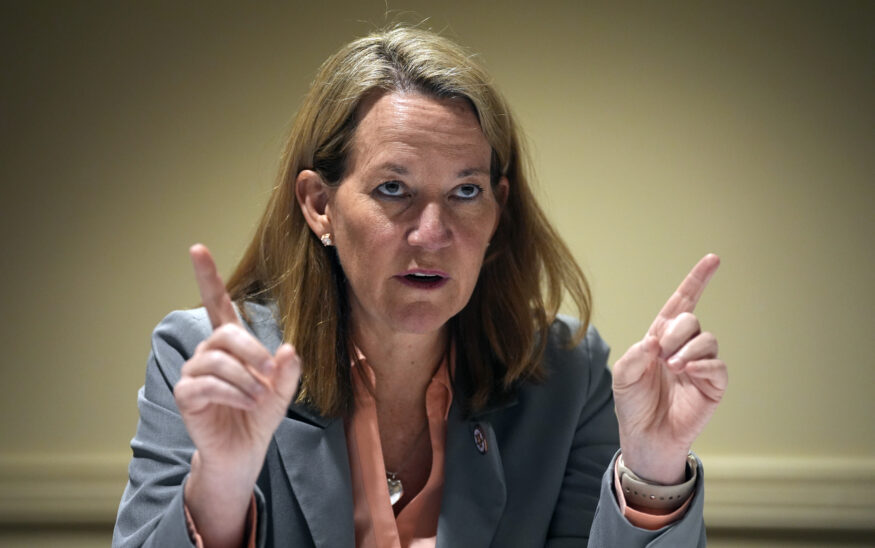
Arizona Attorney General Kris Mayes speaks during an interview with The Associated Press, Thursday, Nov. 21, 2024, in Philadelphia. (AP Photo/Matt Slocum)
Arizona Attorney General Kris Mayes speaks during an interview with The Associated Press, Thursday, Nov. 21, 2024, in Philadelphia. (AP Photo/Matt Slocum)
Attorney General Mayes sparks turf war with Arizona Corporation Commission
Reagan Priest, Arizona Capitol Times//April 9, 2026//


Key Points:
-
Attorney General Kris Mayes is challenging several recent Corporation Commission decisions
-
Commissioners say Mayes is infringing on their authority to set utility rates
-
The battle is likely to head to court as Mayes looks to reverse several policy and rate decisions
Attorney General Kris Mayes is challenging several recent Arizona Corporation Commission decisions, sparking frustration from a body often considered Arizona’s fourth branch of government.
In the month of March alone, Mayes’ office filed three rehearing requests in three separate commission matters, accusing commissioners of violating state law, ignoring the commission’s own rules or acting contrary to the best interests of utility customers. Mayes’ office has also filed a lawsuit over the commission’s approval of a controversial data center contract and is intervening in two rate cases involving Arizona Public Service and Tucson Electric Power.
The commission has the exclusive, constitutionally-granted authority to set rates for the state’s public utility companies. Its general counsel, Tom Van Flein, took issue with Mayes’ assertions that recent commission decisions violated any laws.
“The Commission takes each complaint or application for rehearing seriously. However, policy disputes are not the same as legal error,” Van Flein said in a statement. “The Commission follows the statutes, the Constitution and relevant case law giving it guidance. Policy disputes are not to be resolved in court or even in a rehearing.”
Commission Chair Nick Myers took it one step further and accused Mayes, herself a former commissioner, of wading into the commission’s jurisdiction to score points for her reelection campaign. Myers is also up for reelection this year, alongside fellow Republican Commissioner Kevin Thompson.
“(Mayes) needs to get her name out there, and she’s using the office and using these goofy lawsuits to get her name in the public eye for campaign purposes,” Myers told the Arizona Capitol Times.
Mayes’ communications director Richie Taylor defended the attorney general’s foray into ACC issues in a statement, noting that her office is charged with protecting Arizona consumers.
“When the commission springs 154% utility rate increases on senior citizens, or gives sweetheart deals to data center operators, AG Mayes is going to stand in their way,” Taylor said. “Chairman Myers should focus on fulfilling the constitutional obligations of the Commission on behalf of Arizonans so the Attorney General doesn’t have to step in and do it for them.”
Former Democratic Attorney General Terry Goddard, who served in the role at the same time Mayes served on the commission in the early 2000s, told the Arizona Capitol Times that his office did not intervene in ACC matters.
“But I think that’s because the commission was doing its job,” Goddard said. “I didn’t see any reason for us to get involved, (the Residential Utility Consumer Office) was, as far as I could tell, advocating for consumers and we didn’t have the same environment that AG Mayes does.”
Currently, the commission is made up of five Republican members. Without a single Democratic commissioner, many decisions are made unanimously and tend to favor conservative energy priorities, like promoting coal and natural gas generation and ending “Green New Deal” policies.
The tension between Mayes and the ACC has been simmering for months, with tempers flaring in August as the commission was in the process of repealing its Renewable Energy Standard and Tariff Rules. The rules — which required the state’s major utility companies to get 15% of their energy from renewable sources like solar and wind — were originally adopted by the ACC in 2006, when Mayes was serving as a Republican commissioner.
Mayes called the repeal “silly and ridiculous” which led Thompson, then the commission’s chair, to take a jab at her during an August 26, 2025, hearing on natural gas plants. He facetiously referred to Mayes as the “sixth commissioner” for her public opposition to the REST rules repeal.
The commission voted unanimously to repeal the rules on March 5 and Mayes’ office filed an application for rehearing on March 30, arguing the ACC violated its own rulemaking process by finalizing the repeal before a required economic impact statement was completed.
Myers told the Arizona Capitol Times that he believes Mayes has a more personal reason to oppose the REST rules repeal.
“The policies haven’t worked as well as she wanted them to, or she claimed they would, and we got rid of them and now maybe it seems like a personal attack on her,” Myers said. “I don’t know, but that’s my gut feeling on that.”
The day after filing an application for rehearing in the REST rules docket, Mayes’ office filed another rehearing application in a rate case for two water and wastewater companies serving the Robson Ranch retirement community near Eloy. While commissioners grew irritated, residents in the area celebrated.
“We were pleasantly surprised about the AG’s office involvement,” said Raul Salmon, the leader of a local task force formed to oppose the rate increase. “I mean, the AG’s filing, if you just read it, it vindicates what we’ve been arguing all along.”
Mayes argued the ACC erred in approving a 22% rate increase for water and 154% increase for wastewater for the Picacho Water and Picacho Sewer Companies because commissioners did not adequately consider the impact on ratepayers and did not review documents related to a stock sale of the utilities to JW Water.
“I think it is the kind of thing that just cries out for reexamination by another party,” Goddard said. “The commission seems to be granting the big increases fairly willingly, and I think that’s a bad standard.”
Thompson and Commissioner Lea Márquez Peterson voted against the rate increase, which could open the door for a potential rehearing, though the commission has yet to act on Mayes’ request.
Mayes also requested a rehearing on the commission’s approval of a formula rate structure for UNS Gas, allowing the company to adjust customer rates annually rather than going through the typical rate case process every few years. Mayes’ office opposed the commission’s adoption of a formula rate policy statement in 2024, arguing the commission should have engaged in a rulemaking process to implement the policy.
If the commission does not agree to take up any of the applications for rehearing, Mayes can take the issue to court. That’s exactly what she did in the case of Tucson Electric Power’s energy supply agreement with the developers behind a controversial data center project dubbed “Project Blue.”
The commission approved the contract between TEP and Beale Infrastructure Group in December and Mayes filed suit in Maricopa County Superior Court in November, alleging the agreement allows TEP and Beale to adjust an agreed upon rate schedule for electricity service without review by the commission. Mayes’ office argues that the commission violated its own constitutional ratemaking authority by approving that contract provision.
The Attorney General’s Office has also been vocally opposed to 14% rate increases requested by both Arizona Public Service and Tucson Electric Power. Mayes’ staff attorneys have argued in filings to the commission that those rate increases could be slashed to 3% and 4% respectively, and in statements, Mayes has said approving anything more would be a rubberstamp of corporate greed.
Those rate cases are ongoing, and a final decision isn’t expected until later this year. In the meantime, commissioners say Mayes’ efforts will not only fail, but will actually increase utility costs for customers by creating regulatory uncertainty and by filing lawsuits that taxpayers are footing the bill for.
“As a candidate, as well as a commissioner, I am disgusted to see her doing all of this, knowing full well that there’s not a whole lot of legal (weight) to any of it,” Myers said.