Sign In
 Free Newsletter

Housing Department nominee narrowly clears Senate committee
Reagan Priest Arizona Capitol Times//April 21, 2026//
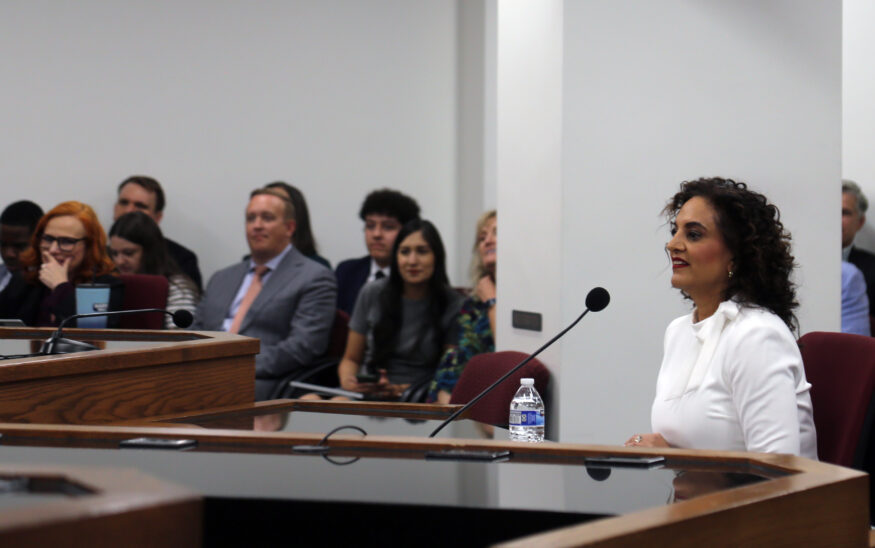
Ruby Dhillon-Williams speaks before the Senate Director Nominations Committee on April 20, 2026. (Reagan Priest / Arizona Capitol Times)
Housing Department nominee narrowly clears Senate committee
Reagan Priest Arizona Capitol Times//April 21, 2026//


Key Points:
-
Ruby Dhillon-Williams was narrowly approved by Senate DINO
-
Republicans raised concern over past financial mismanagement at ADOH
-
Dhillon-Williams’ nomination will go before full Senate for final vote
The Senate Director Nominations Committee (DINO) returned this week after a nearly two month-long hiatus, narrowly approving Gov. Katie Hobbs’ second nominee to lead the Department of Housing.
Three of the committee’s five members voted to recommend the confirmation of Ruby Dhillon-Williams, who has been serving as interim director at ADOH since March 2025. It is a small win for an agency that struggled through intense legislative scrutiny in 2025 following its 2024 sunset review audit. ADOH has been without a Senate-confirmed leader since 2023.
Dhillon-Williams came to ADOH in 2020 after several years working in affordable housing development in the private sector. In addition to having a brief stint as a program manager at the department between 2010 to 2012, Dhillon-Williams started at the department as an assistant deputy director before becoming deputy director under Senate-rejected director Joan Serviss.
Dhillon-Williams’ confirmation hearing was not unlike those of the nominees who came before her. Two Republicans voted against the confirmation after nearly two hours of intense questioning regarding her opinions on the homelessness crisis and the effectiveness of government-funded affordable housing projects.
DINO Committee Chair Sen. Jake Hoffman, R-Queen Creek, and Sen. John Kavanagh, R-Fountain Hills, said they came to the April 20 confirmation hearing with the intention of voting in favor of Dhillon-Williams’ nomination, but changed their minds after hearing her answers.
Kavanagh accused Dhillon-Williams of being “evasive,” and Hoffman said she did not provide good enough answers about her attempts to improve financial processes during her time as deputy director. A 2024 auditor general report found two instances of financial mismanagement within ADOH: the approval of $8.1 million in unsupported expenses for grantees and the inadvertent payment of $2 million to fraudsters posing as a nonprofit housing organization.
Dhillon-Williams assured the committee that ADOH has rewritten its financial protocols and wire transfer procedures in the wake of those findings, but Hoffman insisted she should have identified the problems before they occurred since she oversaw the finance division in her role as deputy director.
“There is nothing more indicative of future performance than past performance,” Hoffman told reporters after the hearing. “As I made clear, it was the Legislature and the Office of the Auditor General which identified the gaps in the process. Had the Legislature not intervened through the sunset review process as it did, we have no assurances that the Department of Housing would have made any changes.”
Hoffman also said she seemed to have a “lack of knowledge” on department information after she was unable to give him an exact number for the average cost per unit for the 10,000 affordable housing units ADOH created using the federal Low Income Housing Tax Credit program, known as LIHTC.
“LIHTC solutions have not made housing more affordable,” Hoffman told Dhillon-Williams during the hearing. “They’ve picked winners and losers, and some people have gotten the benefit of hundreds of millions of dollars, in aggregate, of government subsidies.That hasn’t actually done anything to help move the needle in terms of affordability.”
Kavanagh asked Dhillon-Williams to opine on the housing-first versus treatment-first debate in reducing the state’s homeless population, though he referred to it as “housing-first versus cure-first.” The debate surrounds whether individuals experiencing homelessness should first be required to undergo mental health or substance abuse treatment before being allowed to rent an affordable housing unit.
“I believe that it’s really important to evaluate each individual and find the best intervention that helps,” Dhillon-Williams told Kavanagh. “I don’t believe there’s a silver bullet or magic pill that will make sure an individual can move through the housing continuum successfully without evaluating the needs of that individual.”
Kavanagh was not satisfied with that answer and continued pressing her until he felt she answered the question correctly.
“Okay, that’s cure-first,” Kavanagh said after one of Dhillon-Williams’ responses. “A little tough getting that out, I know it can be difficult.”
Sen Analise Ortiz, D-Phoenix, voted in favor of Dhillon-Williams’ nomination and called out her Republican colleagues for spreading “misinformation” about LIHTC and affordable housing.
“Nobody is going around giving away free apartments to anyone right now, and anyone who thinks that has not had a conversation with those who work in this space and know just how challenging it is for people who are looking for housing,” Ortiz said while explaining her vote. “… and anyone who thinks that LIHTC isn’t making a difference has never talked to a veteran who has been on the waitlist for low-income housing for a year or more, who has been told that they finally have keys to their own place.”
Sen. T.J. Shope, R-Coolidge, ultimately voted alongside Ortiz and Sen. Flavio Bravo, D-Phoenix, to advance Dhillon-Williams’ nomination out of the committee. Notably, Hoffman commended Dhillon-Williams for her professionalism and her relationships within the regulated housing industry, a departure from his typically adversarial interactions with Hobbs’ nominees.
“To your credit, I think you are a lovely person,” Hoffman told Dhillon-Williams before voting against her nomination. “I think that you certainly have built incredible relationships and I’m sure you know this industry incredibly well. None of my commentary should detract from those things.”
Dhillon-Williams’ nomination will need to clear the full Senate before she is officially confirmed, which likely won’t occur for another week since the Senate is adjourned until April 27.
“At this point I anticipate being a ‘no’ on the floor and I anticipate sharing my great concerns with members of the majority,” Hoffman told reporters after the hearing. “The ball is in their court, they now have to work members to see if they can get (Dhillon-Williams) across the finish line.”
Other nominees, like Department of Environmental Quality Director Karen Peters and Department of Agriculture Paul Brierley, have been confirmed by the full Senate without Hoffman’s support, making Dhillon-Williams’ confirmation unclear but not out of the realm of possibility.