Arizona Senator J.D. Mesnard proposes legislation to expand nuisance laws to include excessive marijuana smoke and odor
The bill aims to address the impact of marijuana smoke on families, including restricting its use on residential properties
The legislation would allow judges to issue orders to abate marijuana nuisances
Someone in J.D. Mesnard’s Chandler neighborhood smokes marijuana.
The Republican senator doesn’t know who, though he’s pretty sure it’s not the folks next door.
But wherever it’s coming from, Mesnard said it’s strong enough to keep families from being able to use their own yards.
So the senator is proposing legislation to expand the state’s laws which make it a crime to use residential property in a way that creates a public nuisance. And he would do that by expanding the definition of “crime” to include “the creation of excessive marijuana smoke and odor,” — something that even could land people in county jail, though it does not define what is “excessive.”
The proposal comes 15 years after voters first approved marijuana for medical use. A decade later, they expanded the law to allow adults to use marijuana for recreational purposes.
Nothing in the law permits the use in public spaces.
But it says nothing about elsewhere — including in and around someone’s house, yard and pool.
“I don’t even know where it’s coming from,” Mesnard told Capitol Media Services.
He said that this time of year is “a great time to open our windows.”
“But half the time I can’t keep our windows open,” Mesnard said.
It’s not just a problem for him — or even just in Chandler.
“When I dropped the bill, my phone was blowing up with people letting me know their own experience,” he said. What that shows, Mesnard said, is that “people were just sort of tolerating it.”
That, he said, convinced him that the problem is broad enough to be covered under existing nuisance laws.
Part of his proposal addresses judges’ authority to issue orders to property owners to abate “criminal nuisances” — which his measure would expand to include excessive marijuana smoke or odor—or face having the government or homeowner association do so. But in that case, the cost would become a lien against the property.
But there’s more.
There already is a provision in the state’s criminal code that makes it illegal to recklessly create or maintain a condition that “endangers the safety or health of others.”
Mesnard’s bill goes a step further, declaring as a matter of law that “it is presumed that the creation of excessive marijuana smoke and odor is injurious to health, indecent, offensive to the senses and an obstruction of the free use of property that interferes with the comfortable enjoyment of life or property and is a public nuisance.”
Put another way, it would not be up to the government to prove any of that to get a conviction. Instead, it would be up to the homeowner to prove otherwise.
A conviction for knowingly maintaining such a nuisance could land someone in jail for up to four months and subject them to a $750 fine.
Mesnard said legislative intervention is necessary.
“I’m hearing from some people that, depending on their neighbor situation, they may not be able to have their kids go outside because the marijuana smoke is so potent,” he said. “It can even creep into your own house or, in my case, into my garage.”
Mesnard said he never supported legalizing recreational marijuana. But he also said that fighting it wasn’t his top issue.
“But experiencing now what’s happened, even in my own neighborhood, is a pretty frustrating situation,” he said. The legislation, Mesnard said, is to buttress the idea that “you should be responsible neighbors if you’re going to smoke pot, that it can be a real issue for families, especially with kids.”
Still, that leaves the question of why single out smoke from marijuana as a nuisance and not smoke or odor from cigarettes, cigars and pipes — or even someone lighting wood on fire in a pit.
“I’ll concede I hadn’t thought about it,” Mesnard said. But he also said that, based on his own experience, he hasn’t found that to be a problem.
And there’s something else.
“I’m pretty sure that marijuana smoke has a different impact than, say, other smoke that might make you cough,” Mesnard said.
“I don’t want my kids to get high,” he said. “If someone wants to get high on their own, let them get high on their own.”
Mesnard said that the moment an individual’s actions affect other people, especially kids, “that’s where I take serious issue.”
Less clear is whether voters will have any say.
One version, SB 1725, would take effect if approved by the House and Senate and signed by the governor.
The only thing is, marijuana was legalized in an election. And the Arizona Constitution limits lawmakers’ ability to tinker with anything voters have approved.
Mesnard said his proposal could be considered an effort to amend the initiative. So he also has crafted SCR 1048 which is identical in every way with SB 1725 with the exception that legislative approval would simply send the question to the November ballot where voters would get the last word.
Sen. John Kavanagh proposes legislation to criminalize warning others about police presence
The bill aims to plug a loophole in existing laws that only punish physical obstruction of police
Critics argue the law could lead to excessive prosecution for protected speech activities
Blowing a whistle to alert others when you see an Immigration and Customs Enforcement van in the area could land you in jail.
Ditto bells, gestures, written messages or even electronic communications.
It’s all part of legislation by Sen. John Kavanagh to keep people from preventing the arrest of someone wanted by law enforcement.
But less clear is exactly which acts would become crimes under the proposal by the Fountain Hills Republican.
Kavanagh tells Capitol Media Services the aim is to plug a loophole in the law.
“I saw there were people warning people about ICE coming,” he said. But Kavanagh said none of that is illegal under existing laws which make it illegal to “obstruct” police, something he said requires someone to physically intercede.
“It didn’t deal with warning,” he said.
His SB 1635 is designed to fill that gap.
The senator said nothing in his measure, scheduled for a hearing this week, is designed to interfere with anyone’s First Amendment rights. He said it’s meant to apply only when someone alerts one or more individuals who the person doing the signaling is known to be sought by the police.
By contrast, Kavanagh said, it wouldn’t apply to those who blew a whistle or gave any other warning simply because they saw ICE come down the street.
“Free speech protects that behavior,” he said.
But Sen. Analise Ortiz said she has a hard time believing that what Kavanagh wants the Senate Judiciary Committee to enact is as limited as he claims. The Phoenix Democrat said it leaves too much discretion to prosecutors who she said are too quick to do things like label people who are simply watching ICE as “domestic terrorists.”
“It would absolutely lead to people who simply were sharing information on social media or blowing a whistle in their neighborhood being hit with a Class 1 misdemeanor,” Ortiz said, which carries up to six months in county jail and a $2,500 fine.
And there’s something else that Ortiz told Capitol Media Services makes her question what is the real intent of the legislation: Kavanagh actually singled her out for special mention in a press release when he introduced the measure.
“As President Trump works to remove criminal illegal aliens from our communities, radical Democrat lawmakers, including Sen. Analise Ortiz, have chosen to interfere and help criminals evade arrest,” Kavanagh wrote. “Arizona is not a state of anarchy, and we will not tolerate elected officials undermining active law enforcement operations.”
All that stems from an incident last August where Ortiz shared a social media post from someone else alerting people that ICE agents were outside an elementary school on the southwest side of Phoenix. Ortiz said this is no different than her resharing other posts about things affecting her community, citing another one about a Maryvale Resource Fair.
But what happened this time, Ortiz said, is that LibsOfTikTok, a site that posts conservative viewpoints, posted that Ortiz “is actively impeding and doxxing ICE by posting their live locations on Instagram.”
Things escalated from there.
“Yes,” Ortiz responded online. “When ICE is around, I will alert my community to stay out of the area and I’m not f****** scared of you nor Trump’s masked goons.”
Republican Sen. Jake Hoffman of Queen Creek interjected himself into the dispute, filing a complaint accusing Ortiz of violating Senate rules against “disorderly behavior.” And Sen. Shawnna Bolick, a Republican from Phoenix who chairs the Ethics Committee is now asking for a federal investigation to determine if what Ortiz is doing amounts to “interference with federal law enforcement operations.”
Neither inquiry has gone anywhere. And Bolick, after filing her request with federal prosecutors, never responded to questions about how publishing the location of something occurring in public violates the law.
And that leads back to Kavanagh resurrecting the incident as a reason to push for a new state law.
“Sen. Kavanagh knows it’s unconstitutional,” Ortiz said of the new legislation. “He’s only doing this to make a splash in the headlines and, more importantly, to try to scare people from speaking out when they see masked, armed, violent men in their neighborhood.”
All that goes to the question of whether warning people about the presence of ICE — or any other law enforcement — is constitutionally protected and beyond the reach of state lawmakers.
“People have a right to blow a whistle anywhere they want,” Ortiz said.
True, Kavanagh conceded — but only up to a point.
For example, he said, consider someone who works at a grocery store and knows that people working in the back are not here legally. If that person then warned those people that ICE was out front with a warrant, they would be breaking the law under his legislation.
So why would Kavanagh cite what Ortiz did — which he seems to concede is protected by the First Amendment — as a reason he cited for why the law should be changed?
Kavanagh said it was her actions that “motivated me” to introduce the legislation.
“I think her behavior should be illegal,” he said. “But the Constitution said that’s too general and, therefore, free speech.”
Anti-immigration protests over the past few weeks have included students and teachers walking out of class
Legislators and some state officials have questioned if they should be using class time to exercise their First Amendment rights
Two First Amendment experts said if legislators did write such a law, it would have to be content-neutral and narrowly tailored
In the past few weeks, students and teachers have walked out of school to protest the actions of immigration authorities and the federal government.
On Jan. 30, thousands of Tucson Unified School District employees called out sick, according to the Arizona Luminaria. As a result, 21 schools closed due to lack of staff. While peaceful protest is protected under the First Amendment, several legislators and state officials have questioned whether it should be allowed during school hours.
After the protests, state Rep. Matt Gress, R-Phoenix, and state Sen. Hildy Angius, R-Bullhead City, said in a news release they’ll introduce legislation to limit when public school students and teachers can protest. Angius said the closures highlighted a lack of accountability in school district systems and a troubling willingness to disrupt students’ education for political purposes.
“Parents send their children to school expecting stability and instruction, not sudden closures driven by organized protests,” Angius said in a news release. She chairs the Senate Education Committee. “Using sick leave to shut down campuses crosses a line and undermines trust in public schools.”
They weren’t the only ones concerned with protesting during school hours. Sen. John Kavanagh, R-Fountain Hills, pointed out the number of schools that had to shut down and added, “Time to revoke some teacher licenses” in a post on X.
The Arizona State Board of Education said they have not been contacted by any legislator regarding that topic and didn’t have a comment, per Executive Director Sean Ross. All decisions related to student attendance and behavior are addressed at the local level by the school or district, he added.
However, State Superintendent of Public Instruction Tom Horne said in a statement on the Arizona Department of Education’s X page that students have the First Amendment right to peacefully protest but “it should be done after school hours. Teachers and other school personnel should not be a part of a protest during class time.”
Speaking up in opposition to potential legislation, Sen. Catherine Miranda, D-Laveen, said the threat is another example of the Republican Party claiming to stand for freedom and the Constitution while criticizing educators for exercising their constitutional right to speak out.
“Educators are human beings and Americans first. They have the same rights as anyone else to raise their voices when they believe their students and communities are being harmed,” she said in a news release.
She acknowledged parents’ frustration and said it’s understandable, but the focus should be on addressing the root cause affecting school communities. She added, “You cannot demand stability in schools while ignoring the conditions that are creating fear and instability for students and staff.”
Meanwhile, organizations like the nonpartisan, nonprofit advocacy group Secular AZ have a form on their website that serves as an excused absence for students who are protesting. The group frames protesting during school hours as an important exercise of civic engagement. It also cites several court cases, including Tinker v. Des Moines, one of the most famous student free speech cases.
The case determined that schools may regulate conduct that materially interferes with school operations, but it does not require punishment when school officials determine that student demonstrations serve legitimate educational and civic purposes. The court ruled students do not “shed their constitutional rights to freedom of speech or expression at the schoolhouse gate.”
If such a law was written that told students and educators when they could protest, it would need to be narrowly tailored and content-neutral, two First Amendment law experts at Arizona State University said. Neither speaks on behalf of the university.
The First Amendment is broad and it doesn’t cover any specific time frame on when people can protest, Gregg Leslie, Executive Director of the First Amendment Clinic at the Sandra Day O’Connor College of Law, said.
“The biggest thing is if someone’s trying to make a law to make this illegal and they’re doing it based on the content of their speech, then it’s subject to a higher level of scrutiny,” he said.
As for addressing potential absenteeism, if lawmakers make a special rule regarding being absent because people are exercising their freedom of speech rights, then it would be a content-based regulation and it should be struck down, he said. If there’s a broader policy on absenteeism that’s very strict, but it applies to all situations, then it would likely be upheld.
It could also have a chilling effect on people exercising their First Amendment rights, or it might do the opposite and encourage more protesting, Leslie said.
Any law restricting when students and teachers could protest would have to be narrowly tailored and content-neutral, Erin Coyle, Associate Professor of Media Law and the First Amendment at the Walter Cronkite School of Journalism and Mass Communication, said.
Content-neutral essentially means that restrictions or punishments for engaging in free expression and freedom of assembly would have to be applied in ways that do not single out or target particular messages, she said, and they would also have to be narrowly tailored.
“If they are limiting any expressive activity, they are limiting the least amount possible. It’s possible that a law could be written that appears entirely neutral, and that it is not written in a way that it is specifically targeting protesting, or protesting on specific topics. It also would need to be in a neutral way,” she said.
What about private school employees?
Leslie said there have been a lot of attempts in Arizona to apply everything to all school teachers, but it depends on the authority and the state laws that govern private schools.
“If they found a justification, if they found a cause or even if, you know, there’s often some level of state funding of private schools,” he said, “and so they could certainly threaten to withhold money. A creative legislator could try to find a way to make it apply to private schools.”
Arizona counties want to permanently move the state’s primary date from the first week of August to the final week of July
Federal law shortens the time Arizona has to submit primary election results before the general election
Counties say the change likely has to be enacted during February
Just as in 2024, one of the first issues lawmakers must tackle in the upcoming legislative session will be the state’s primary election date.
Arizona did move its primary election date from the first week of August to the final week of July in 2024, but that was a temporary measure. Now, with another upcoming midterm election, lawmakers will attempt to move the state’s primary election date to July permanently.
The 2024 law resulted from the Electoral Count Reform Act of 2022, which changed the procedure for the counting of electoral votes.
Under those changes, election officials across the state worry that they could miss federal deadlines to submit election results if a recount is triggered. A recount is required if the race is within one-half of a percent, instead of one-tenth of a percent, which was the requirement before a 2022 law went into effect.
Rep. Alex Kolodin, R-Scottsdale, prefiled House Bill 2022 for the upcoming legislative session. His measure would permanently move the primary date to the last week of July while also allowing county party chairs to designate observers at voting locations. “This is another commonsense measure that recent election cycles have demonstrated is critical to clean elections in Arizona,” Kolodin said in a statement. “The bill ensures that Arizonans will not be disenfranchised by Congress’ mistakes and clarifies that independent observers are permitted at all voting locations.”
Getting observers at voting locations has been a goal for Kolodin and other Republican members of the Legislature in recent years under Democratic Gov. Katie Hobbs. In 2024, Hobbs vetoed a bill from Rep. Rachel Keshel, R-Tucson, which would have established the practice into law.
The governor wrote in her veto letter of House Bill 2153 that she didn’t object to uniform laws regarding political party observers but wasn’t sure whether counties could implement them.
“I am concerned this bill will strain the resources of counties that already struggle with recruiting poll workers by adding additional responsibilities to manage observers who would be required to act as challengers,” Hobbs wrote in her letter.
Jen Marson, executive director of the Arizona Association of Counties, told the Arizona Capitol Times that the counties have not yet taken a position on whether to include the ballot observer language in the bill.
The counties plan to run their own mirror bills through both House and Senate election committee chairs, Sen. Wendy Rogers, R-Flagstaff; and Rep. John Gillette, R-Kingman, Marson said. Those bills were not drafted to include the language about ballot observers.
Lawmakers had to act quickly with the 2024 temporary measure. Hobbs signed the bill in early February of that legislative session after the counties warned the Legislature that they might not have enough time to secure polling places and voting locations before the primary election if the bill remained in session.
This year, the counties have run into the same problem.
“We tried to do it last (session) and we had what we thought was a pretty good vote count, but then we got word that we should not move forward this year and we should wait and do it first out of the gate in 2026, so that’s what we’re doing,” Marson said. “We did take a lot of heat for changing the primary in the year of the primary and I did not want to do that again, but here we are so that’s what we’re going to need to do.”
Kolodin was one of the key negotiators of the 2024 temporary measure with former Democratic state Rep. Laura Terech. Both he and Terech described the negotiations over the bill as an exhausting ordeal, leaving some lawmakers in tears of triumph when they knew the bill would become law.
It was also an opportunity for Kolodin and other Republicans affiliated with the Arizona Freedom Caucus to negotiate election policies they had previously been unsuccessful in getting signed by Hobbs, including requiring county election officials to compare voters’ signatures from their voter records with a list of specific characteristics. Many election workers were already doing that, but the law established it as a required practice.
Kolodin’s bill for the 2026 legislative session would also change the amount of time voters have to correct any problems with their mail-in ballot signatures from five business days to five calendar days, which was also implemented in the 2024 measure.
Some Democrats opposed going to five calendar days because they believed it could disenfranchise voters who rely on public Wi-Fi and public transportation which have reduced service on weekends. Marson said the counties requested that change because it helps give election workers enough time to gain days before federal deadlines if a recount is triggered.
Despite existing laws on sex offender registration and monitoring gaps exist
Arizona, along with many other states, chose not to follow the federal requirements
18 states, four US territories, 137 tribes have implemented the requirements
Legislators and field experts say Arizona’s “patchwork” of sex offender registration and notification laws still need improvement.
Existing gaps include how offenders are supervised, the lack of auditing of offender level files, the need for more transparency in probation programs and ensuring probation officers and law enforcement have the resources to do their jobs as the law and statutes direct, Beth Goulden said.
Goulden chairs the Sex Offender Management Board, a new multi-disciplinary board under the Department of Public Safety that develops and recommends statewide procedures for evaluating, treating and supervising adult and juvenile sex offenders.
A renewed call for reform comes after 25-year-old Abel Gblah, who is a level two sex offender on lifetime probation, followed a student into Orangewood Elementary School after they entered the building. Gblah is alleged to have falsely claimed to be a doctor, and led a 10-year-old girl into an empty classroom and sexually assaulted her, according to Phoenix Police and court documents.
Sen. Janae Shamp, R-Surprise, said the system failed and she’s making it a top legislative priority in the upcoming 2026 session. She held a news conference in November with several other legislators and experts who said the laws need improvement, even after three of her bills to improve them were signed into law over the past two legislative sessions.
“We are asking every hard question. Why was this man still on probation? Why were repeated violations met with leniency? Why were warning signs ignored until a child was hurt?” Shamp said.
Shamp pointed out Arizona fails at least five out of 11 categories of a federal law that established a comprehensive set of minimum standards for sex offender registration and notification, according to a 2021 Department of Justice report. The state meets four categories and has two deviations that “do not substantially disserve the purposes” of the act.
The law, known as the Adam Walsh Child Protection and Safety Act, was passed in 2006.
Arizona, along with many other states, chose not to follow the federal requirements. Instead, Arizona follows the Sex Offender Community Notification statutes, which were passed in 1996, after a federal community notification statute known as “Megan’s Law” was passed. That law came after the 1994 sexual assault and brutal murder of a 7-year-old girl by her neighbor, who was a recently released sex offender.
The assessment is a screening tool that provides criminal justice practitioners with an awareness of a sex offender’s risk of recidivism. It evaluates 19 criteria that have been identified as good predictors of future behavior, according to the Department of Public Safety.
Goulden pointed out the difference between the federal requirements and the state’s system. The federal act focuses on consequences of the offense, which can often result in plea agreements and that doesn’t necessarily tell the whole story, she said.
“You have to look at the actual behavior because the plea and the charge don’t always paint an accurate picture of what the person did to have them end up either on the registry or probation or whatnot,” she said.
Arizona’s assessments factor in the offense and consider risk criteria, such as impulsivity.
“If you think about it, it’s more on the rare side to have stranger danger. A guy pulls up to a park and decides I’m going to kidnap a child and molest or rape them right then, and if you compare that to someone who may take months or years to groom a child,” Goulden said.
The issue Goulden sees is there is not an audit of the assessments, which are subjective. For example, someone living in Phoenix could be classified as a level three offender, then move to Gilbert, get re-assessed and be classified as a level one offender, Goulden said.
“Are we assessing people the best way that I can? The most accurate way?” she said.
Under the 2006 federal law, states were required to implement the Sex Offender Registration and Notification Act, known as SORNA. States were given until 2009 to comply with the act, but Arizona requested two time extensions, which extended the deadline to 2011, according tolegislative committee documents. If states do not implement it, they lose 10% of their federal funding from the Edward Byrne Memorial Justice Assistance Grant (JAG) Program, which is the leading source of federal justice funding to state and local jurisdictions, according to the Department of Justice.
A report from the Justice Policy Institute concluded it would have cost Arizona about $10.2 million to implement it in 2009 dollars. By not implementing it, the state would lose about $365,388 in federal justice funding at that time.
In fiscal year 2024, Arizona received about $3.94 million in federal justice funding under the Edward Byrne Memorial Justice Assistance Grant (JAG) Program, according to the Bureau of Justice Assistance. Losing 10% equates to almost $400,000.
Only 18 states, four American territories and 137 tribes have substantially implemented the requirements, according to the Department of Justice. In Arizona, 19 tribes have substantially implemented the requirements.
Arizona’s current notification statutes kick off when someone registers as an offender. The Department of Public Safety and the sheriff’s office for the county in which the person resides are notified. That information is forwarded to the local jurisdiction, which may be the sheriff’s office itself. Then, officers conduct the risk assessment and assign one of three levels. The local law enforcement agency has to notify the community within 45 days of the person’s presence in the community, according to the statute.
Arizona legislators prepare for the 2026 session with 32 prefiled measures
Lawmakers introduced 1,724 bills last year, second most in state history
Increased number of bills is leading to longer legislative sessions
With state legislators already prefiling bills for the upcoming session, Arizona is poised to have more legislation introduced this decade than at any other point in its recorded history.
Lawmakers had prefiled 32 measures through Nov. 26, nearly two weeks after the prefiling period began on Nov. 15. Of those measures, 26 were bills and eight were memorials and resolutions, which are not required to be signed by the governor.
So far, the 2020s have seen about 1,650 bills introduced each regular legislative session, according to session statistic data from the Arizona Legislature’s website. The website only tracks bill statistics up until 1989, or from the 39th Legislature.
Last year, lawmakers introduced 1,724 bills, the second most in state history. Following the shortened 2020 session due to the COVID pandemic, legislators filed 1,774 bills in 2021.
The average number of bills introduced this decade outpaces the 2010s by almost 300. The previous decade saw an average of 1,372 bills annually and the 2000s saw an average of 1,373 bills introduced in regular legislative sessions.
The legislator who has introduced the most bills so far in the early prefiling period is Rep. Nick Kupper, R-Surprise, who has already prefiled 10 bills before the session’s start.
The second-year lawmaker told the Arizona Capitol Times that many of his bills focus on addressing modern issues for a digital world.
Kupper was the sponsor of last year’s age verification law that requires websites showing explicit adult content to verify a user’s identity before granting access. For the upcoming session, he has introduced House Bill 2010, which would require sellers of digital goods, including movies, TV shows, music and video games, to provide a disclaimer that buyers of these products are paying for a license to access what they’re buying, not owning the item like a physical CD.
“At the end of the day, we as lawmakers, we can do almost any law we ever want to do. It’s just, do we have the gumption to do it?” Kupper said.
For many lawmakers and lobbyists, the interim period between the end of the previous legislative session and the prefiling date is the best time to work on legislation for the next session.
Joe DeMenna, a partner with DeMenna Public Affairs, said the fall season is critical for lobbyists like him who hope to get bills passed and signed by the governor.
“If your issue is being heard by lawmakers in committee, and that’s the first time they’ve heard it, you’ve messed up,” DeMenna said. “There’s so much groundwork to be done.”
In addition to the new proposals, some bills are returning from previous sessions. Senate Bill 1004 from Senate Majority Leader John Kavanagh, R-Fountain Hills, is a returning measure from last session that would allow Empowerment Scholarship Account students to participate in interscholastic activities and athletics at a public school district near their home.
The 2025 version of Kavanagh’s bill was heavily opposed by Democrats and failed on the House floor with some Republicans absent on the day the House voted on the measure.
With the increase in bills being filed in the 2020s, the length of the session has also increased. Each session in the decade has gone deep into June despite both chambers historically aiming to adjourn sine die by the 100th day of session, which typically falls near the end of April.
The last time lawmakers adjourned a regular legislative session in April was 2015. Lobbyist Barry Aarons said the increased length of the session is somewhat of a new practice in his 55 years of experience at the Legislature.
“This year you could argue that it’ll be a shorter session because they all want to get out and campaign,” Aarons said. “I’ve seen election years where they just keep going, kind of like the Energizer Bunny, they just keep going. Why? Because they can. A lot of people just love being down there.”
League of Arizona Cities and Towns seeks legislation to regulate short-term rentals
Municipalities want to limit short-term rental licenses to address housing challenges
Short-term rentals make up 10% of local housing stock in some areas
In the next session, the League of Arizona Cities and Towns will pursue legislation that allows municipalities to further regulate short-term rentals.
Members of the league’s resolutions committee approved seven policy goals to pursue as legislation for the 2026 legislative session during the organization’s annual conference Aug. 19-22, including an item that would allow cities to limit the number of short-term rental licenses issued in their jurisdictions.
“The focus will be on addressing the continued growth of investor-owned short-term rentals, which have contributed to housing challenges in many communities,” said Tom Savage, the league’s legislative director.
According to a resolution prepared by the league, municipal leaders are seeking legislation that would allow them to cap the number of short-term rentals in an oversaturated area and reduce the threshold for license revocation to take action against properties that have repeat violations of city ordinances.
The resolution states that short-term rentals have greatly impacted housing affordability and availability in some areas of the state, particularly small communities. Some areas with high tourism visitation are seeing short-term rentals make up as much as 10% of the local housing stock.
One area of the state that’s been affected greatly by short-term rentals is Sedona. A 2024 community report from the city notes that 18% of the city’s housing stock was comprised of short-term rentals, leading the City Council to declare a housing shortage emergency and designate a parking lot for workers in the city to sleep in their vehicles if they’re experiencing homelessness through the Safe Place to Park program.
Efforts to change state law for short-term rentals have gone unheard in recent legislative sessions. Republican and Democratic lawmakers introduced legislation related to short-term rentals in the 2025 legislative session, but no bill was heard in any committee despite Gov. Katie Hobbs urging the Legislature to address the issue in her State of the State Address at the beginning of session.
Sen. John Kavanagh, R-Fountain Hills, sponsored Senate Bill 1141 during the session, which would have shortened the threshold for cities to suspend a short-term rental license. Kavanagh was recently named Senate majority leader following the end of the recent legislative session.
The league has stayed away from lobbying efforts against short-term rentals at the Capitol as part of a 2022 moratorium league officials agreed to with Airbnb and Expedia Group that prevented the group from lobbying for local regulation for three years. That deal was a result of a 2022 law that allowed municipalities to issue short-term rental licenses.
That moratorium also prevents the league from attempting to repeal a 2016 law that prohibits cities and towns from banning short-term rentals until 2027, although individual cities have lobbied for changes to the statute individually.
Counties are also seeking changes to short-term rental policy. Mohave County Assessor Jeanne Kentch hoped for legislation last session that would codify assessing properties that are used for renting for periods of less than 30 days in the same classification as hotels and motels.
Rep. John Gillette, R-Kingman, sponsored the legislation with House Bill 2316, which was among the short-term rental bills that didn’t get a hearing.
“When nobody likes it, it goes in a drawer,” Kentch said. “That’s what happened to my bill.”
Kentch said she believes her bill would create a more equitable environment for hotels and motels and make it easier for assessors in the state to determine their assessments for properties that are operating as short-term rentals.
HB2316 would have specifically applied to properties with transient renters. Kentch said she’s not looking to include a primary property that rents out an accessory dwelling unit to long-term renters with the bill.
“I’m not fair to my hotels right now because I’m classifying them as commercial but I’m not classifying the house down the street that’s doing the exact same thing as commercial,” she said.
According to data collected by the Arizona Neighborhood Alliance, a statewide organization of neighborhood leaders, there were more than 70,000 short-term rental units across the state in 2024, but there were only about 5,550 short-term rental transaction privilege tax licenses accounts established that year.
A July report from AirDNA, a vacation rental and analytics company, indicates about a quarter of short-term rentals in the state are “professionally managed” by a company that has at least 21 listings in the state.
AirDNA didn’t have data about ownership of vacation properties, but the company shared with the Arizona Capitol Times that the two companies that manage the most properties in the state, Evolve and Vacasa, typically don’t own the assets they manage.
Gov. Katie Hobbs vetoed a myriad of laws on April 18
She has vetoed 52 so far this year, less than her record of 143 in 2023
Hobbs issued a moratorium on all bills until funding for disabilities programs passes
Gov. Katie Hobbs has nixed legislation designed to promote greater cooperation between local officials and federal immigration agents.
In a flurry of vetoes late Friday, the governor also rejected a host of proposed changes in state water laws, alterations to statutes governing the conduct of elections and even a prohibition against the state Department of Agriculture enacting any rules designed to ensure that laying hens have enough room to spread their wings.
And school board elections around the state won’t be turned into partisan affairs as some Republicans had proposed.
Those are just several of the 33 measures from the Republican-controlled Legislature that found disfavor with the Democratic governor. That brings her tally so far this year up to 52.
With dozens of measures still pending, Hobbs could easily match the 73 vetoes she issued last year. But she is a long way from breaking the all-time record of 143, which she set herself in 2023.
Not everything Hobbs touched on April 18 was quashed. The governor signed 38 others, including a controversial bill allowing Axon Enterprises to build a campus for its international headquarters, a hotel, and nearly 2,000 apartments despite a local referendum that halted the plan.
Hobbs also gave her approval to impose new requirements and regulations for “sober living homes” which are operated by private entities and designed to help people recover from alcohol and drug addictions. There have been a series of reported abuses where individuals were taken to these facilities but not provided any care yet the state was billed.
And Hobbs signed legislation to end the immunity of public agencies, including schools, if they fail to conduct background checks on staff who later go on to molest children and others. That is a direct outgrowth of efforts by attorney Gretchen Jacobs who acted after her special needs daughter had been sexually assaulted and there was no way to hold the school liable.
There won’t be any more bills signed or vetoed for some time to come.
Hobbs told lawmakers on April 18 that they should not send her anything else until they develop a plan she accepts to fully fund services for the developmentally disabled through the end of the fiscal year on June 30. Put simply, anything that reaches her desk before that will automatically be vetoed.
The highest profile bill vetoed was dubbed the Arizona Immigration, Cooperation and Enforcement Act, or Arizona ICE Act for short, designed to require law enforcement to cooperate with federal immigration authorities.
The Arizona ICE act would have required law enforcement to hold someone accused of committing a crime for up to 48 hours if federal authorities have designated a “detainer” on them. That would have made it easier for immigration officials to track those on track for deportation..
But the measure also contained a broader provision preventing any state or local agencies from adopting or enforcing a policy that prohibits cooperation with federal immigration authorities.
Simply put, it would have required the attorney general, on request from any lawmaker, to investigate and file suit against offenders. But it also would have allowed any taxpayer to file complaints with the attorney general and sue if there was no action within 60 days.
Hobbs, in her veto message, said she has “worked productively” with the federal government to secure the border, specifically mentioning funding for a task force to stop fentanyl trafficking. “But we should not force state and local officials to take marching orders from Washington, D.C.” she wrote.
The veto immediately drew criticism from the Republican Governors Association, which called the governor’s policies “window dressing.” That is not surprising, given that Hobbs, who faces reelection next year, has been on the defensive about her border policies.
Hobbs also rejected a series of new procedures to verify that food stamp recipients remain eligible, including verification of employment records, income amounts and job-search activities on a monthly basis. While benefits under what is known as the Supplemental Nutrition Assistance Program are paid for solely with federal funds, Sen. John Kavanagh, R-Fountain Hills, said it would ensure that the funds available help those most in need.
In her veto, Hobbs cited her own experience receiving food stamps.
“Instead of creating needless frustration for Arizona families, I invite you to join me in more targeted efforts to secure transactions and prevent theft that robs eligible SNAP participants of their benefits,” she wrote.
The governor also rejected four measures designed to alter specific provisions in state law dealing with the use of groundwater.
Some were technical, like extending the amount of time someone using water in the Willcox Active Management Area has to claim a “grandfathered” right to pump. But some created new exceptions to pumping regulations for things like growing wine grapes.
Hobbs criticized lawmakers for failing to examine groundwater policy more comprehensively, calling the vetoed measures “just political cover for the Legislature’s inaction on water security.”
There also were a couple of vetoes related to electricity and regulation.
One now-dead measure would have barred the Arizona Corporation Commission from shutting down any coal, natural gas or nuclear power plant source unless it was replaced by something that provided equal “dispatchable” energy, meaning something constantly available and, by definition, excluding power sources like wind and solar. The governor said Arizona needs “an all-of-the-above approach to energy.”
And she also rejected a measure that would have allowed the construction of “small modular reactors” without zoning and regulatory oversight. Proponents said these could fill the needs of data centers that are large energy consumers.
“This bill puts the cart before the horse by providing broad exemptions for a technology that has yet to be commercially available anywhere in the nation,” Hobbs wrote in vetoing the bill.
Hobbs also returned several election-related bills to the Legislature with a veto stamp.
One would have outlawed paying individuals in cash or anything of value based on the number of voter registration forms collected, completed or submitted; the governor calling it “speculation” that the practice creates problems.
She also rejected the requirement that ballot papers have a watermark to ensure their validity, saying she is confident elections can be administered fairly “without added expense and complexity.”
Hobbs said a requirement that anything that looks like an official election-related document must have a bold disclosure “not from a government agency” was so broad it could “inadvertently discourage qualified citizens from registering to vote.”
Other now-dead measures include:
– Requiring lessons on fetal development to seventh and eighth graders, a curriculum mandate Hobbs said should be left to local schools and the state Board of Education;
– Banning the sale of any land in Arizona to a foreign entity “hostile to the United States,” a measure Hobbs said could lead to arbitrary enforcement while noting it conflicts with federal law;
– Requiring only merit hiring by the state which Hobbs said Arizona already does but worried its wording could eliminate preferences now provided for veterans;
– Limiting fees that could be collected by the Arizona Registrar of Contractors, a move the governor said could undermine the ability to reimburse homeowners who have been harmed or defrauded by contractors;
– Prohibiting the Department of Child Safety from refusing to place a child in a foster home or kinship foster care parent based solely on the vaccination status of that child or others in the home, a measure Hobbs called unnecessary while failing to address the need for foster homes for older children in DCS custody;
– Barring state agencies from enforcing actions against those who violate regulations until the offending party is given time to fix the problems, a move Hobbs said undermine the ability to conduct inspections and threatens the health and safety of Arizona consumers;
– Giving state lawmakers control over certain federal grant funds now controlled by the governor’s office and state agencies under her purview;
– Expressing support for the Electoral College, something the governor pointed out has no actual legal effect;
– Making changes to laws defining virtual currencies, crypto currencies and other digital assets, with the governor saying county treasurers are concerned about operational, legal and accounting changes the bill would require.
Following nearly 5,000 west Phoenix students being at risk of seeing their school district close amid financial turmoil, lawmakers at the state Capitol are attempting to exert their influence over school boards across the state.
One of the main priorities for Republicans is House Bill 2610. The GOP proposal from Rep. Matt Gress, R-Phoenix, is a direct response to the Isaac School District’s placement into receivership after overspending its budget by more than $28 million and falsifying financial records.
HB2610 originally proposed requiring the superintendent and school board members of any district to be removed from their positions if their district is placed into receivership, but it has been amended to remove the required resignation of school board members.
After House Republicans called for an investigation into the matter, House Speaker Steve Montenegro, R-Goodyear, said in a press release, “The falsification of financial records and the mismanagement of public funds are a betrayal of trust and must be investigated immediately. The people of Arizona deserve to know how this happened, and those responsible must be held accountable.”
Sen. Flavio Bravo, D-Phoenix, represents the district where Isaac is located. He said while he’s concerned about how leadership at the district allowed its financial crisis, he voted against the measure because he said he’s skeptical the bill would prevent similar behavior at other school districts from happening.
Democrats, too, have called on the school board’s leadership to resign, but would rather see the issue be handled by Attorney General Kris Mayes’ ongoing investigation of the district.
“House Bill 2610 is absolutely overbroad,” said House Minority Leader Oscar De Los Santos, D-Laveen. “The only reason that we are aware of this problem is because of the transparency requirements that public schools have that the ESA program does not have.”
There is a bill that some Democrats support intended to prevent a situation like Isaac’s from happening again, but the measure has been halted in the House after lawmakers became aware of a potential conflict of interest from the bill’s sponsor with an amendment to the bill.
House Bill 2883 from Rep. Lydia Hernandez, D-Phoenix, would establish biennial training requirements for school board members related to school finance.
That measure failed on the House floor on March 10 after drawing up controversy with an amendment that would allow immediate family members to serve on the same school board if they live in the same household and the younger family member is under 20 years old.
Hernandez and her daughter are members of the Cartwright School District and are being sued for serving on the board together.
Several Republicans and nearly all Democrats voted against Hernandez’s bill, defeating it 21-35. Rep. Junelle Cavero, D-Phoenix, said she supported the training requirements of the bill but could not support the measure with the amendment.
The House has since removed the amendment language from the bill, but it has not yet received another floor vote.
Another school board measure from Sen. Carine Werner, R-Scottsdale, would make school district governing board elections partisan, listing candidates’ political party affiliation on the ballot.
“The voters deserve transparency to know which party the candidate aligns with,” Werner said.
Werner’s measure, Senate Bill 1441, is waiting for a vote on the House floor, and has faced opposition from Democrats.
House Assistant Minority Leader Nancy Gutierrez, D-Tucson, said she doesn’t believe school board members should be viewed in a partisan light.
“Adding this on is just asking for more political fodder, not less,” Gutierrez said.
Gress said he’s been subject to partisan attacks when he was a candidate for the Madison Elementary School District in 2020, and he feels school board races have become increasingly organized and partisan.
“(The state is) putting this facade of nonpartisanship on these school board positions, and that’s what it is – a façade,” Gress said. “These are big political positions that both parties would like to have influence on, and they do,”
A Republican bill moving through the Legislature would allow the legislative leaders to make appointments to the Governor’s Regulatory Review Council, the entity that reviews state agency rules.
GRRC is set to sunset at the end of this year and Republicans are reluctant to continue the council without major changes and another review in two years. Rep. Walt Blackman, R-Snowflake, sponsored a bill to renew GRRC, but the bill would also change the council’s makeup and add several additional responsibilities.
The bill would remove full control of GRRC from Democratic Gov. Katie Hobbs and allow lawmakers to appoint half of the council’s members. For his part, Blackman said the bill is not motivated by partisanship or a desire to “beat these agencies up.”
“My mindset was, what can we do to help this committee or this organization to be able to perform the way they’re supposed to perform,” Blackman said.
GRRC is housed under the Department of Administration and was created in 1981 to oversee agency rulemaking. Though small and often overlooked, it has an extremely important role in state government – reviewing proposed rules for clarity, compliance with statute, economic impact and other factors.
The council also conducts periodic reviews of existing rules to determine whether they need to be amended or repealed. According to a presentation by a GRRC staff attorney given to lawmakers in January, the council improved or eliminated 677 existing rules in fiscal year 2024 and has reviewed 317 new rulemaking packages since 2019.
GRRC oversees nearly every state agency, with the exception of the Arizona Corporation Commission and certain rules made by both the Industrial Commission and the State Lottery. It also does not oversee policies made by government entities that are headed by an elected official, like the Governor’s Office or the Secretary of State’s Office.
GRRC has seven members, one ex-officio member from the Arizona Department of Administration who is the council’s chairperson and six members appointed by the governor. Currently, two members must be appointed by the governor from two lists of names provided by the speaker of the House and the president of the Senate.
Under Blackman’s bill, the governor would only be able to appoint three members of GRRC and one would have to be chosen from a list provided jointly by the House speaker and Senate president. Each legislative leader would then get to make one appointment respectively and one appointment jointly.
The bill would also prohibit the chair of GRRC from serving as the general counsel of ADOA and would instead designate the ADOA director or assistant director as the chair. The current chair of GRRC, Jessica Klein, is also ADOA’s general counsel.
Blackman said the change in makeup is less about taking away control from Hobbs and more about giving some control to lawmakers who create the statutes that kickstart the agency rulemaking process.
“We make the laws, and those rules are depending on the laws that we make, so that’s why I believe the Legislature should have a say on GRRC,” Blackman said.
Will Humble, who served as the director of the Department of Health Services during former Gov. Jan Brewer’s administration, said he thinks balancing out the representation on GRRC could be a good thing.
“The Legislature gives the executive branch the statutory authority to write the regulations and rules and the way it is now, the agencies go to GRRC and they get those rules approved,” Humble said. “But there’s not a whole lot of input from the legislative branch because they’re not on GRRC. So I think it makes sense, and it would be reasonable checks and balance wise, to have some members appointed by legislators.”
Rulemaking is a lengthy process that usually starts when the Legislature passes a law giving an agency authority to make policies in a certain area. Once rules are drafted, they go through a public comment period and several internal reviews during which changes are made. After rules are finalized by an agency, they go to GRRC for another review and final approval.
Republicans in the Legislature have raised concerns in recent years over whether or not GRRC is taking constitutional concerns and legislative intent into account when approving rules. However, state statute requires the council to consider whether rules are illegal or inconsistent with legislative intent before approving them.
Blackman’s bill would require GRRC staff to review the state Constitution and relevant statutes independently of any statutory justification provided by an agency as part of its rulemaking package.
Diane Brown, the executive director of Arizona Public Interest Research Group, said GRRC’s current review of the constitutionality and economic impact of rules tends to be “comprehensive, bordering on excessive.”
“As is the case with any proceeding where legality is concerned, there are likely to be differences of opinion,” Brown said. “Generally, GRRC has more review through both its study sessions and its meetings than most laws go through before they are adopted and implemented.”
Members of the public can petition GRRC to review a rule if they believe it was not made in accordance with state law. Blackman’s bill would also allow the public to request a review if they believe a rule violates their fundamental legal rights.
Blackman’s bill has a few other provisions, like requiring GRRC staff to distribute meeting materials to the House speaker and Senate president, clarifying when members can vote on rules and requiring that equal time be given during public comment for those opposing and supporting a rule.
Humble said he doesn’t have any issue with the provisions of the bill, but noted that they could place an extra burden on staff or GRRC members who are already not well compensated. Currently, council members are paid $200 per meeting, which does not factor in time spent reviewing rules before meetings.
“GRRC members, like all other board members, get pocket change for being on these things,” Humble said. “If you want people to read the agenda ahead of time and do the homework and give them this extra responsibility that’s in this new statute, then you should increase the compensation to make it worth their trouble.”
Blackman agrees that GRRC members should be paid more and said the council also needs more staff to fulfill its responsibilities. He said his bill is still “fluid” and that the issue could be addressed in the future.
Humble and Brown both said they believe stipulations added to GRRC’s renewal are motivated by the fact that state agencies are overseen by a Democratic governor.
Brown said attaching these stipulations to the bill that determines the fate of the council, “smacks of politics instead of the thoughtful review that is expected to consider the reauthorization of an agency.”
Despite what he sees as partisan motivations, Humble said adding more guardrails to state agencies now could be helpful for Democrats if and when a Republican lands in the Governor’s Office again.
“This kind of stuff is coming up now because [Republicans] don’t like that Hobbs is a Democrat, but for governance purposes, I think it’s important.” Humble said. “You should be thinking about what the guardrails should be for state government, not necessarily what [should be for] the people today, that way you can prepare for, like, a Governor [Andy] Biggs.”
Blackman’s bill still needs final approval from the House and will need to clear several hurdles in the Senate, and he said he is still open to making changes on it as it moves through the Legislature. It also would need to be signed by Hobbs, but her office usually does not comment on pending legislation and declined to comment on this specific bill.
A bill that aims to strengthen the state’s animal cruelty laws and clearly define suitable conditions for pets is moving through the Legislature with bipartisan support.
The bill, SB1234, aims to clarify what constitutes inhumane conditions for domestic animals, redefine what it means to provide the appropriate food, water, and shelter, and add a misdemeanor charge for failing to provide an animal with medical attention to prevent unnecessary suffering.
The law was prompted by an animal cruelty case in September 2023, when 55 disabled dogs were seized from a Chandler home. The homeowner, April McLaughlin, was arrested on multiple charges of animal cruelty, fraud and theft.
McLaughlin was taken into custody and indicted, but it took three weeks for the Chandler Police Department to get a search warrant for the property and rescue the animals.
“The reason it took so long is because the language is very lax in its description of animal abuse, especially around suffering and food, shelter and water,” said Dr. Steven Hansen, president and CEO of the Arizona Humane Society.
The Humane Society treated the injured dogs that were rescued from the home, but seeing the condition of the animals took a personal toll on many of the workers at the organization, Hansen said.
“There were several dogs with fractured limbs, and bone was exposed, and had been exposed for a very long amount of time, and they were paralyzed dogs, so they actually didn’t feel their fractures, which is just awful,” he said. “You can imagine…there were tears in our hospital when those dogs were coming in.”
Hansen worked with Sen. Shawnna Bolick, R-Phoenix, to craft the bill. It is modeled after a similar bill introduced last year by Sen. T.J. Shope, R-Coolidge, which stalled in the Legislature. The current bill passed the Senate Regulatory Affairs and Government Efficiency Committee unanimously on Feb. 20, cleared the Senate Rules Committee, and is now awaiting consideration by the Senate Committee of the Whole.
The updated bill requires that water be drinkable, food be appropriate for the species and fit for consumption, and shelter be structurally sound and sized to protect a dog from injury while allowing the animal to stand, move around freely, and maintain normal body temperature.
It also raises the threshold for what’s considered proper food, water and shelter for animals.
“Right now, animals just have to have water,” Hansen said. “It can be a mud puddle. It can be a quarter of an inch with algae growing in it, with feces in it. That technically passes as water.”
One of the most important aspects of the bill is a change in language that holds someone accountable for not providing medical care that would prevent “unreasonable suffering” as opposed to “protracted suffering,” he said.
“It’s an average person’s understanding of what suffering is. So it’s intensity versus length of time, and it would allow a search warrant to be written sooner on these egregious cases,” he said.
Bolick said the bill was crafted to provide more tools for law enforcement to quickly rescue animals and prosecute animal abusers.
“That was the impetus behind this, because law enforcement, they weren’t able to do anything,” Bolick said. “This will hopefully get them to where they need to.”
The bill doesn’t target homeless people with pets or farm animals. It’s only intended to focus on the most egregious cases of animal abuse, Hansen said.
“It is not your average ‘my dog has an ear infection’,” he said. “That would never rise to the level of a case under this legislation or any legislation.”
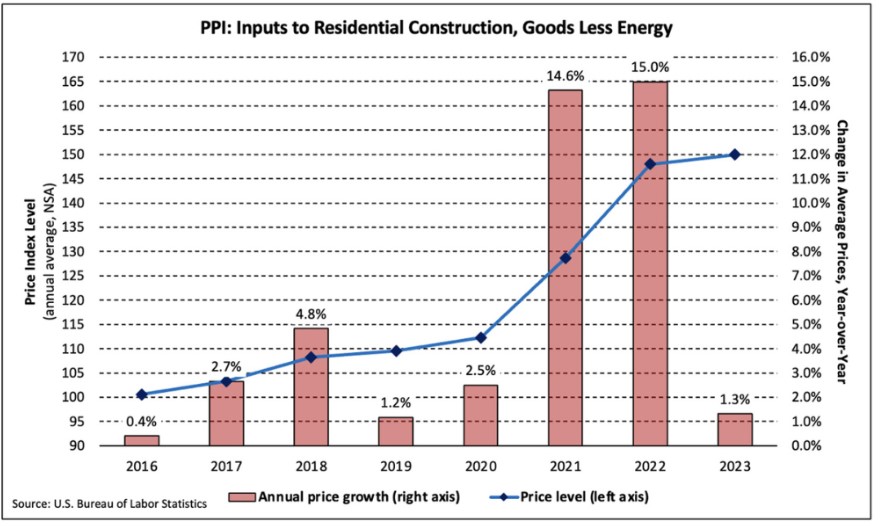
A series of very unusual economic recessions (Great Recession; Covid-19 Recession) and the following expansions changed the financial model for homebuilding. Heightened costs of labor and materials, combined with some complex financial issues, led to housing price escalation in Arizona, across the nation, and across the globe to other well-developed countries.
Arizona’s cities and towns did not cause the breakdown of the financial model for housing development, nor did they cause the housing price escalation that has been realized across the globe. Local government entities also did not influence the Federal Reserve Board to make such bad decisions that led to inflation further increasing, near zero cost access to money influencing investor purchases, and the current “Golden Handcuffs” of mortgage rates below 3.0% that is restricting housing sales.
Nick Ponder
Of course, making such arguments would be either purposefully misleading, or implies a lack of knowledge or bias among the advocates.
The correct explanation is that larger-scale macroeconomic influences negatively impacted housing affordability, and that cities and towns are helping to remedy the problem. This is not an opinion, it is an economic fact.
Fixing housing affordability problems requires developers to partner with local government entities, not scapegoat the cities and towns of impacting global housing price escalation.
WHY IS THE PROBLEM NATIONAL & INTERNATIONAL?
The housing crisis is a macroeconomic issue, not a microeconomic issue. This is why blaming zoning is a misguided analysis of the origin of the crisis and solutions to the crisis.
When you look at this in a macro sense, the housing crisis is not a micro Arizona problem but rather a macro national issue and, in many cases, an international issue. In Arizona, in particular, housing remained affordable immediately before Covid but after 2020 several shocks and factors made the housing market unaffordable.
Let’s look at several variables:
Great Recession of 2008 and subsequent slow recovery
Post Great Recession under-building of housing after excessive overbuilding
Growing trend of corporate ownership in housing
COVID work from home culture allowed people to move to places with lower costs of living (AZ); we have always been growing rapidly.
Californians moving to AZ had higher AMI to compete with Arizonans
Supply chain congestions created significant inflation in materials costs
Changes in workforce participation inflated labor costs
Rapid reductions followed by increases in mortgage rates by the Federal Reserve froze people in their homes
These eight variables combined with other Arizona market challenges like increasing land costs, labor costs, and regulatory challenges have pushed housing costs up by over 60%. None of these issues have to do with newly restrictive zoning! But these issues can be marginalized with better partnering between the development community and local government entities rather than the misleading and false information campaign currently being deployed by the same members of the development community.
GREAT RECESSION
Arizona was in a housing boom before the Great Recession. However, when the economy collapsed, we were hit harder and our housing industry was slower to recover. The virtual shutdown of the housing industry created a growing challenge that would be realized after Covid when several other variables came into play.
Development is on the rise. Since January 1, 2020, Arizona ranks 6th in the nation in total units permitted despite being 14th in population. We have permitted 315,000 units and constructed 249,000 of those units.Additionally, in Maricopa County alone Arizona communities have approximately 110,000 units in the pipeline and with an assured water supply certificate just awaiting construction. The 110,000 permitted units in Maricopa County are enough to satisfy today’s housing shortage.
COVID-LINKED INFLATION
The Covid pandemic created inflationary pressures in multiple ways. First, it created pressures in many individuals seeking larger homes with more space for home offices and outdoor space, inspired by greater flexibility in where they could locate as a result of telework opportunities. The beginning of the pandemic reflected a low interest rate environment that fueled competition and pushed up prices.
In addition to the initial competition created by low interest, the addition of government stimulus and the inability of people to travel or dine out inspired using disposable income on home renovations, appliances, furniture, and other products and materials used for housing.
Prior to the pandemic certain materials prices were already on the rise driven by trade disputes overseas. Those rising prices were followed by the pandemic, which saw an increased demand in all material and product areas.
One additional item often not cited is Arizona’s area median income was lower than that of California. Because of the transient nature of the new workforce, people moved from Silicon Valley and Los Angeles to Phoenix-metro during the pandemic and they brought their Silicon Valley salaries. This provided Arizonans with yet another additional challenge in an already competitive market.
INTEREST RATES
Housing is a ladder. People moving out of their starter homes and into a forever home make way for those in apartments to move into a starter home. Those moving out of a forever home and into a 55+ community make way for those moving from a starter home to scale into their forever home, and so on.
While Covid started with historically low interest rates the hot inflation that followed in 2021 was met with increased interest rates. Many Americans had already locked in at 3% interest rates. With interest rates spiking to 7% this has locked people into their homes breaking the housing ladder.
CORPORATE HOME OWNERSHIP
Since the Great Recession private equity and corporate interests have been purchasing significantly more units in the Arizona housing market. These investment opportunities diminish the supply of starter homes, competing with first-time homebuyers and increasing rents 25% or higher above their pre-sale rents.
In Phoenix-metro, 20% of the single-family rental housing units are owned by large corporate owners such as Invitation Homes (Blackstone), Tricon, Progress, and FirstKey. These entities serve as market manipulators, able to offer full cash purchases with short closing periods and no inspections; options a traditional first-time buyer cannot offer.
In addition the corporate ownership of single family homes, many communities in Arizona have been subjected to the exposure of corporate ownership in the short term rental (STR) market as well. In 2016, legislation was pursued to preempt local governments in Arizona from limiting the use of STRs in cities and towns. At the time, testimony spoke to the sharing economy and the need for the widow to rent a room in her house or the veteran to rent his home when he was deployed overseas.
Arizona became the first and only state in the country with a statewide preemption on STRs and became a testing ground for corporate ownership in the market. Today, upwards of 20% of the homes in some communities are STRs with many owned by corporations. In other communities the numbers may only be 1% to 5% but those are units that take away from individuals seeking shelter.
Today, 60,000 units in Arizona are consumed in the STR market. Further, there is a new trend in housing seeking fractional ownership of homes similar to a share in the stock market. This fractional ownership model is another way corporations keep individuals from owning homes and capitalize on the housing shortage.
Perhaps if government wants to incentivize first time individual home buying they should consider reducing the incentive for corporate ownership of individual family homes. It has often been said with worldly wisdom that if you want less of something you tax that something. Since individual homebuyers are being pushed from the market by corporate ownership entities one would consider the tax policy which treats both types of ownership identically rather than differently.
MULTIFAMILY SALES
Sales of multifamily units are at a 40-year low in the United States. Condos and townhomes are more affordable than single family homes. However, due to federal FHA regulations and, more importantly, challenges with state construction defect laws, developers are choosing to rent these units (build-to-rent) rather than sell them due to risk concerns and insurance costs, pushing sale prices higher.
Phoenix-metro has become one of the hottest markets for build-to-rent communities. Not placing these shared-wall units for sale robs Arizona first-time home buyers of a low cost options.
LAND EFFICIENCY
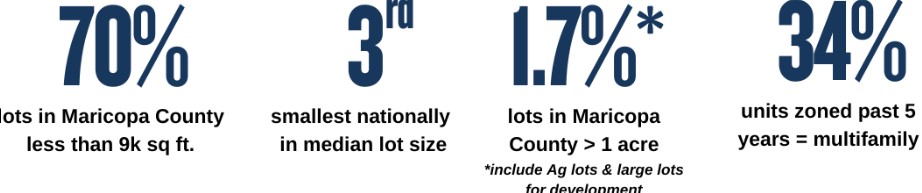
Arizona has limited private land. For that reason we’re are extremely efficient with the land we have. Arizona has the 3rd smallest median lot size in the nation and today, in response to limited private land, we are building smaller than we ever have.
John F Long built Maryvale and his first development averaged 9,100 sq. ft. per lot. Seventy percent of all lots in Maricopa County are smaller than his first development.
The average Maryvale lot is around 6,500 sq. ft. Today our growing communities are routinely building homes on lots smaller than the Maryvale lots of the 1950’s and 60’s.
While our communities remain committed to being efficient with the limited land Arizona has available for development, we must also create diverse options for our residents. Arizona residents want options for small, medium, and larger lots that allow them to climb the housing ladder within their same community. We need space for apartments but also lots that value the agrarian history in our communities.
Creating a one-size-fits-all option that cuts out local input and smart community planning is not what Arizona residents want.
If the State truly wants to incentivize first-time homebuyers and builders they could consider amending the State Constitution to prioritize the sale of some of the 9 million acres of the land they own for that very purpose. Providing more land for such developments would help incentivize the supply of starter homes in the State.
AGE OF OWNERSHIP & AFFORDABILITY
In recent discussions about the average age of ownership for first-time homebuyers there have been some anecdotal suggestions that in the past first- time homebuyers frequently obtained their first homes in their mid-twenties. However, data proves otherwise. While it is accurate the price have increased due to these macroeconomic forces and the age of ownership for first-time homebuyers has correspondingly increased, the average age has been over 31 years of age since 1981.
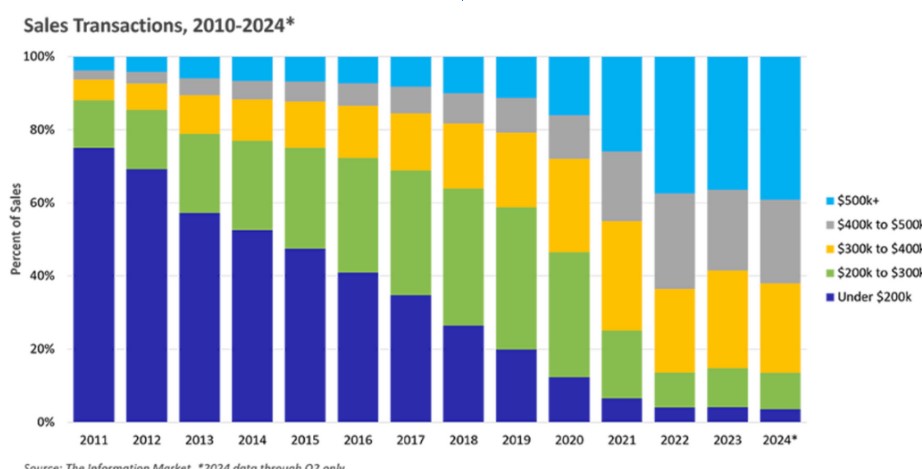
Data from the Maricopa Association of Governments, specific to the Maricopa County planning area (includes City of Maricopa, Casa Grande, Marana, Coolidge, and Florence) housing remained affordable despite the development communities under-building following the Great Recession. Through 2019 nearly 60% of all homes in the MAG region sold for under $300,000 and 80% were under $400,000.
While these market-driven forces have created the housing challenges that we have today, Arizona communities have been at the forefront of policy solutions in their communities to increase housing units. Arizona communities have reduced lot sizes, minimized setbacks, supported legislation to restrict approval timeframes, providing programs to invest locally in affordable housing, supporting the state Low Income Housing Tax Credit (LIHTC) program, and many more.
Arizona municipalities, residents, and developers have built incredible, vibrant communities that are attracting businesses and people from across the globe. The answer to this point-in-time macroeconomic housing crisis is not to treat so flippantly what we’ve taken so much care, resources, and patience to curate.
We look forward to supporting more locally driven solutions to the housing challenge that keep in place the essential 3-legged stool of municipal planners, developer input, and resident input.
MYTH vs FACT
Cities do not allow carports
Many cities allow carports and after checking with them developers have not requested to build a carport or a home w/o a garage in at least the past decade.
Cities have outlawed small lot homes
Cities are required by the Legislature to go through the general plan process. Lot sizes in units per acre are set forward in the general plan. We are building smaller than we ever have today.
Cities mandate carriage lights on homes
The city in question does not require streetlights. The $100 carriage lights take the place of thousands of dollars in streetlights. Lighting houses provides neighborhood deterrents for property crimes.
Cities require private streets
Cities do not require private streets. If a road is not built to spec the city will require the street to be “private” rather than conveyed to the city as it may not meet standards for public safety or public works traffic.
Cities require neighborhood parks as amenities, that should be the role of the city
40 cities in Arizona do not have a primary property tax. Other cities keep property taxes very low. Those taxes are kept low by requiring, for a nominal cost in the construction of a home, small neighborhood parks rather than large taxpayer funded regional parks.
8 QUICK TOOLS TO FIX HOUSING
Now that we have level-set the REAL reasons for the housing crisis that is macroeconomic in nature and not only hit Arizona but the nation, let’s talk about potential solutions. We believe there are 8 easy solutions to address the current housing challenges:
Tax Increment Financing (TIF)
Arizona is the ONLY state in the country that does not allow TIF. In many states it is used to build infrastructure which reduces taxpayer costs (impact fees) or is also used for affordable housing projects.
Local tools (infill property tax freeze)
In 2024 the League proposed an effort to freeze local property taxes for 7 years on infill housing projects to allow those developments to pencil out for builders.
League Starter Home bill
A pragmatic approach that maintains the 3-legged stool between developers, residents, and municipal planners.
SB1698, HB2834
Restrictions on corporate mass ownership
SB1209
Removing local constraints on short term rentals
HB2308
Extending LIHTC
HB2660
Correcting construction defect challenges
We are at a 40-year low in multifamily home sales in part because of this issue.
HB2713
Inclusionary zoning prohibition repeal
As part of the adaptive reuse bill from 2024, HB2297, developers were required to include 10% of the units as affordable. Some allowance for inclusionary zoning at the local level would aid in affordable and workforce housing.
HB2595
Nick Ponder is senior vice president for Governmental Affairs at HighGround
You don't have credit card details available. You will be redirected to update payment method page. Click OK to continue.

 Sign In
 Free Newsletter