Please ensure Javascript is enabled for purposes of website accessibility

All the bills Gov. Katie Hobbs vetoed since taking office in 2023

Key Points:
  • Gov. Katie Hobbs has vetoed 390 bills during her first three years in office
  • The Arizona Capitol Times analyzed all 390 and organized them into a database
  • Hobbs has defended her use of the veto pen, while Republicans say it proves she is ineffective

Since Gov. Katie Hobbs took office in 2023, her veto stamp has been a bane for Republicans and a backstop for Democrats. Hobbs has broken the state’s veto record twice and shot down 390 bills over three legislative sessions, with even more veto-bait bills expected to make it to her desk in 2026.

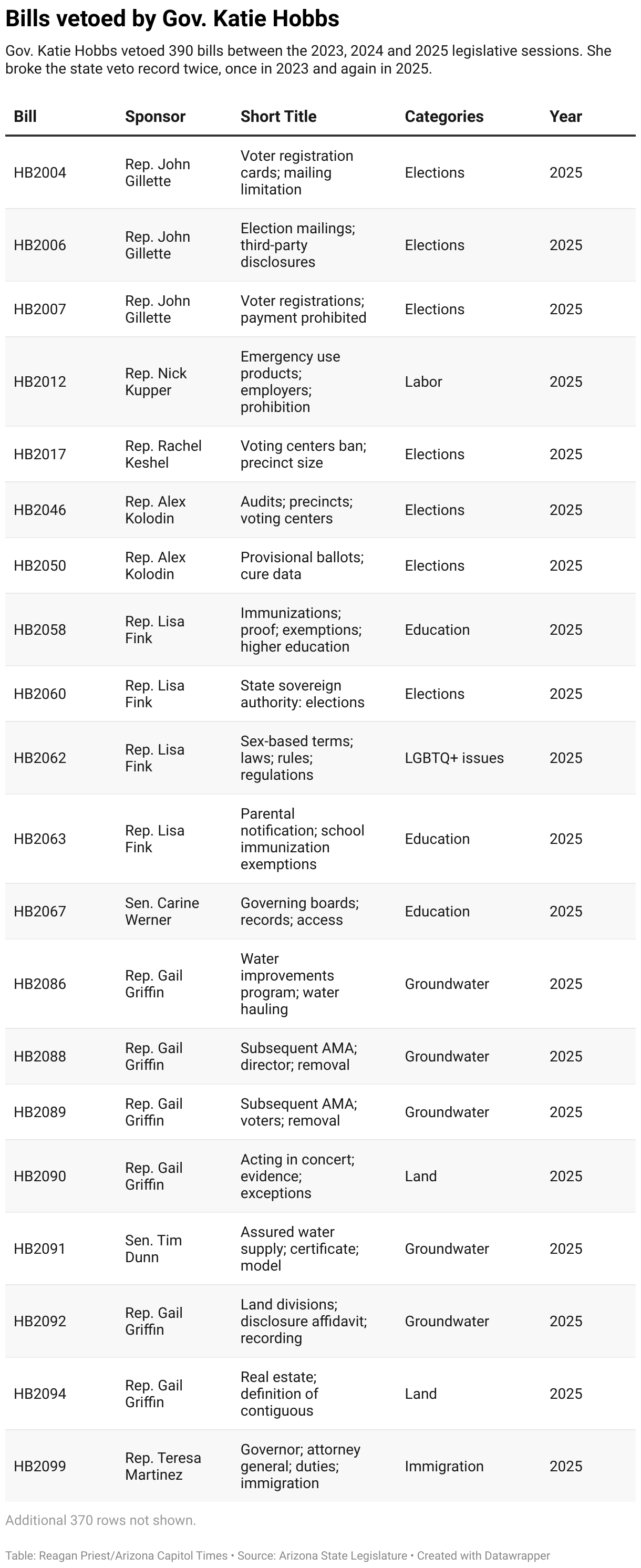
The Arizona Capitol Times analyzed all 390 vetoes issued by the governor and broke them down by category, sponsor, and session. The bills have been organized into a searchable, sortable database.

Hobbs has defended her use of the veto stamp as a last line of defense against harmful and extreme conservative policies promoted by legislative Republicans. Meanwhile, her opponents have used it as evidence of her inability to work with the Legislature and produce meaningful results.

According to the database, Hobbs has vetoed more election bills than any other category of legislation. She vetoed 71 bills related to elections over the last three legislative sessions, in part due to a Republican fixation on election administration following the 2020 and 2022 elections. 

Other popular veto categories for the governor include legislation related to state government and groundwater. Those categories likely see a large number of vetoes in part because of the large number of bills introduced on those topics. 

Sen. John Kavanagh, R-Paradise Valley, had the most bills vetoed by Hobbs in the last three sessions, with 39 pieces of legislation rejected by the governor. Thirteen of those bills comprised the skinny budget Republicans sent Hobbs in 2023, which Kavanagh sponsored as the chairman of the Senate Appropriations Committee.

Rep. Gail Griffin, R-Hereford, is notorious for sending the governor groundwater legislation destined for her veto stamp. She has had 36 bills vetoed by Hobbs since 2023, the second most of any lawmaker. 

Republican lawmakers have been known to send the governor legislation she already vetoed in a prior session. The Arizona Capitol Times found that 50 of Hobbs’ 390 vetoes came from legislation that had been vetoed previously and was reintroduced.

Hobbs has also vetoed 41 bills related to the state budget after the Legislature sent her a skinny budget in February 2023 and House Republicans sent her two separate budget proposals in 2025. 

Additionally, an analysis of bills filed ahead of the 2026 session found that 30 previously vetoed bills will make another appearance in 2026. Most of those bills have seen little, if any, change since being shot down by Hobbs. 

Hobbs has long accused Republicans of purposely attempting to make her look obstructionist by sending bills to her desk that they know she will veto. But some lawmakers and consultants say the Governor’s Office should be working more closely with the Legislature to better communicate which bills can make it across the finish line. 

Whether or not Hobbs will break another veto record in 2026 is unclear. Republican lawmakers are expected to refer legislation to the ballot in order to bypass the governor’s veto stamp, a tactic that yielded mixed results in 2024.

View the complete data set here: https://datawrapper.dwcdn.net/4yrQy/1/


Session Wrap: 2025 by the numbers

Key Points:
  • Gov. Hobbs signed more legislation this session than her previous two as governor
  • Lawmakers introduced 1,724 bills in total, 439 made it to the governor
  • Hobbs called the session successful despite breaking veto record

Gov. Katie Hobbs signed more bills this session than in either of the previous two sessions she has occupied the Ninth Floor. But she also broke the state veto record she set in 2023. 

The governor signed 265 bills this session, up from 259 in 2024 and 205 in 2023. That number could be due, in part, to the large number of bills introduced by lawmakers this session, though they didn’t break any records like Hobbs did.

Lawmakers introduced 1,724 bills this session and 439 of those made it out of both chambers and to the governor’s desk. That brought Hobbs’ veto total to 174 bills, blowing past her 2023 record of 143 bills. 

But Hobbs said she only broke the record with the help of Republicans, who sent her three separate budgets and several pieces of legislation she vetoed in previous sessions. 

“There was definitely an orchestrated attempt to run up the score on that veto record,” Hobbs said. 

Without counting the 28 budget bills, 14 for each of the two House budgets the governor vetoed, Hobbs still would have broken her own veto record by three bills. But, an analysis by the Arizona Capitol Times of legislation vetoed by the governor between 2023 and 2025 found at least 18 bills vetoed in 2025 which she had also vetoed in either 2023 or 2024.

All of those bills were reintroduced by Republicans — most without any significant changes. They cover a range of issues, including elections, firearms, LGBTQ+ rights and school boards. 

Despite that, almost all of the legislation Hobbs signed this session came from Republicans. Democrats only managed to get 10 bills out of the Legislature this year, seven of which came from the House and three from the Senate.

Excluding budget bills, Sen. Shawnna Bolick, R-Phoenix, takes home the title of most bills signed by a single lawmaker at 16. Republican Sens. J.D. Mesnard and David Gowan tied for second place, each with 15 bills signed. 

Bolick attributed her success this session to her own tenacity and the support of her constituents in Legislative District 2.

“I didn’t allow personalities to get in the way of being successful,” Bolick said in a written statement. “It also doesn’t hurt that I am not afraid to stand up for myself, or for the issue or the people that I am championing. Having coalitions of support to speak in favor of your bill is an absolute must.”

Bolick said she received an outpouring of encouragement for her bill, which expands the definition of animal cruelty and was signed by the governor in late June.

“My fellow dog lovers would stop and thank me when I would walk our own dogs each morning because they were receiving email alerts or reading the newspaper,” Bolick said. “A small gesture like a thank you is a big motivational factor when you must go to the Capitol for six months to try to force your bills to the board for a vote.” 

But in Arizona’s Republican Party, getting the most bills signed by the Democratic governor doesn’t necessarily spell success. According to conservative group Turning Point USA’s lawmaker scorecard, Bolick is “losing patriotism” and only scored 68.18 out of 100 on their ranking. 

“Most of the bills I have sponsored over the years received bipartisan support even under Governor Ducey because I have always represented a competitive legislative district,” Bolick said. “…I am all about getting things done, not attacking my fellow Republicans.” 

On the Democratic side, Rep. Alma Hernandez, D-Tucson, had the most bills signed in her caucus at four. Six other Democrats each had one bill signed, including Sens. Catherine Miranda, Mitzi Epstein, Analise Ortiz and Reps. Consuelo Hernandez, Kevin Volk and Myron Tsosie.

Rep. Gail Griffin, R-Hereford, had the most bills vetoed by the governor for the second year in a row, at 18. In 2024, that number was just 12. 

The increase can be attributed to Griffin’s penchant for introducing rural groundwater legislation despite the governor’s promise to veto “bills that are just political cover for the Legislature’s inaction on water security.” Nearly every bill of Griffin’s that Hobbs vetoed was related to groundwater.

Griffin criticized Hobbs throughout the session for vetoing her groundwater legislation, saying in a March 18 statement, “It’s time to put politics aside and pass real solutions for rural Arizona.” 

Republican Sens. Jake Hoffman and Wendy Rogers tied for second-most vetoes with each reaching 12 rejected proposals for the session. Several of the veto letters attached to Hoffman’s bills featured a special message from the governor related to their spat over her director nominees. 

“This bill is Detrimental, Ineffective, Nonsensical, and Objectionable,” Hobbs wrote, in an apparent reference to Hoffman’s chairmanship of the Senate Director Nominations Committee, often called DINO. 

Despite breaking her own veto record and getting into spats with lawmakers, Hobbs said she feels the session was very successful and should be measured by the bipartisan legislation that passed, rather than the bills that ended up on the cutting room floor.

Hobbs vetoes photo radar ban, House blames political games

Key Points:
  • Bill would have banned photo radar enforcement of traffic law
  • Some believe the measure was sabotaged in committee
  • Legislators can still push the measure to voters next year

Gov. Katie Hobbs vetoed a bill that would prohibit law enforcement agencies from using photo enforcement systems to issue tickets, but Republican lawmakers have a chance next year to bring an identical measure to voters. 

The governor’s veto of Senate Bill 1019 was no surprise for the many Republicans who anticipated the outcome after Hobbs vetoed a similar bill in 2023. 

During the House’s vote on June 24, several Republicans expressed disappointment that they were voting on Senate Bill 1019 rather than an identical measure in Senate Concurrent Resolution 1002, which would have been referred to voters in 2026 instead of going to Hobbs. 

“This bill attempts to remove the ability of local law enforcement to keep our streets safe by eliminating a tool used to enhance roadway safety,” Hobbs wrote of the bill in her veto message. 

The bill’s sponsor, Sen. Wendy Rogers, R-Flagstaff, introduced both measures as a way to try to get around Hobbs’ veto, but the resolution was held in the House until the day before lawmakers adjourned sine die, leading to frustration among Republicans after some members were absent ensuring that the resolution didn’t have enough votes to make it out of the House. 

One House Republican accused chamber leadership of playing “games” with the measure and intentionally delaying the resolution until a day when Republicans couldn’t pass it because they lacked the necessary numbers. 

“It’s almost as if we’re more interested in making a show of solving the problem than actually solving the problem when actually solving the problem is within our power,” said Rep. Alexander Kolodin, R-Scottsdale. 

The resolution was double assigned to committees in the House earlier in the session. It passed the House Transportation and Infrastructure Committee but never received a hearing in the House Government Committee, chaired by Rep. Walt Blackman, R-Snowflake, who spent part of the session criticizing Rogers for not holding a hearing on his bill that criminalized impersonating a veteran.

A measure must get a do pass recommendation from a majority of members in each committee it’s assigned to, and multiple committee assignments have typically been a method to keep a bill from advancing in the Legislature. 

Rep. Justin Wilmeth, R-Phoenix, noted the resolution was double assigned during his vote for SB1019. 

“This is what majorities are about, and on this issue, we are wasting our opportunity,” said Wilmeth. 

House Republicans waived chamber rules to introduce the resolution for a floor vote on June 26, but it failed 29-27, with four Republicans absent. 

Speaker Steve Montenegro said the House and Senate have always had an agreement to wait until the budget is passed before voting on measures that would go to the ballot, which is what the House did with SCR1002.

The Senate waited to pass House Concurrent Resolution 2021, which would cap municipal food taxes at 2%, on the same day it first passed the budget on June 20. Montenegro also sponsored House Concurrent Resolution 2055 (drug cartels; terrorist organizations), which the Senate approved the day it passed the budget in a final read.

The only other ballot referral the House passed this session was Senate Concurrent Resolution 1004, which would prohibit government subdivisions in the state from imposing a tax based on vehicle miles traveled. That measure passed the House on June 13 before it passed the bipartisan budget, but, on the same day, House Republicans passed their first budget proposal, which was vetoed by Hobbs and not supported by Senate Republicans.

There is still time for Republicans to get the resolution to voters. If an identical resolution passes the Legislature next session, it would appear on the 2026 ballot. Rep. Teresa Martinez, R-Casa Grande, said she expects to see the resolution next year. 

Gov. Katie Hobbs clears desk of all bills for the session

Key Points: 
  • Governor vetoed 178 bills this session, surpassing her previous record
  • Photo enforcement and expedited election results bills vetoed
  • Hobbs looking to improve vote counting next session

It may have resulted in faster election returns, with the winners and losers known shortly after the polls close.

However, on July 1, Gov. Katie Hobbs vetoed legislation designed to help Arizona expedite results. The governor said she could not accept a provision she believed could penalize voters who wait until the last minute to cast their ballots.

Her rejection of Senate Bill 1001 was in the last batch of bills sent to her before the Legislature adjourned for the year on June 27. She now tallies 178 vetoed bills this session.

Among those last-minute rejections was the governor’s decision to veto a proposal by Sen. Wendy Rogers which would have outlawed the use of photo enforcement to catch speeders and red light runners.

The Flagstaff Republican sided with those who contend such automated enforcement ignores individual circumstances that an on-site police officer could take into account before issuing a citation. And some critics argue that the system is merely a means for communities to generate revenue.

Hobbs, who vetoed an identical measure two years ago, has had no change of heart.

“This bill attempts to remove the ability of local law enforcement to keep our streets safe by eliminating a tool used to enhance roadway safety,” she wrote in her veto message.

Rogers, anticipating a veto, had already crafted a parallel measure to bypass the governor and put the issue directly to the voters. However, that plan faltered when, due to the absence of some state representatives, she was unable to garner the necessary votes on the last day of the session to make it happen.

The state does not allow photo enforcement on its highways after then-Gov. Jan Brewer moved in 2010 to have them removed from any state-controlled road.

More controversial, in some ways, has been the question of how to address the fact that Arizona has developed a reputation as one of the last states in the nation, if not the last, to have final election returns.

It occurred in 2022 when it took days to confirm that Hobbs had beaten Republican challenger Kari Lake. And the situation repeated itself last year when delays in processing ballots left many wondering whether Kamala Harris could make up her vote deficit against Donald Trump.

The problem, according to Sen. J.D. Mesnard, R-Chandler, is that Arizona law allows people to request mail-in ballots but, rather than dropping them in the mail box, wait until Election Day to drop them off in person at a polling place.

The problem is that ballots cannot be tabulated until the signatures on the envelopes are verified. And that verification process for those “late-early ballots” cannot begin until after Election Day.

That’s not a problem when there are just a few.

But in the 2024 general election, there were about 265,000 of these ballots, including more than 210,000 in Maricopa County.

Senate President Warren Petersen sought to address the issue by repealing the ability of voters to drop off their early ballots at polling places on Election Day. That, however, proved to be a non-starter.

So Mesnard came up with an alternate plan.

It would still allow ballot drop-offs – but with the option of on-site verification. That would mean obtaining photo identification from those dropping off their ballots after Friday night, a move that would eliminate the need for the kind of signature verification of “late-early ballots’ that would otherwise not be possible until after Election Day.

His legislation would still allow people to simply drop a ballot and leave. And those ballots would still be counted.

But there was a price of sorts to be paid for forcing that after-election signature verification: That voter would be removed from the “active early voting list,” meaning they would not automatically get another ballot by mail ahead of the next election.

Hobbs pronounced that a non-starter.

She said some voters depend on family members or caregivers to drop off their early ballots, meaning they could not appear in person to have their identification checked.

And that, said the governor, presents them with the choice of either losing the option to complete their ballots on Election Day — an option that exists for everyone else — or being removed from the active early voter list.

“I’m certain that we all agree that every eligible vote should count, and no American should be deprived of this right,” Hobbs wrote.

Mesnard, for his part, was unapologetic for offering the measure.

First, he noted, anyone removed from the active early voter list can be reinstated simply by submitting a new request.

More to the point, Mesnard said nothing in his bill would have interfered with anyone’s right to vote. Instead, he said, it simply would have installed “parameters that ensure that we’re not bogging down the system and delaying results of elections by days or weeks.”

“The idea that that is disenfranchising is confusing the right to vote with the convenience we’ve extended people,” he said. “We, in no way, undermine a person’s right to vote, whatsoever.”

Hobbs said she remains interested in possible changes.

“We must balance the speed of counting votes with accessibility, accuracy and security,” she said, promising to work with any legislator next year “to improve voting and vote counting in Arizona.”

Hobbs breaks state veto record thanks to budget bills

Key Points:
  • Hobbs broke her own veto record on June 25
  • The new record is 169 bills in one session
  • Veto number could climb amid ongoing budget negotiations

Gov. Katie Hobbs set a new veto record June 25 with the help of House Republicans’ budget bills and some repeat offender bills.

After vetoing 28 budget bills, Hobbs’ 2025 veto record shot from 140 to 168. She also vetoed one other piece of legislation after the budget bills, bringing the grand total to 169 and beating her own record of 143 bills vetoed in a single session.

Hobbs blamed House Republicans for the vetoes after repeatedly promising to veto both budget packages because they did not align with the bipartisan deal her office worked out with the Senate.

“It’s now time for House Republican leadership to set the political games to the side and work with their colleagues in a productive fashion to deliver a bipartisan solution for the people of our state,” Hobbs wrote in a veto letter

Republican Rep. David Livingston sponsored the 28 budget bills, 14 of which consisted of House Republicans’ preferred budget and another 14 of which made up the “skinny” continuation budget. He celebrated setting a different kind of veto record in a post on social media.

“I set the State of Arizona record for most bills vetoed in a single day!” Livingston wrote on X. “28 budget bills vetoed by Governor Hobbs today.” 

And though Hobbs broke her own record, she did not veto 169 unique pieces of legislation this session. According to an Arizona Capitol Times analysis of bills Hobbs has vetoed during her three years in office, at least 18 were also vetoed in 2023 or 2024.

Those bills were all introduced by Republicans and cover a range of issues from elections and firearms to LGBTQ+ rights and school boards. Some of the bills received slight tweaks after meeting the veto stamp, but others were reintroduced without any changes at all. 

The governor previously told reporters that she believes Republicans are hoping to portray her as “obstructionist” by pushing legislation she has already vetoed or has stated she would not support. Hobbs’ spokesman, Christian Slater, defended her use of vetoes in a statement.

“The governor didn’t get elected to veto bills, and she has a long record of bipartisan accomplishments,” Slater said. “But she won’t hesitate to stand up to extreme and partisan legislation that attacks everyday Arizonans. That’s exactly what she has done throughout her term and that’s what she will continue to do so long as she’s governor.”

Republican Sen. John Kavanagh of Fountain Hills is one of the more prolific sponsors of previously vetoed bills. He has reintroduced the same three bills related to LGBTQ+ students, pronouns and restroom use every year of Hobbs’ tenure. 

Many bills vetoed in 2023 were reintroduced in 2024 as ballot measures, only to be rejected by voters in November. Other 2023 vetoes were reintroduced in 2024, but failed to make it to the governor’s desk. 

And Sen. Wendy Rogers’ infamous bill banning red light cameras is currently awaiting action from the governor thanks to a late night vote in the House on June 24. It is almost certainly headed for a veto after receiving one in 2023 and failing to make it to Hobbs’ desk or the ballot in 2024. 

Excluding budget bills, Rep. Gail Griffin is currently leading Republicans in the most bills vetoed by the governor at 17. Griffin also took home that trophy in 2024 due to her introduction of groundwater legislation that Hobbs pledged to veto during both sessions. 

As of publication, Hobbs has signed 225 bills this session. That’s more bills than the 205 she signed in 2023, and fewer than she signed in 2024 – 259. 

Republican Sen. J.D. Mesnard currently has the most legislation signed by Hobbs in 2025, with 15 of his bills making it across the finish line so far. Democratic Rep. Alma Hernandez leads her caucus in the number of bills signed, with four under her belt this session. 

Lawmakers are still sending legislation to Hobbs’ desk — including the Senate’s budget proposal — so the numbers are not yet set in stone. As of the afternoon of June 26, 14 bills are awaiting the governor’s action.

Hobbs vetoes bill targeting school districts in serious financial trouble

Key Points:
  • Bill would have forced removal of school board members
  • Governor called it “blatant legislative overreach”
  • Bill’s supporters focused on Isaac’s loans and contracts

Gov. Katie Hobbs vetoed a measure that would have forced the removal of elected school board members if their district is placed into receivership.

The governor vetoed House Bill 2610 on June 24, which was advanced through the Legislature as a response to the Isaac Elementary School District overspending its budget by more than $20 million. 

HB2610 contained a retroactive clause that would have removed Isaac’s Governing Board members from their elected positions. 

In her veto letter, Hobbs wrote: “This bill appears to seek broad retribution rather than providing targeted methods to address problems. Mandating the upheaval of an entire elected school board is blatant legislative overreach that would create disruption and confusion for school districts during times of crisis.” 

Even with the veto, Hobbs called on Isaac’s Governing Board leadership to resign and stated that the district’s financial mismanagement is unacceptable. 

Attorney General Kris Mayes and the state’s Auditor General’s Office are investigating the district’s financial practices.

Isaac school board President Patricia Jimenez thanked Hobbs for vetoing the measure and sent a letter to Hobbs before her veto that HB2610 would have plunged the district into “deeper chaos” than before the state Board of Education appointed a receiver to the district. 

“Although we disagree with the governor’s assessment of the governing board’s leadership, we look forward to completing the job of steering Isaac on a path of long term financial solid footing and to continuing to protect Isaac’s students, teachers and schools. The Isaac community was well served by the governor’s veto,” Jimenez said in a statement provided to the Arizona Capitol Times.

Republican lawmakers have scrutinized the financial management of Isaac and an agreement the district made with the Tolleson Union High School District to climb out of its budget deficit. 

Tolleson acquired the leasehold rights over Isaac Middle School for $25 million, which it has leased back to Isaac. Tolleson will hold the land rights of the school for 12 years at a 6% interest rate, which Rep. Matt Gress, R-Phoenix, has called a “predatory loan.”

Gress has also questioned Jimenez’s leadership multiple times during the session. Most recently, during a June 6 Joint Legislative Audit Committee meeting, he said an $88,000 contract the district entered into with Jimenez’s boyfriend for marketing services appeared “unethical” to him. 

Jimenez told the Arizona Capitol Times that Gress’ inquiry was related to a near-$43,000 invoice from the Glendale-based Brand Regal Media Tech that was mistakenly duplicated and has been voided. She also denied Gress’ claim of being in a relationship with Chris Louis, who is listed as the statutory agent for the company in the Arizona Corporation Commission’s entity database.

“I categorically deny any unethical behavior or acting against the best interests of Isaac and its students,” Jimenez said. 

Gress and Sen. Mark Finchem, R-Prescott, said they want to hear from Tolleson Union officials about the agreement with Isaac during the next Joint Legislative Audit Committee hearing. They invited Tolleson’s Superintendent, Jeremy Calles, and its Governing Board President, Leezah Sun, to its June meeting, but neither attended. 

If Tolleson officials skip the next meeting, Gress said the committee would explore other compulsory options to hear from them.

Hobbs vetoes antisemitism bill allowing lawsuits against teachers

Key Points:
  • Governor Hobbs vetoed antisemitism bill citing teacher liability concerns
  • Critics said bill suppressed free speech, hindered Israel criticism
  • Hobbs supports Holocaust education, promotes empathy over punitive measures

Gov. Katie Hobbs vetoed a bill that would have prohibited teaching and promoting antisemitism in Arizona public schools, but also would have allowed lawsuits against individual teachers suspected of doing so.

House Bill 2867, sponsored by Republican Rep. Michael Way, was sent to the governor’s desk last week with some House Democrats voting in favor of it. But other Democrats, teachers’ groups and First Amendment advocates raised a variety of objections to the bill, arguing it could make teachers quit, suppress free speech and prevent any criticism of Israel amid the ongoing Israel-Hamas conflict.

“Unfortunately this bill is not about antisemitism; it’s about attacking our teachers,” Hobbs wrote in a veto letter. “It puts an unacceptable level of personal liability in place for our public school, community college, and university educators and staff, opening them up to threats of personally costly lawsuits.”

Hobbs also included a letter from the Tucson Jewish Museum and Holocaust Center dated June 6 that urged her to veto the bill. The center’s executive director, Lori Shepherd, said the bill is “not the answer” to combating antisemitism in Arizona schools.

“While I support the need to fight hate and antisemitism, the bill’s vague language and punitive approach send a dangerous message to teachers: avoid controversy, or face a courtroom,” Shepherd wrote.

In her letter, Hobbs pointed to other areas where she has worked to combat antisemitism, like signing a bill in 2023 that expanded Holocaust education requirements in public schools and signing a budget that included funding for a Holocaust education center in Phoenix. Earlier this session, Hobbs also signed House Bill 2880, which prohibits encampments on college campuses after they were used during pro-Palestine protests on Arizona campuses last spring. 

Hobbs attended a groundbreaking ceremony for the new Hilton Family Holocaust Education Center last week and pledged her support for Jewish Arizonans.

“Arizona will always be an ally and partner to the Jewish community,” Hobbs said while speaking to a crowd at the site on June 5.

She also referenced that visit in her veto letter, saying it informed her decision not to sign the legislation.

“It was a powerful reminder that the most effective way to combat antisemitism is through education, empathy, and community,” Hobbs wrote.

Gov. Hobbs nears state veto record with GOP bills still in the pipeline

Key Points: 
  • Gov. Hobbs is five vetoes short of the state record for governor
  • She blames Republic legislators for passing large numbers of bad bills
  • Many of the rejected bills were concerning education, food stamps and immigration enforcement

Katie Hobbs is hurtling toward a new record in Arizona for the number of bills vetoed in one year.

But the Democratic governor insists it’s not because she cannot work across the aisle with Republican legislators.

Hobbs told Capitol Media Services, the fault lies with them. According to Hobbs, if they stop sending her bad bills, she’ll stop putting her veto stamp on so many of them.

“I have made it clear that I’m not going to sign legislation that is a solution in search of a problem. That takes away people’s freedom,” the governor said.

What is virtually certain is that when lawmakers return from their break they will resume approving measures that advance the GOP policy agenda. And there’s still a host of bills in the pipeline that are virtually certain to meet with the governor’s displeasure, from changes in election laws and cuts in the state income tax rate to easing some groundwater regulations.

And that all but guarantees she will set a new record for total bills vetoed.

As of right now, Hobbs has vetoed 138 bills since the Legislature convened in January — five short of her first year in office. 

House Republicans aren’t taking kindly to her effort to blame them.

“Gov. Hobbs has made vetoing good policy her full-time job, rejecting bipartisan solutions supported by the elected representatives of the people of Arizona,” said Andrew Wilder, spokesman for House Speaker Steve Montenegro and the GOP caucus. “Instead of governing, she’s cementing a record as an ineffective obstructionist whose only accomplishments cater to the extreme fringe of her party.”

Not everything that Hobbs has rejected have been strictly partisan affairs. There have been a few bills that she has rejected that have had some support from legislative Democrats.

One, for example, would have ensured that parents are entitled to a minor child’s medical records, regardless of whether parental consent is required for treatment. There are exceptions under existing law to the need for that consent such as emergency situations, including those that might involve a drug overdose, and instances where a minor may have contracted a venereal disease.

Hobbs said the proposal by Rep. Julie Willoughby, R-Chandler, would create “legal ambiguity” for health care providers with existing obligations to patient privacy.

Several Democrats also supported a proposal to pave the way for “small modular nuclear reactors” in Arizona.

Still, the vast majority of what met with the governor’s disapproval were Republican-only affairs ranging from major policy issues to minor regulatory affairs.

Take the measure, also by Willoughby, to mandate employment and training requirements for food stamp recipients. Hobbs said lawmakers should instead use their efforts to support an existing voluntary program for recipients to get jobs and training.

The governor also rejected a requirement for the state’s Medicaid program to provide a “conspicuous link” on the agency’s website to information on adoption and support for pregnant women. Hobbs saw it through the lens of efforts to attack reproductive freedom in the wake of voters putting a right to abortion in the Arizona Constitution.

Only Republicans supported a proposal by freshman Sen. Carine Warner, R-Scottsdale, to make all school board elections into partisan affairs.

Hobbs said she doesn’t understand why Republicans are surprised at her decisions.

“Some of these vetoes are bills that have been sent to me multiple times, even in one session,” she said. “It’s ridiculous, quite frankly.”

One of those returning bills was a proposal by Sen. Wendy Rogers to allow those with state-issued permits to carry a concealed weapon onto college campuses.

And then there were a pair of bills from Sen. John Kavanagh. The Fountain Hills Republican wanted to ban teachers from referring to students by a first name or pronoun that did not match their gender at time of birth and prohibit students from using a restroom other than the one based on their biological sex.

Then there were the measures sent to Hobbs to score political points, with little belief they would be signed, like the proposal by Rep. Teresa Martinez, R-Casa Grande, to ensure that Arizona schools were aligned with the orders of President Trump when referring to the Gulf of Mexico as the Gulf of America.

Hobbs lumped that in with other measures that she rejected, saying they take away attention from what she believes should be the focus of lawmakers.

“I would like the Legislature to prioritize lowering costs, addressing our housing crisis, securing our water future, securing the border,” she said.

On that last point, Republicans have advanced measures designed to do just that.

One of those was crafted by Senate President Warren Petersen. The Gilbert Republican sought to ensure state and local law enforcement cooperate with federal immigration officials and, specifically, that they honor requests by Immigration and Customs Enforcement to detain people sought by the federal agency.

The governor recognizes public sentiment on that, with voters in November having approved Proposition 314 on a 63-37 margin. It allows state and local police to arrest those who are not citizens who enter the country at other than a port of entry.

So Hobbs, in her veto message of the Petersen bill, said she has worked with the federal government to secure the border, cited efforts to stem fentanyl smuggling and sought to keep border communities safe.

That explanation left Petersen cold, responding to the veto by calling it “another slap” at Arizonans who “suffered greatly” from the open border policies of the Biden administration.

But Petersen, who is running to be the Republican nominee for attorney general in 2026, declined to discuss what he thinks of the governor’s overall veto record and her explanation of why so many GOP-sponsored bills have wound up being returned with veto stamps.

Hobbs said she still believes there are areas of accommodation with the Republican majority. All they need to remember, she said, is what she told them when the session started in January.

“I made it really clear in my State of the State that I wanted to work with the Legislature to advance opportunity, freedom and security for Arizonans,” the governor said. “to achieve these goals and address the needs that Arizonans have.”

Gov. Hobbs vetoes bills requiring hotel warning signs, teaching of Gulf of America

Key Points:
  • The governor rejected proposals to require warning signs for hotels hosting homeless people
  • She also rejected a measure to require teachers to use the term Gulf of America
  • Approved measures related to pornography websites and utility securitization

On May 13, Gov. Katie Hobbs rejected a proposal by Rep. Matt Gress which required hotels and motels to warn guests that they also provide rooms for people experiencing homelessness.

The Phoenix lawmaker called his measure “consumer protection,” saying that paying customers should be alerted to “keep hotels doors locked, safely store their belongings and report any health or safety concerns to local law enforcement.” And there would have had to be signs to that effect at every entrance.

Proponents argued there is evidence that many of the homeless are drug users, alcohol abusers or mentally ill — or a combination of any of those — a fact that guests should know. Foes said there is no evidence to prove they are more dangerous than any other group.

“We should not micromanage local businesses who have stepped up to help address our state’s housing challenges,” the governor said, saying lawmakers should engage in “more productive efforts to create more transitional and affordable housing options.”

Hobbs also rejected a bid by Rep. Teresa Martinez to force high schools to teach students about the “Gulf of America.”

The Casa Grande Republican acknowledged her proposal followed the directive from the president to unilaterally rename what has been called the Gulf of Mexico for centuries. She said it would have promoted patriotism and “start teaching pro-America to our students.”

The governor called the measure a diversion.

“This Legislature has chosen to attempt to dictate how teachers refer to geographic features,” she wrote. “I encourage you to refocus your time and energy on solving real problems for Arizonans.”

The measures were two of 13 bills the governor found unacceptable on May 13. That brings her tally this session up to 138 — a figure just five shy of the record the governor set in her first year in office in 2023.

But the governor did find favor with a number of other bills sent to her.

Most notably, she signed legislation sought by utilities that would allow them to sell low-interest bonds to cover certain debts, a move that companies said would save money for consumers.

That signature comes even though most legislative Democrats voted against the plan, saying it lacked protections for ratepayers. They also said it would make it easier for utilities to keep open older, more polluting power plants,

Hobbs provided no explanation for her decision.

Other bills approved by the governor include:

– Requiring those who distribute materials on a website, of which more than a third is pornography, to use “reasonable methods” to verify that users are at least 18;

– Mandating that those who have internet applications designed for children 11 and younger make sure the site does not display inappropriate or mature advertising;

– Overruling local ordinances that prohibit construction and noise before certain hours in the summer, a move that backers say will allow for work to be done during cooler hours;

– Making it illegal to use a computer-generated recording of another person if the intent is to defraud someone else. There are exceptions for parody, artistic expression or circumstances where a viewer or listener would know the recording has been digitally altered.

Gov. Hobbs’s vetoes measure requiring hospitals to check immigration status and 34 additional bills

Key Points:
  • Rejected bill would have required hospitals accepting Medicaid funding to check patient’s immigration status
  • Gov. Hobbs also vetoed a measure that would bar cities from making cuts to law enforcement funding
  • Gov. Hobbs’s veto tally is 123 so far

Patients showing up at Arizona hospitals won’t be asked if they are in this country legally.

In one of 35 new vetoes on May 13, Gov. Katie Hobbs rejected a proposal by Sen. Wendy Rogers to require hospitals that accept Medicaid — a program funded in part with federal dollars — to inquire about a patient’s immigration status.

The Flagstaff Republican said nothing in someone’s answer would result in denial of medical care. Nor, she said, would it lead to hospital officials calling immigration authorities.

Instead, said Rogers, it would have given the state an idea of the costs of illegal immigration on the state.

Hobbs pointed out that people not here legally generally do not qualify for Medicaid. However, there is some concern that hospitals can get stuck with the bills when patients show up, particularly in emergencies, and cannot pay.

The governor also said that the legislation was opposed by business leaders, hospitals and others “who understand that immigration enforcement is best left to federal law enforcement and not health care professionals.”

This and other vetoes bring her tally this session up to 123. That is just 20 shy of the governor’s record in her first year in office in 2023.

In another gubernatorial action, the governor refused to bar cities from initiating year-over-year cuts in city spending on police services. To ensure compliance, the state treasurer would have been required to cut that community’s state aid by an equal amount.

Rep. David Marshall has championed the measure now for two years. The Snowflake Republican said he wants to short-circuit “defund the police” movements that have occurred elsewhere.

Marshall conceded that has not occurred elsewhere. But he said he wanted to be proactive and ensure that “activists” in Arizona do not convince city councils to divert funding elsewhere.

Lobbyists for cities were opposed, at least partly because they said these decisions should be made locally. But they also expressed concern that it would stifle efforts to move certain functions, like code enforcement, from sworn officers to civilian employees.

Hobbs, in her veto message, said she has “consistently advocated” for increased funding for law enforcement but believes the bill “undermines local decision making which is needed for public safety agencies to operate efficiently.”

The governor also vetoed two related measures.

One would have told teachers they cannot use pronouns for students or a first name that does not reflect their “biological sex” absent parental permission. The other says students cannot use bathrooms and locker rooms that do not match their biological sex.

Both are repeats of what has become perennial legislation by Sen. John Kavanagh. The Fountain Hills Republican said the first one respects the rights of parents to decide issues for their children; the second prevents students — mainly girls — from having to share locker rooms with biological males.

The governor did not address either contention. Instead, she said in identical veto messages that the bills “will not increase opportunity, security or freedom for Arizonans” and encouraged them to focus on legislation to lower costs, protect the border, create jobs and “secure our water future.”

That last theme also found its way into Hobbs’ veto of four measures changing groundwater regulations.

The governor has acknowledged there are issues, particularly in rural areas, but said what is needed is a comprehensive plan.

“To see more effort misspent on pointless bills that would only weaken groundwater protections or duplicate existing programs is a continued affront to rural Arizonans who have asked their legislators for years to address rural groundwater problems,” the governor wrote.

Also rejected was a perennial effort to allow those with state permits to carry concealed weapons to bring them onto college and university campuses.

Proponents have argued that having such people on campuses keeps them safe. But foes noted that Arizona has some of the laxest standards in the country to get a permit, with no actual requirement to show the ability to use the gun.

“This bill could lead to increased risk on campus and other unintended consequences,” the governor wrote.

Hobbs also nixed legislation to remove a prohibition against Arizonans owning “muffling devices,” more commonly known as silencers.

These devices are legal under federal law, though buyers must undergo a more intensive screening than the one required to purchase just any weapon. That did not impress the governor.

“Gun silencers make it more difficult for hard-working law enforcement officers to do their job and keep Arizonans safe,” Hobbs wrote.

She also rejected a related bill that would have barred the government and certain private entities from creating a legal distinction between those who sell guns and all other types of retailers. The governor said these “merchant categories codes” are “vital tools that help law enforcement identify perpetrators of illegal activity, including mass shootings.”

Other measures meeting with the governor’s displeasure include:

– Restricting the ability of the Arizona Corporation Commission to advocate for legislation without first having a public vote. The governor said it would be “stifling” the agency’s ability to provide lawmakers with necessary feedback.

– Giving school board members access to all information and records to carry out their duties. Hobbs said she won’t provide such blanket access to “sensitive records without compelling reasons and sufficient guardrails.”

– Allowing attorneys who win disputes in disciplinary matters with the State Bar of Arizona to recover not only their legal fees and court costs, but also be reimbursed for lost earnings and allow the lawyers to sue for damages to their reputations. Hobbs said this appears to be aimed at a case involving one attorney who peddled “conspiracy theories.” “Attorneys who speak honestly and practice with dignity have nothing to worry about,” she said.

– Permitting the state to accept cryptocurrency as a method of payment. Even with certain built-in protections, Hobbs said, “it still leaves the door open for too much risk.”

– Prohibiting courts in domestic relations cases from ordering a party to pay for any type of therapy, treatment or counseling program designed to improve or maintain the parent-child relationship. The governor said this bill was intended to address one specific situation and urged lawmakers to work with the courts and judges to “better understand existing practices aimed to support the best interests of children.”

– Making health care professionals personally liable for costs of “detransition procedures” for minors who underwent gender transition. Hobbs said existing medical malpractice laws already provide a right to sue when patients say they had not given “informed consent” to a procedure.

Hobbs vetoes Republican proposals for unemployment benefits, abortion services

Key Points: 
  • Gov. Hobbs has rejected 87 measures sent to her by state lawmakers
  • One now dead proposal would have limited the amount of time people could receive unemployment benefits
  • Another would have mandated a link to adoption services on the websites of abortion providers 

Arizonans who are laid off won’t have to worry about their unemployment benefits being cut off sooner.

And the state won’t add additional requirements for those who get food stamps.

Republican-sponsored bills with those mandates were among 12 vetoed late May 6 by Gov. Katie Hobbs. That means she has now rejected 87 measures sent to her by state lawmakers.

The common thread? Almost all of the vetoed bills proposed alterations to benefits and access to state aid.

Under Arizona law, those who lose a job through no fault of their own are entitled to payments from a special account financed by a tax on employers.

The benefit is supposed to equal half of what the person was making, but Arizona law limits the payments to $320 a week, regardless of the person’s prior salary, one of the lowest caps in the nation.

Those payments now can last for up to 24 weeks — 26 weeks if the state jobless rate exceeds 5%. During that time, recipients have to be available for work and seek employment.

The proposal by House Majority Leader Michael Carbone, R-Buckeye, sought to cut off benefits after 12 weeks during periods where the unemployment rate is below 5%. That includes now, where the statewide rate is just 4.1%.

And the jobless rate would have to hit 8% for the full 26 weeks of benefits.

The measure drew scrutiny amid concerns that it can take more than 12 weeks to find suitable employment.

It was also noted that the jobless rate the legislation would use to compute maximum weeks is pulled from the average unemployment across the state, and does not reflect individual counties. For example, the current unemployment rate for Yuma County is 11.2%

“Cutting unemployment insurance will not connect Arizona workers to jobs that match their skills more quickly,” Hobbs wrote in her veto message. “If anything, it will send them and their families into needless financial hardship.”

The governor had similar reasons for rejecting another measure aimed at the Supplemental Nutrition Assistance Program — more informally known as food stamps.

These programs already have 30 hour-per-week work requirements unless someone fits an exception. Those exceptions range from being a caregiver to a young child or incapacitated person, being a student in a recognized school or training program, or participation in drug or alcohol treatment and rehabilitation programs.

Rep. Julie Willoughby, R-Chandler, sought to add a mandate that those who do not meet any of the exceptions must participate in an employment and training program.

“Putting up additional barriers for families already struggling to put food on the table is not the way to expand opportunity, security and freedom for Arizonans,” Hobbs wrote in her veto.

The governor also questioned the effectiveness of what Willoughby had proposed. Hobbs said a better idea would be for lawmakers to expand the existing SNAP Career Advancement Network which already provides, on a voluntary basis, opportunities for food stamp recipients to get employment and job training.

Hobbs also vetoed a proposal by Rep. Rachel Keshel to require the state’s Medicaid program to provide a conspicuous link on its website to direct individuals to where they can find more information on adoption and support for pregnant women.

Hobbs, however, said she saw the proposal by the Tucson Republican as one-sided, particularly in the wake of the repeal last year of the state’s territorial-era law outlawing most abortions — a vote that she noted occurred over the objection of most Republicans.

“Unfortunately, that same legislative majority continues to send me bills that limit access to abortion and information on the full spectrum of reproductive health choices available to Arizona women,” the governor wrote.

And Hobbs rejected another Keshel bill, one that would have barred the attorney general from bringing criminal charges or filing a civil lawsuit against any county supervisor who refused to certify election results.

That measure followed the indictment of two Republican members of the Cochise County Board of Supervisors on charges of interfering with an election after they had initially refused to perform the formal canvass following the 2022 general election, claiming they had questions about the equipment.

Peggy Judd eventually pleaded guilty to a single count of failing to perform her duties and was placed on probation for 90 days. Tom Crosby continues to battle the charges.

“My priority lies with protecting the voice of every eligible Arizona voter, not protecting politicians,” wrote Hobbs, who had been secretary of state at the time of the election.

Other vetoed bills include:

– Requiring all election equipment used by 2029 to be built in this country using only domestic parts. Hobbs said the legislation “is predicated on conspiracy theories rather than fact.”

– Outlawing voting centers where anyone in the county can cast a ballot and instead requiring voters to show up at their local precincts. The governor said she will not sign anything “that makes it harder for eligible Arizonans to exercise their constitutional right to vote.”

– Requiring separate hand-count audits for early and Election Day ballots, something Hobbs called “inefficient and cumbersome.”


Gov. Hobbs vetoes Republican bills on immigration, city officials and DEI

Editor’s note: This article has been updated to include the current total number of bills vetoed. 

Key Points:
  • Gov. Katie Hobbs vetoed 23 bills on May 2
  • Many were Republican proposals on immigration, gun laws and DEI
  • The governor has vetoed a total of 76 bills so far this session

Arizona won’t be taking money away from state universities and community colleges that offer courses in diversity, equity and inclusion.

In a series of vetoes late Friday, May 2, Gov. Katie Hobbs rejected a proposal by Sen. David Farnsworth, R-Mesa, that would remove all state funds from any school that had even one course that his legislation declared unacceptable. That includes anything that relates contemporary American society to things like whiteness, institutional racism, unconscious bias, gender identity, social justice, race-based reparations and gender-based inclusion.

Farnsworth, who is pursuing a bachelor’s degree in elementary education, said he crafted the proposal after reading a book in a course on cultural diversity at Rio Salado Community College.

In her veto message, the governor ignored Farnsworth’s concerns and instead focused on the effects the bill would have for Arizona’s colleges and universities.

“Our state universities and community colleges play a vital role in developing Arizona’s workforce, improving our economy, and strengthening our quality of life through transformational research,” she wrote. “Jeopardizing their state funding with a bill that lacks clarity attacks future stability and would lead to negative effects on the state’s workforce and economy.”

And Farnsworth’s bill was not the only veto that day either. All counted, Hobbs found fault with 23 proposals that reached her desk on May 2, bringing her total vetoes in this still-ongoing legislative session to 76 — three more than her 2024 total.

Her record, and the record for any governor in Arizona history, is the 143 bills she vetoed in 2023.

Sen. David Gowan’s proposal to impose personal fines of $5,000 against any elected or appointed official who “knowingly and willfully” violates existing laws that preempt cities and counties from enacting any local regulation of firearms was also rejected after Hobbs called it unnecessary.

“There are existing mechanisms to challenge city ordinances,” she wrote.

That’s true, according to Michael Infanzon, a lobbyist for the Arizona Citizens Defense League, which has filed such challenges. Most recently, the organization’s efforts were aimed at a Pima County ordinance imposing a fine of up to $1,000 on people who fail to report the theft or loss of a firearm within 48 hours. A judge struck down the ordinance.

And Infanzon said such rulings haven’t deterred officials from enacting restrictions.

Those officials, according to Infanzon, have legal defenses and fines paid by taxpayers, but Gowan’s measure, which imparts civil fines that officials would have to pay from their own pockets, could make them think twice.

Hobbs also refused to be told by state lawmakers that she must “enforce, administer and cooperate with federal actions, orders and programs that relate to the enforcement of federal immigration laws.”

The proposal is one of several being pushed by Republicans who say they want state and local officials to do all they can to help the Trump administration round up and deport those here illegally. This one, sponsored by Rep. Teresa Martinez, R-Casa Grande, imposed the requirement on not only the governor but also the attorney general as well as all cities, towns and counties.

Hobbs called it unnecessary.

“When I assumed the role of governor, I pledged to uphold both the U.S. Constitution and the Arizona Constitution, as did each of you,” she wrote in her veto message to lawmakers. Hobbs said she has worked with the federal government to secure the border, stop the flow of fentanyl and disrupt cartel operations.

But she said these are decisions that must be made locally.

“Arizonans, not Washington, D.C. politicians, must decide what’s best for Arizona,” the governor said.

Hobbs also rejected a related proposal that would have required county jails to transmit to Immigration and Customs Enforcement the name, address, date of birth, gender and social security number of anyone arrested for certain offenses. These range from larceny and shoplifting to burglary, assault on a law enforcement officer and any other offense that results in death or serious bodily injury.

The legislation is one in a series of measures designed to ensure local governments cooperate with ICE to identify and remove those not here legally. 

The governor, again, called it unnecessary.

“Existing state law already bans sanctuary cities,” she said.

“I expect state and local governments to uphold the law and work with the federal government to secure the border,” Hobbs wrote in her veto message. “However, this places extreme burdens on local law enforcement.”

Hobbs also objected to legislation crafted by Sen. Mark Finchem, R-Prescott, proposing new restrictions on unemployment benefits.

These payments are available to those who lose their jobs through no fault of their own, including layoffs. The cost is borne by a premium on employers, with the rates paid by each linked to how often they release employees.

The proposal would have tightened some requirements for recipients to seek employment, but would have also barred the Department of Economic Security from paying benefits until they had checked a series of state and federal databases, something that would have to occur weekly.

“This legislation creates unnecessary delays for workers, burdens for employers, and costs for the state,” Hobbs wrote.

The governor also vetoed legislation making voter registration rolls available on the internet.

Proponents said that would enable any individual to have access and report inaccuracies. But Hobbs said it “poses risks that the information will be misused or used for commercial purposes.”

The governor also vetoed legislation that would make the “cast vote record” — essentially a digital representation of every vote cast — a public record. Hobbs said she believes it would put voter privacy at risk.

Hobbs also rejected two measures making changes in groundwater regulation, saying she is trying to work with lawmakers to develop a comprehensive plan.

“I am disappointed that neither of these bills would move toward solving the water policy challenges that Arizona residents and communities are facing today,” the governor said. “To see more effort misspent on pointless bills that would only weaken groundwater protections is a continued affront to rural Arizonans who have asked their legislature for years to address rural groundwater challenges.”

Other bills vetoed Friday by the governor include:

  • Allowing the state treasurer and public retirement funds to invest up to 10% of their holdings in “virtual currency” like Bitcoin. “Arizonans’ retirement funds are not the place for the state to try untested investments like virtual currency,” the governor said.
  • Prohibiting state agencies, boards, commissions and departments from using any programs on DEI —  diversity, equity and inclusion — in the hiring, training and promotion of employees. Hobbs dismissed the legislation as “Detrimental, ineffective, nonsensical and objectionable.”
  • Requiring school districts to prepare budgets for three years. “It would do nothing to improve the budgeting process for school districts,” the governor said.
  • Eliminating the ability of transgender people to get an amended birth certificate. “I encourage the Legislature to focus on real issues that matter and impact people’s everyday lives,” she wrote.
  • Mandating a minimum award of $2,500 for each violation of the Parents’ Bill of Rights.

You don't have credit card details available. You will be redirected to update payment method page. Click OK to continue.